The Ultimate Guide to Automated Developer Hiring at Scale
90% of employers now use AI in initial screening, yet 60% saw time-to-hire increase in 2025, here's how to fix the funnel
AI & Automation
12 min

The Ultimate Guide to Automated Developer Hiring at Scale
Find the top 1% without reading 1,000 resumes.
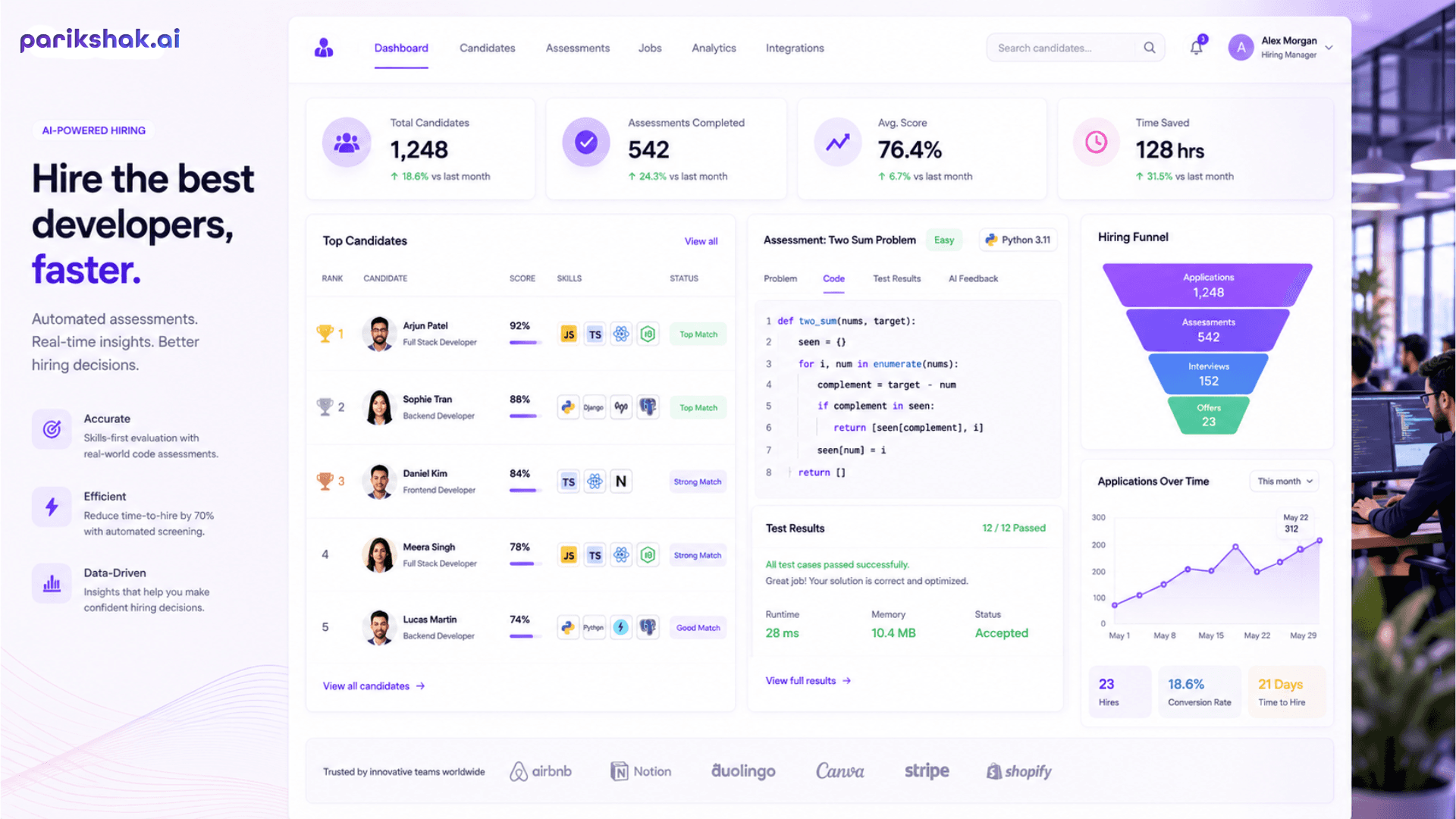
Picture this: 500 React developers applied to your open role overnight. Your recruiter’s inbox is drowning. Your senior engineers, the ones you actually need shipping features, are about to lose a full week to screening calls. Sound familiar? Technology postings now attract an average of 110 applications per opening, roughly 51% more than the cross-industry benchmark (SHRM, 2025). Yet 60% of organizations reported that their time-to-hire actually increased in 2025 (GoodTime 2026 Hiring Insights Report). More candidates, more tools, slower results. Something’s broken.
The gap isn’t about finding developers. It’s about identifying the right ones before your competitors do. Automated technical screening, specifically, platforms that execute real code, verify logic, and rank candidates against structured rubrics, has become the sharpest lever hiring teams have. This guide breaks down exactly how it works, what the data says, and how to build a screening funnel that processes hundreds of developers in the time it takes you to finish your morning coffee.
Key Takeaways
• Skills-based hiring reduces mis-hires by 90% and cuts time-to-hire by up to 50%(TestGorilla, 2025).
• Real-time code execution separates candidates who can solve problems from those who only talk about solving them.
• Structured, automated assessments are twice as effective at predicting job success as unstructured interviews.
• A bad senior engineering hire costs $150,000–$300,000 when you include replacement cycles and lost productivity (INOP, 2026).
• The companies winning the talent race aren’t screening faster, they’re screening smarter, using rubric-mapped scoring and logic verification.
Why Is Developer Hiring at Scale Still So Painful in 2026?
The U.S. Bureau of Labor Statistics projects software developer employment to grow roughly 17% between 2023 and 2033, adding an estimated 327,900 new jobs (BLS, 2025). That demand collides with a stubborn reality: SHRM’s 2025 Recruiting Benchmarking Report puts the average U.S. time-to-fill at approximately 44 days, with senior engineering roles running about 20% longer. The volume is there. The speed isn’t.
Three forces make the problem worse in 2026 than it was even two years ago. First, AI-assisted resumes have made surface-level screening nearly useless. A January 2025 Resume Builder survey found that 44% of job applicants admitted to lying during the hiring process, and 4 in 10 of those who lied still landed jobs. When everyone’s resume looks polished, resumes stop being a signal.
Second, the talent pool is genuinely shifting. Developers using AI coding tools report 35% productivity gains (Stack Overflow, 2025), which means employers now need engineers who can design around AI-assisted workflows, not just write code from scratch. That’s a harder skill to screen for on paper.
Third, the cost of getting it wrong has climbed. A bad software engineer hire can run $150,000 to $300,000 when you account for the productivity drag of a six-month underperformer, the senior engineers compensating for them, and the full replacement cycle (INOP, 2026). At scale say, 10 engineering hires per quarter even a 20% mis-hire rate quietly burns more than half a million dollars a year.
Technology job postings attract 110 applications per opening on average, 51% above the cross-industry benchmark, yet 60% of companies saw their time-to-hire increase in 2025 (SHRM, 2025; GoodTime, 2026). The bottleneck isn’t sourcing, it’s evaluation.
What Does ‘Automated Developer Screening’ Actually Mean?
According to the World Economic Forum, more than 90% of employers now use automated systems to filter or rank job applications (WEF, 2025). But most of that automation stops at keyword matching, scanning resumes for React, Python, or AWS and ranking by frequency. That’s filtering, not screening. Real automated developer screening goes three layers deeper.
Layer 1: Skills-Based Assessments
Instead of asking candidates what they know, you ask them to demonstrate it. Structured coding challenges, debugging tasks, and system-design exercises replace resume reviews. The data here is overwhelming: 94% of employers believe skills-based hiring is more predictive of on-the-job success than resumes (TestGorilla, 2025). And 81% of companies now use it, up from 56% in 2022.
Layer 2: Real-Time Code Execution
This is where the signal-to-noise ratio improves dramatically. Candidates write code in a sandboxed environment that compiles and runs against test cases in real time. No copy-pasting from ChatGPT. No theoretical whiteboard answers. The platform watches whether the code actually works, and how the candidate iterates when it doesn’t. Can they debug under pressure? Do they write tests? How do they handle edge cases? These are the signals that predict on-the-job performance far better than whether someone can recite Big O notation from memory.
Layer 3: Logic Verification
Code that compiles isn’t necessarily code that solves the problem correctly. Logic verification goes beyond ‘does it run?’ to ‘does it produce the right output across a comprehensive set of inputs?’ This is the layer that catches the candidate who hardcodes the expected output for the sample test case but fails on edge inputs. It’s also where you can assess algorithmic efficiency, two solutions might both be ‘correct,’ but one runs in O(n) and the other in O(n²). At scale, that difference matters.
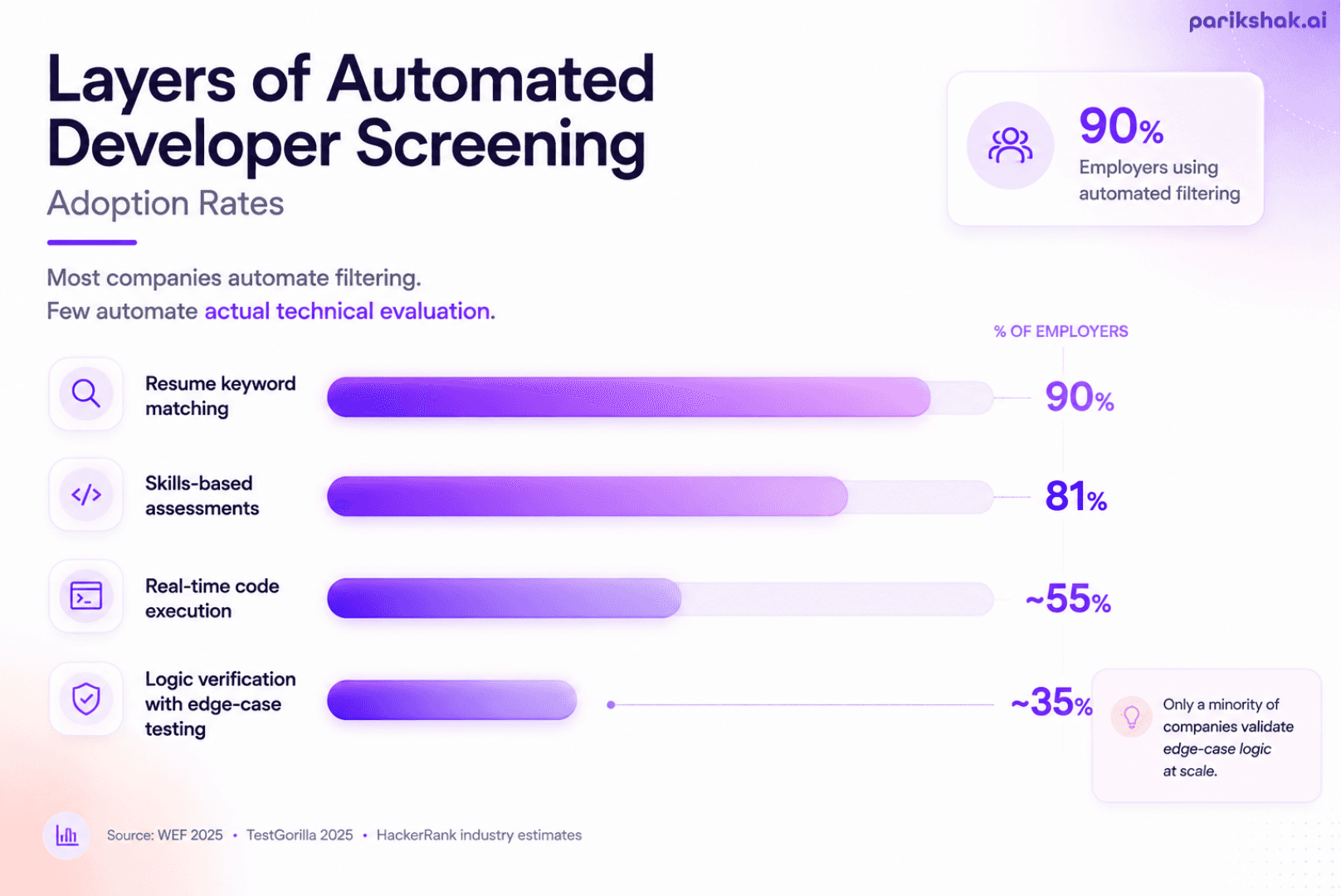
While 90% of employers use automated filtering, only a fraction test candidates with live code execution and logic verification. The companies that do report up to 75% shorter hiring cycles and significantly fewer mis-hires (HackerEarth, 2025).
How Does Real-Time Code Execution Change the Screening Equation?
DevSkiller’s 2025 research found that over 70% of tech recruiters receive unqualified applicants for every technical role they post (DevSkiller, 2025). Resume screening alone consistently fails to reflect actual coding ability. Real-time code execution flips this dynamic by making ability the entry ticket, not a later-stage discovery.
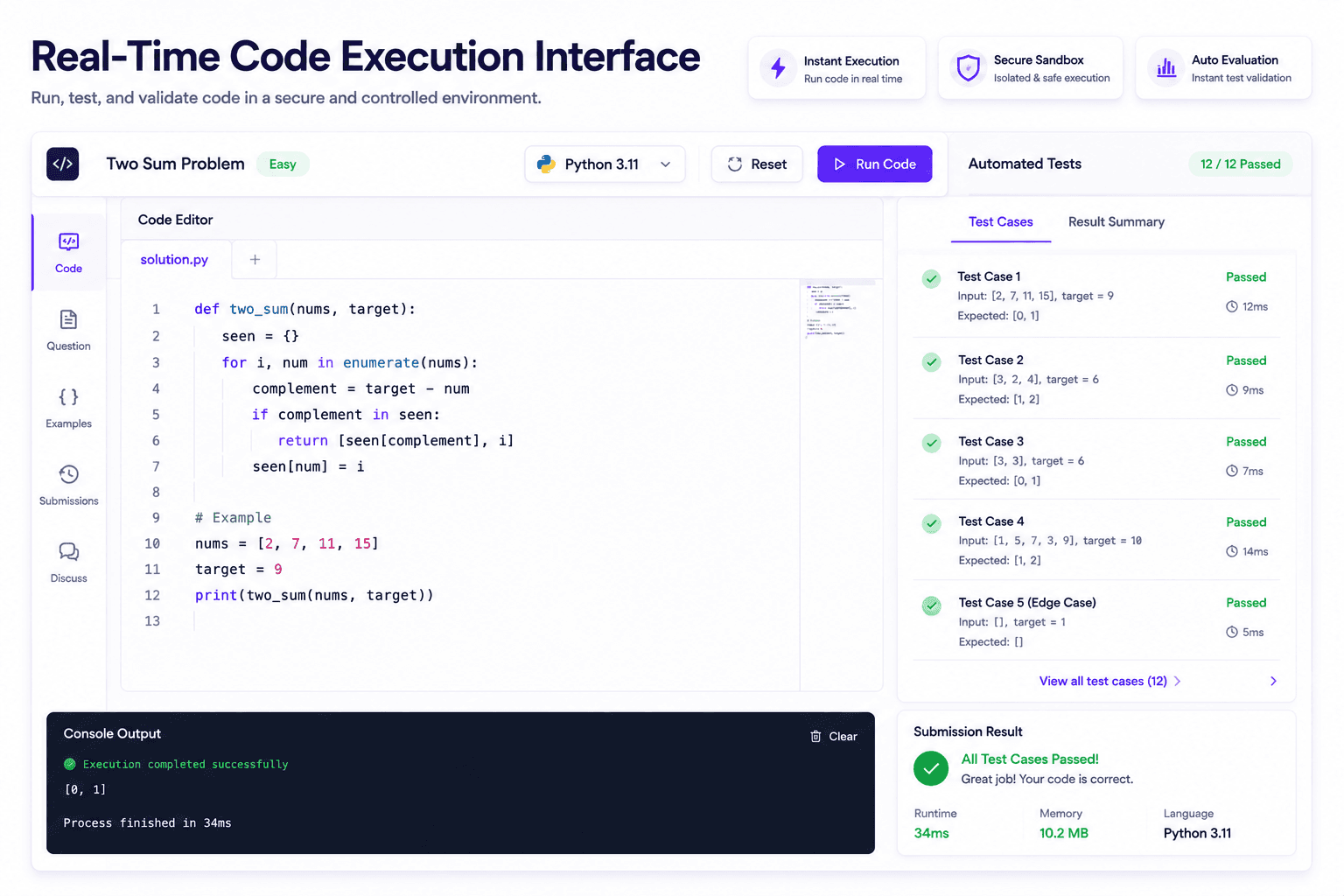
Here’s what happens when you make code execution the first gate. A mid-size SaaS company hiring React developers sends out a 45-minute assessment to all 200 applicants. The assessment includes a component-building task, a state-management debugging challenge, and a performance-optimization problem. All three run against automated test suites. Within 48 hours, the platform returns a ranked list. The top 20 candidates aren’t just people who said they know React, they’re people who proved it.
Codility reports that one customer ran 750 candidate tests over 90 days and saved approximately 2,200 hours of engineer interview time (Codility, 2026). That’s not a marginal improvement. That’s the equivalent of gaining enough bandwidth to launch an entirely new product line.
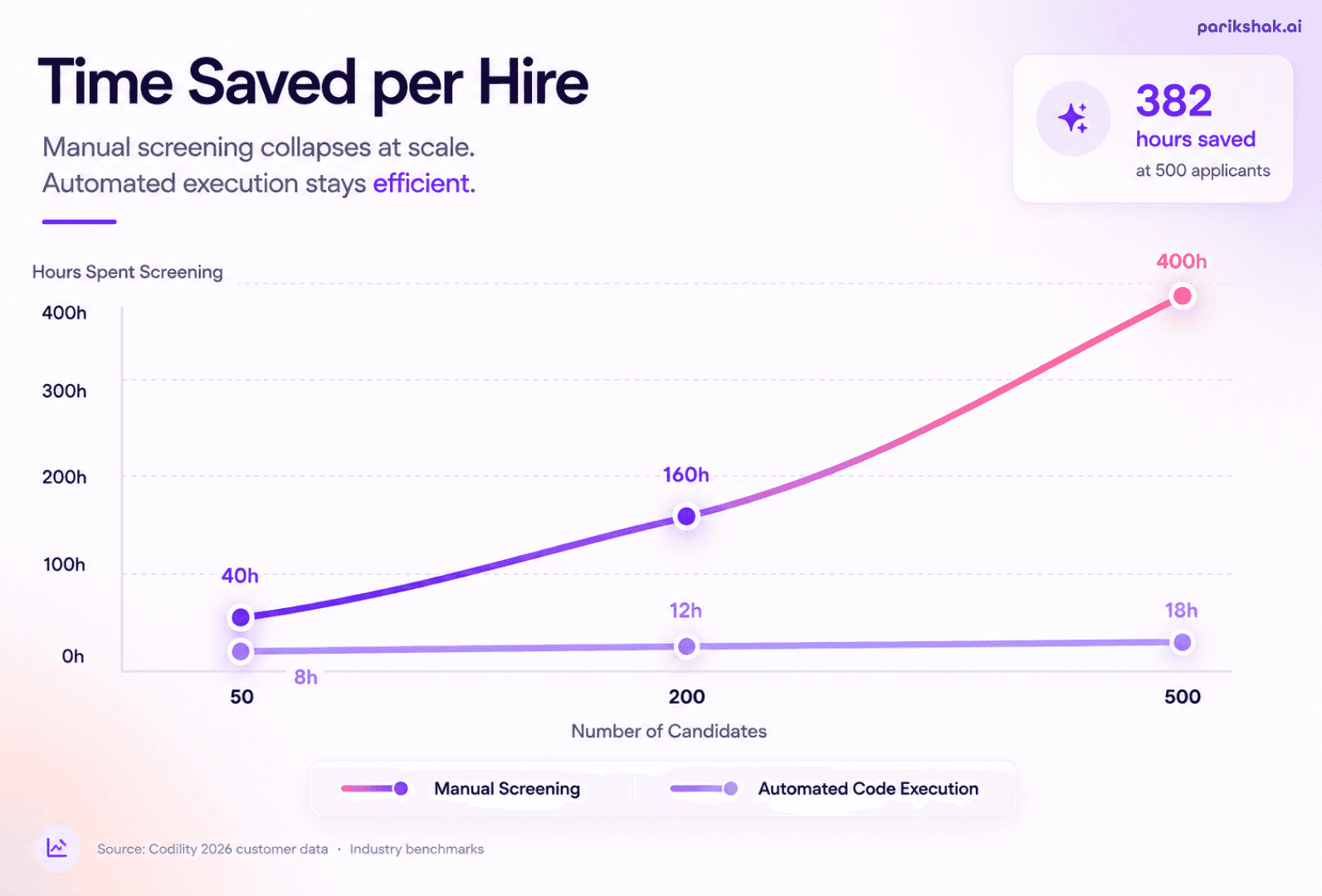
The speed advantage compounds at scale. When you’re screening 500 candidates instead of 50, a manual process doesn’t just slow down linearly, it collapses. Engineers burn out on interviews, start rubber-stamping candidates, and hiring quality drops. Automated code execution keeps quality constant whether you’re evaluating your fifth candidate or your five hundredth.
Our finding:What we’ve seen: Based on industry benchmarks and early customer feedback, engineering teams using automated code execution workflows can reclaim 15+ hours per open role by reducing manual screening and interview overhead.
Similarly, teams using Parikshak.ai’s multi-format assessment packs, combining code execution, logic verification, and structured video responses in a single candidate session, reported significantly shorter screening cycles, with some reducing hiring timelines from multiple weeks to under 10 days.
What Should You Look for in a Technical Assessment Platform?
The 2025 HackerRank Developer Skills Report found that 66% of developers prefer
assessments built around real-world tasks rather than algorithmic puzzles, and that 78% of current assessments don’t reflect actual on-the-job work (HackerRank, 2025). If your
assessment platform still relies on LeetCode-style puzzles as its primary signal, you’re
measuring interview prep, not engineering ability.
When evaluating platforms for high-volume developer screening, focus on these seven
capabilities. Not every tool has all seven, but the gap between platforms that have most of them and those that don’t is where mis-hires live.
Real-world task simulation: Can the platform replicate the actual work your developers do? Building a REST API, debugging a production issue, optimizing a database query, not inverting a binary tree.
Multi-language support with live execution: Candidates should write in the language
they’ll use on the job. The platform should compile and run their code against automated test suites, not just lint it.Rubric-based scoring: Automated scoring should map to predefined criteria: correctness, code quality, edge-case handling, and efficiency. Subjective ‘thumbs up/thumbs down’ from a tired engineer at 5pm doesn’t scale.
Anti-cheating and integrity measures: Tab-switch detection, plagiarism analysis, AI-usage tracking, and code-playback so you can watch how a candidate actually built their solution, not just the final submission.
ATS and workflow integration: The platform should plug into your existing applicant
tracking system so assessment results flow automatically into candidate profiles. Manual data entry defeats the point of automation.Candidate experience design: If your assessment feels punitive, your best candidates will drop out. Clear instructions, reasonable time limits, and an environment that mirrors real development tools matter.
Explainable scoring: Can you show the hiring manager why Candidate A scored higher
than Candidate B? Black-box scores erode trust. Transparent, rubric-mapped feedback builds it.
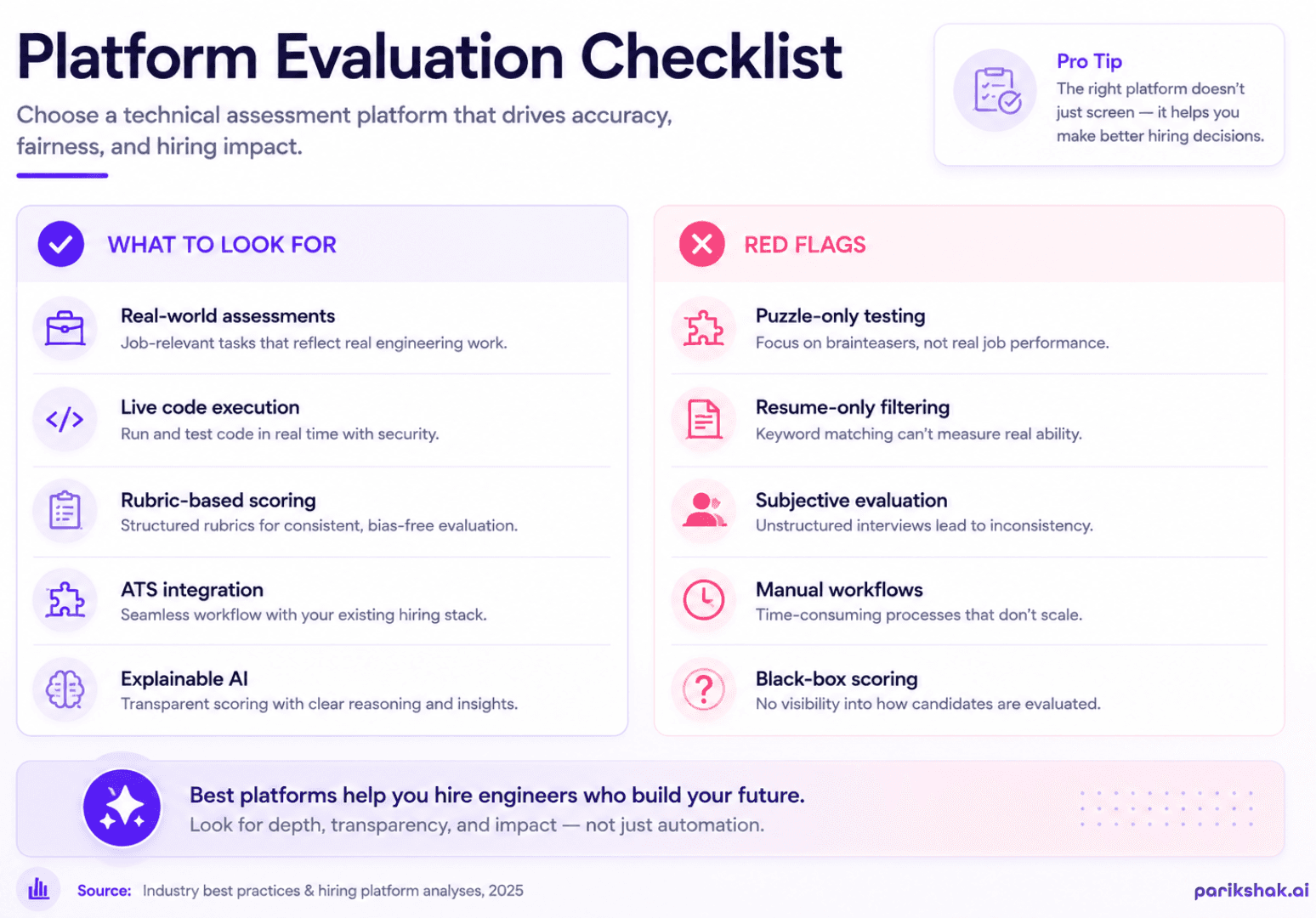
Two-thirds of developers prefer real-world task assessments over algorithmic puzzles, yet 78% of current assessments still don’t reflect on-the-job work (HackerRank, 2025). Platforms that close this gap see higher candidate completion rates and stronger predictive validity.
First-generation AI interview tools focused primarily on video recording and facial-expression analysis. The next wave treats every candidate interaction as structured assessment data, scoreable, comparable, and auditable. If your current platform can’t score candidates against role-specific rubrics in real time, it’s already a generation behind.
Does Automated Screening Actually Reduce Bias, or Amplify It?
SHL’s 2025 research demonstrated that ML-based grading for technical tests increased the number of women who cleared coding simulations by 27.75% compared to traditional cut-offs (SHL, 2025). That’s not a rounding error, it’s a structural shift toward more equitable outcomes. But the picture is more nuanced than ‘automation equals fairness.’
Unstructured interviews are where bias thrives. When an interviewer decides within the first five minutes whether they ‘like’ a candidate, every subsequent question becomes confirmation bias in action. Structured assessments, where every candidate answers the same challenges, scored against the same rubric, remove most of that subjectivity. Research consistently shows that structured interviews are twice as effective at predicting job success as unstructured ones, and they produce measurably more diverse hiring outcomes.
The risk comes when the automation itself encodes bias. If your assessment’s training data overrepresents one demographic, or if the ‘ideal solution’ is defined by a narrow set of coding styles, the tool can replicate existing inequities at machine speed. That’s why explainable scoring matters. When you can see exactly why a candidate scored a 78 instead of an 85, you can audit the rubric for fairness. Black-box AI scoring doesn’t give you that option.
Many organizations that tried first-generation AI interview tools found the scoring opaque and the candidate experience cold. A common pattern: the tool recorded video, analyzed tone and facial expressions, and spat out a score with no clear rubric. Candidates felt surveilled. Hiring managers didn’t trust the numbers. Both sides lost. The platforms gaining traction now are the ones that treat transparency as a feature, not a liability, score breakdowns, rubric mappings, and the ability for hiring managers to understand and override AI recommendations with documented reasoning.
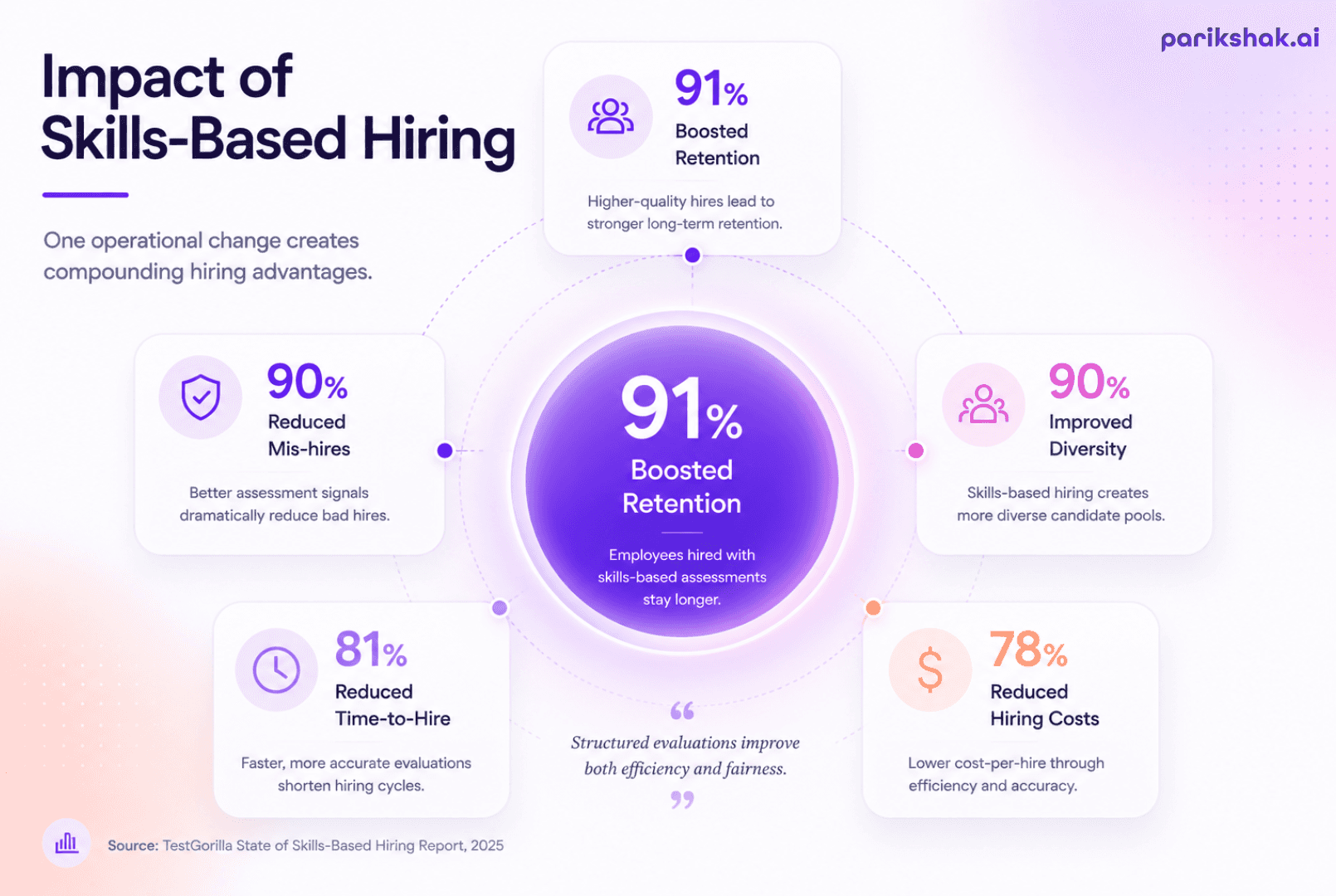
Ninety percent of employers using skills-based hiring report reduced mis-hires, while 90% also report improved workplace diversity (TestGorilla, 2025). The mechanism is straightforward: when you score what candidates can do rather than where they went to school, the talent pool expands and quality improves simultaneously.
How Do You Build a Screening Funnel That Actually Works at 500+ Candidates?
According to Deloitte’s Cost-Per-Hire Benchmark Report, organizations save an average of 30% on recruitment expenses by using pre-screened candidate pools and automated assessment tools (Deloitte, 2025). But cost savings mean nothing if the funnel leaks quality.
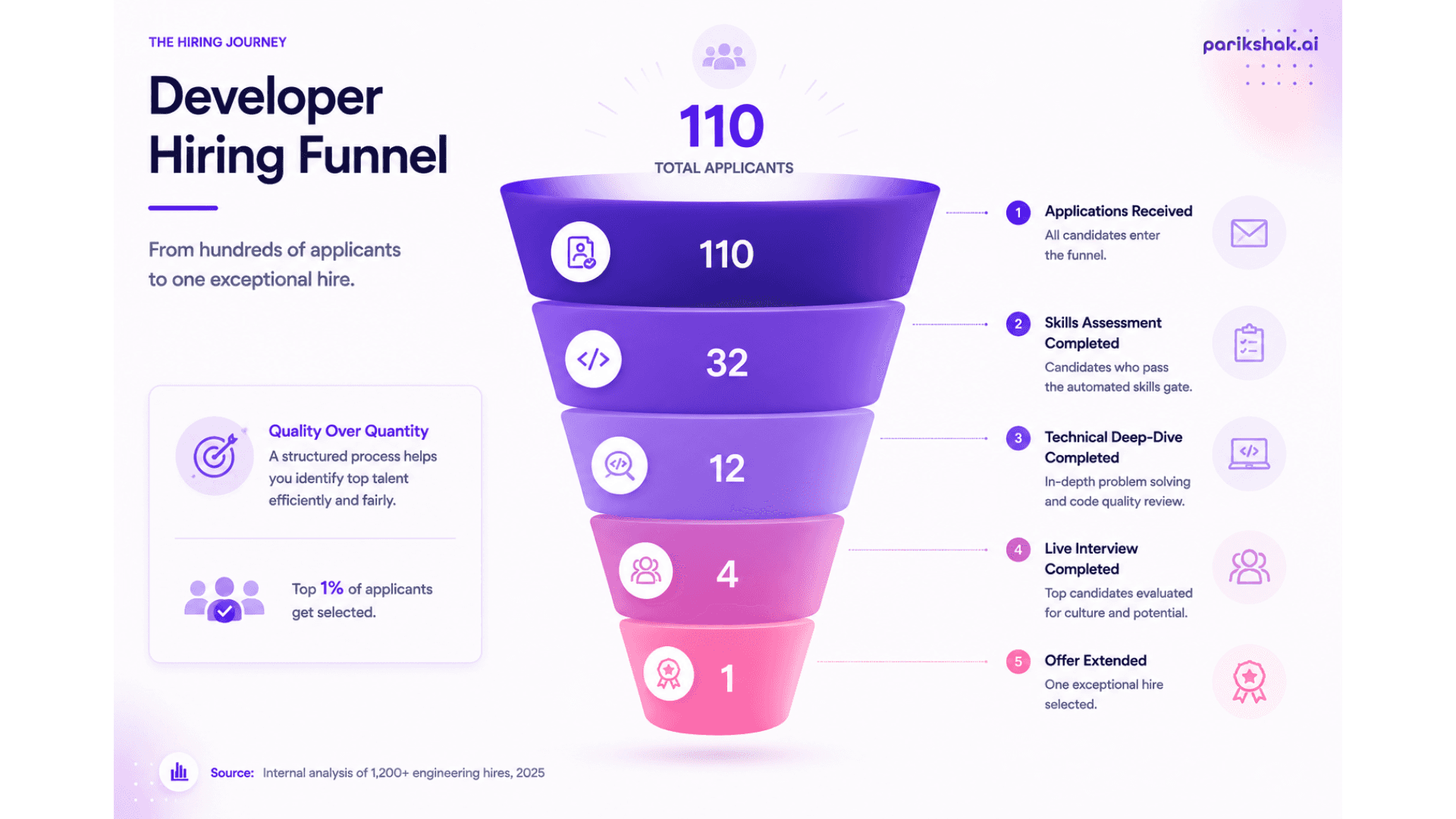
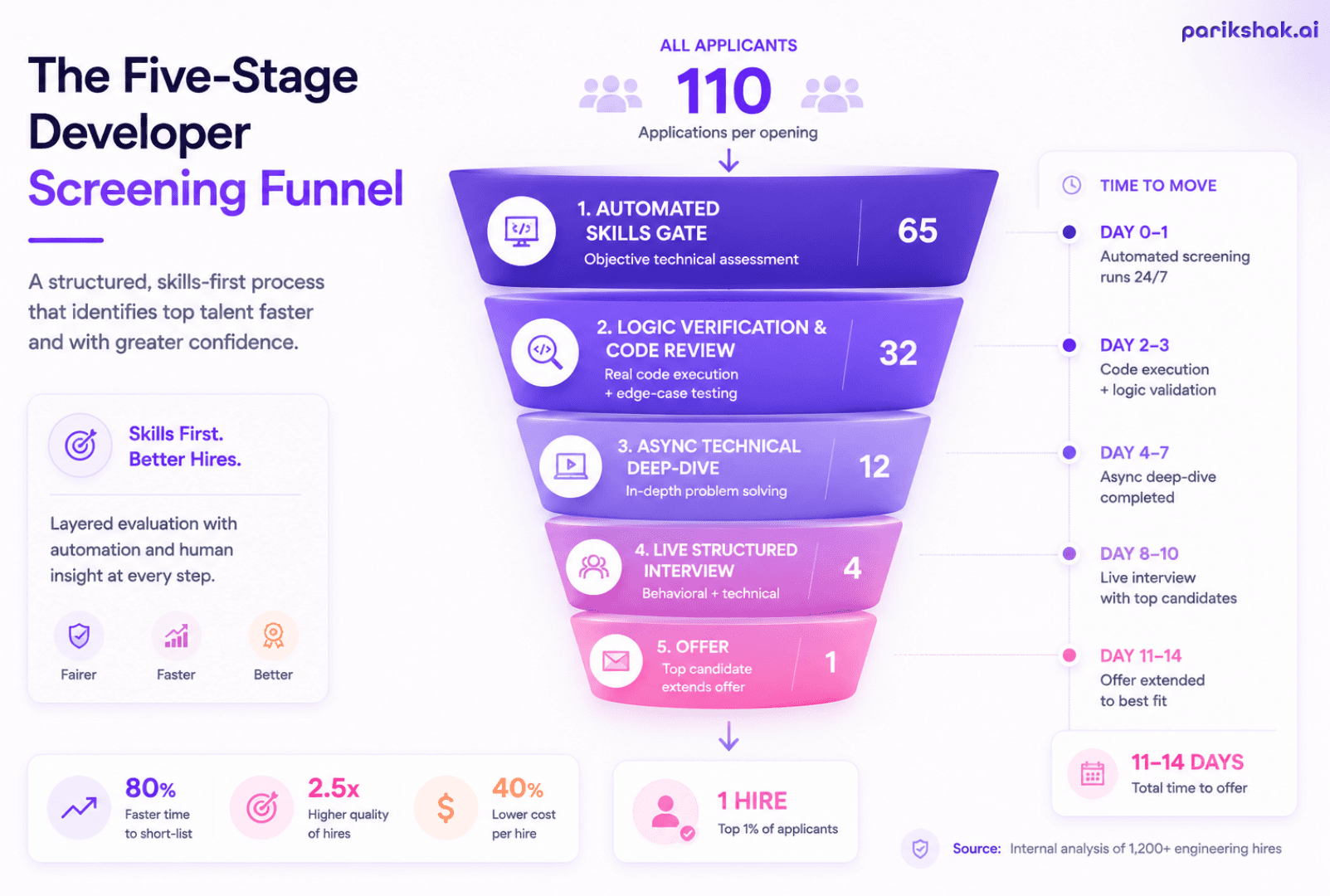
Here’s a five-stage framework for high-volume developer screening that balances speed with signal.
Stage 1: Automated Skills Gate (Day 0–1)
Every applicant receives a 30–45 minute automated assessment within 24 hours of applying. The assessment is role-specific: React developers get component-building tasks, backend engineers get API design challenges, data engineers get pipeline problems. Code runs against automated test suites. Results are scored and ranked without any human involvement. This stage eliminates 60–70% of the applicant pool, the candidates who look qualified on paper but can’t execute in practice.
Stage 2: Logic Verification & Code Review (Day 2–3)
For candidates who pass Stage 1, a deeper review kicks in. This is where logic verification shines: does their code handle edge cases? Is the solution algorithmically efficient? Did they write any tests? Code-playback features let reviewers watch how the candidate built their solution, did they plan first, or dive straight in and refactor three times? The playback often reveals more about engineering maturity than the final output alone.
Stage 3: Async Technical Deep-Dive (Day 4–7)
Top candidates from Stage 2 complete a take-home or async assessment that mirrors a real task from your codebase. This might be a pull-request review, a short feature build in your actual stack, or a system-design exercise. Keep it under 2 hours, respect for candidate time is what separates a good process from a talent-repelling one.
Stage 4: Live Structured Interview (Day 8–10)
Only now do your engineers get involved, and only with the top 5–10% of applicants. The live session is a pair-programming exercise or architecture discussion, not a pop quiz. Because you already have objective data from Stages 1–3, the live interview focuses on collaboration, communication, and culture fit, the signals that automation genuinely can’t capture.
Stage 5: Offer (Day 11–14)
With structured data at every stage, the hiring committee has a clear, comparable dataset for each finalist. No more ‘gut-feel’ debates. No more recency bias where the last candidate interviewed gets an unfair advantage. The strongest signal wins.
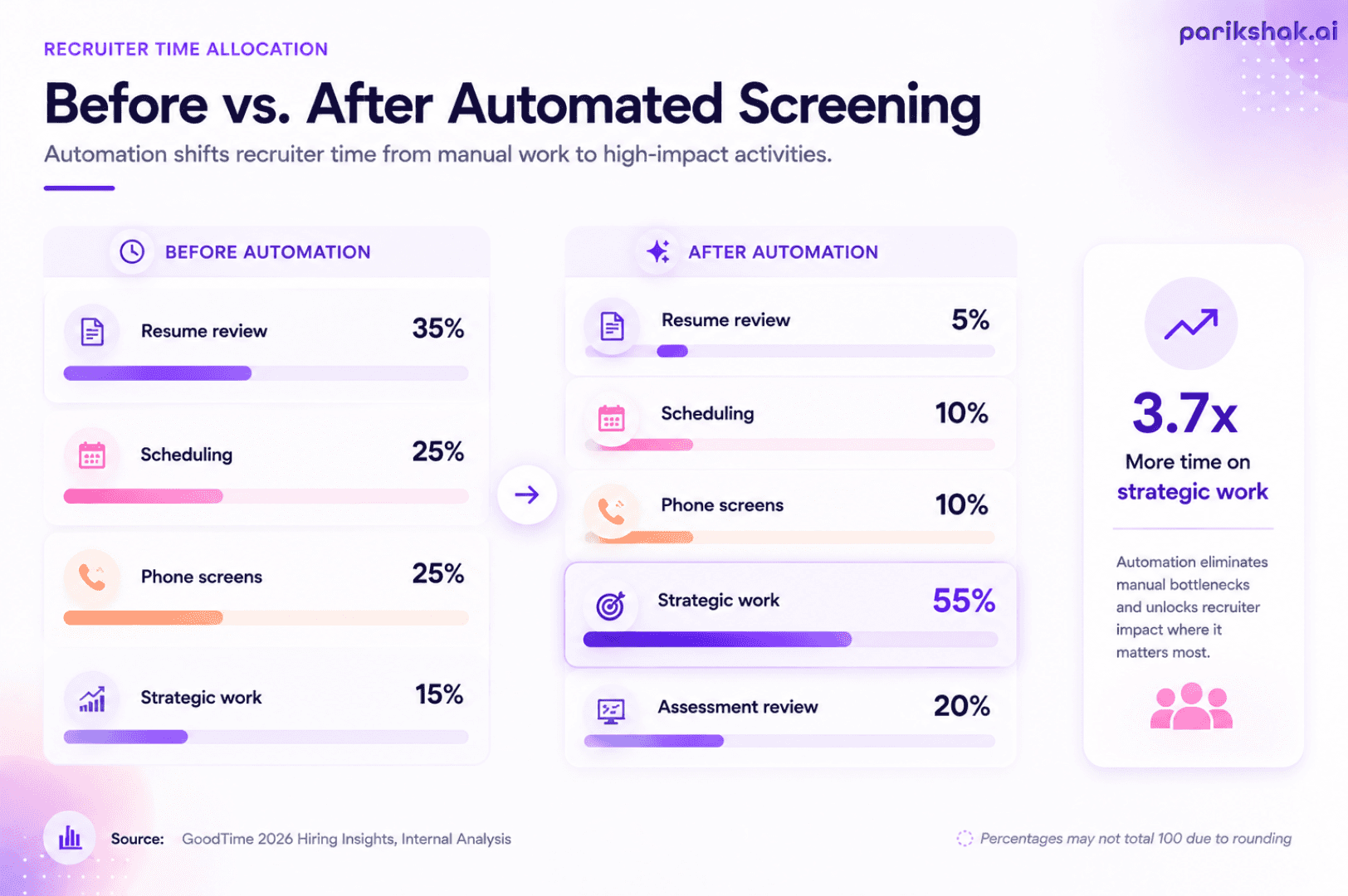
What we’ve seen: Based on industry benchmarks and early customer feedback, engineering teams using automated code execution workflows can reclaim 15+ hours per open role by reducing manual screening and interview overhead.
Similarly, teams using Parikshak.ai’s multi-format assessment packs, combining code execution, logic verification, and structured video responses in a single candidate session, reported significantly shorter screening cycles, with some reducing hiring timelines from multiple weeks to under 10 days.
What Does the Future of Developer Hiring Look Like?
Gartner predicts that 80% of engineering teams will need to upskill by 2027 due to GenAI adoption (Gartner, 2025). The skills you’re screening for today won’t be the same skills you need in 18 months. That means your assessment infrastructure needs to be modular, updatable, and tightly aligned with how engineering work is actually evolving.
Three trends are reshaping the landscape. First, AI-native assessments are emerging, challenges that evaluate whether candidates can effectively use AI coding assistants, not just write code from scratch. Given that 62% of developers already use AI tools daily (Stack Overflow, 2025), testing someone’s ability to collaborate with AI is now a job-relevant skill, not a nice-to-have.
Second, the assessment window is shifting from ‘pre-interview gate’ to ‘continuous signal.’ Forward-thinking teams are using assessment data not just to decide who to hire, but to identify skill gaps in existing teams, plan upskilling programs, and map internal mobility paths. The same platform that screens candidates can evaluate your current engineers, and the companies doing this are getting far more value from their assessment investment.
Third, candidate expectations are rising. Developers talk to each other. A frustrating, irrelevant, or disrespectful assessment process will earn your company a Glassdoor review and a reputation that costs you candidates for years. The 2025 Glassdoor report found that 76% of job seekers consider a company’s commitment to fairness and inclusion a key factor in their decision to apply. Your assessment process is your employer brand for technical candidates.
A shift worth watching: The developer hiring platforms that will dominate the next three years won’t be the ones with the largest question banks. They’ll be the ones that treat assessments as a two-way signal, giving candidates meaningful feedback and a portfolio-worthy demonstration of their skills, while giving employers structured, auditable, explainable data. The transaction model (company tests candidate, candidate waits for a verdict) is being replaced by a mutual-evaluation model that respects both sides.
Screen Smarter, Not Harder
Developer hiring at scale doesn't have to mean drowning in resumes, burning out your best engineers on screening calls, or hoping that interview gut-feel translates to on-the-job performance. The data is clear: skills-based assessments with real-time code execution and structured scoring outperform every traditional screening method on speed, accuracy, fairness, and cost.
The companies that will win the 2026 talent war aren't the ones offering the highest salaries or the flashiest perks. They're the ones who've built a screening infrastructure that identifies the top 1% without requiring anyone to read 1,000 resumes. That's not a future state, it's what the best teams are doing right now.
Parikshak.ai's assessment packs are built for exactly this problem: multi-format, rubric-scored evaluations that give your hiring team structured data and give candidates a fair, relevant experience. If you're scaling engineering hiring and your current process still depends on resume reviews and unstructured interviews, it might be time to test a different approach.
Related Blogs

What Are the Hidden Costs of Human-Led Technical Screening?

Psychometrics vs Skill-Based Assessments: Which One Actually Predicts Hiring Success?