The CHRO's Guide to Reducing Cost-of-Vacancy with AI Automation
Learn how to calculate cost of vacancy and identify where AI-assisted screening, assessment, and scheduling may reduce avoidable delay in a hiring workflow.
Hiring Strategy
10 min
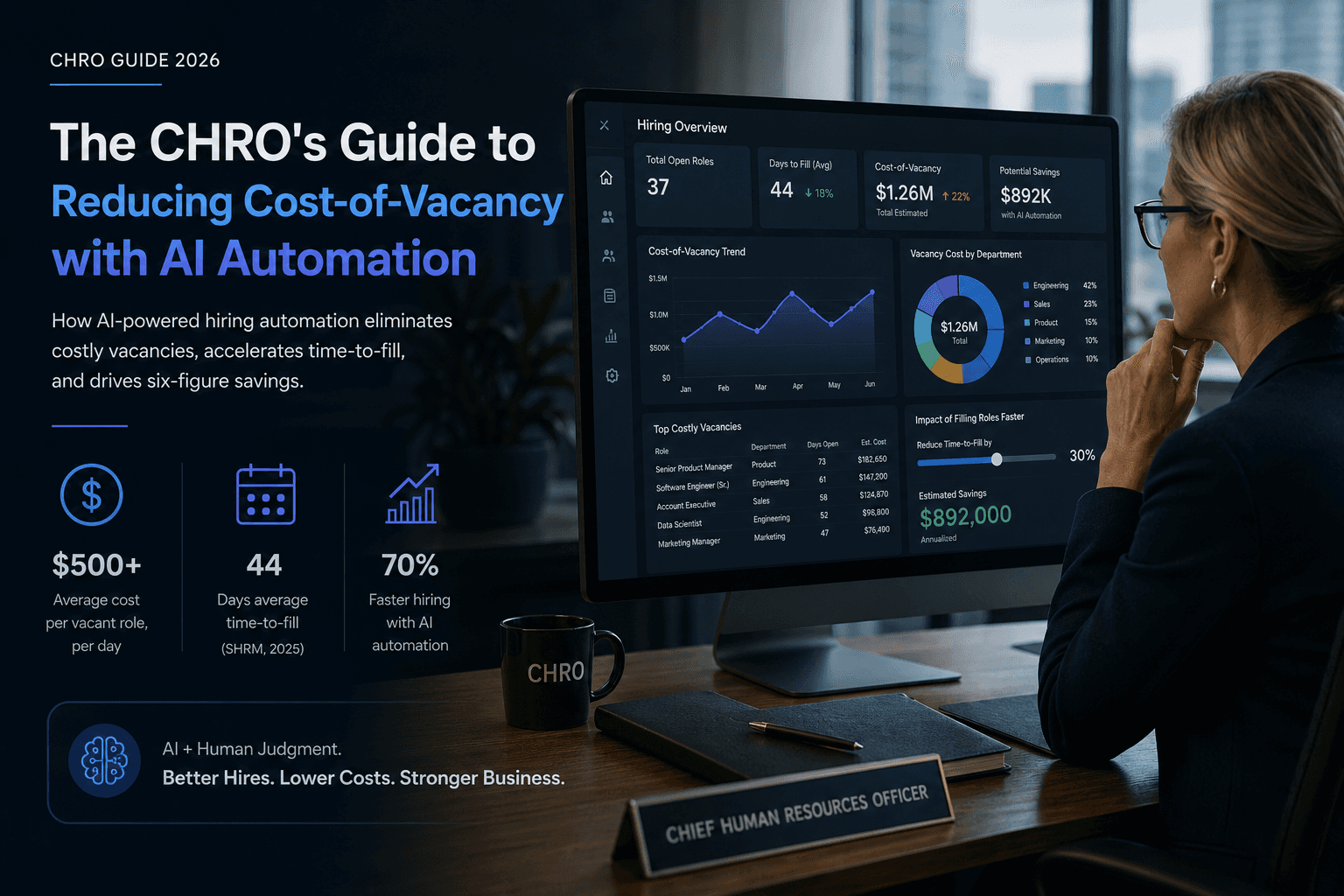
The CHRO’s Guide to Reducing Cost-of-Vacancy with AI Automation
Every day a position sits empty, your company hemorrhages money. Not in the abstract, feel-bad-about-it sense. In the hard, quantifiable, show-it-to-the-CFO sense. SHRM’s 2025 Benchmarking Report puts the average U.S. time-to-fill at 44 days. At a conservative $500 per day in lost productivity per vacancy, a figure CEB (now Gartner) has cited for years, that’s $22,000 evaporating before a single recruiting invoice lands on your desk.
And that $500 figure? It’s the floor. Dr. John Sullivan, one of the most widely cited HR researchers in the world, has documented vacancy costs running $7,000 to $50,000 per day for engineering roles and as high as $1 million per week for key leadership positions. The gap between what most CHROs track and what vacancies actually cost is staggering.
This guide gives you the math, the formula, and the playbook. You’ll learn exactly how to calculate your organization’s Cost-of-Vacancy (CoV), understand why traditional hiring timelines are bleeding your budget, and see how AI-powered assessment automation is compressing 44-day timelines into days, not weeks. Because time is money. And right now, most HR departments are leaving both on the table.
Key Takeaways
• The average U.S. vacancy costs $500/day in lost productivity; over a 44-day fill cycle, that’s $22,000 per role (SHRM, 2025).
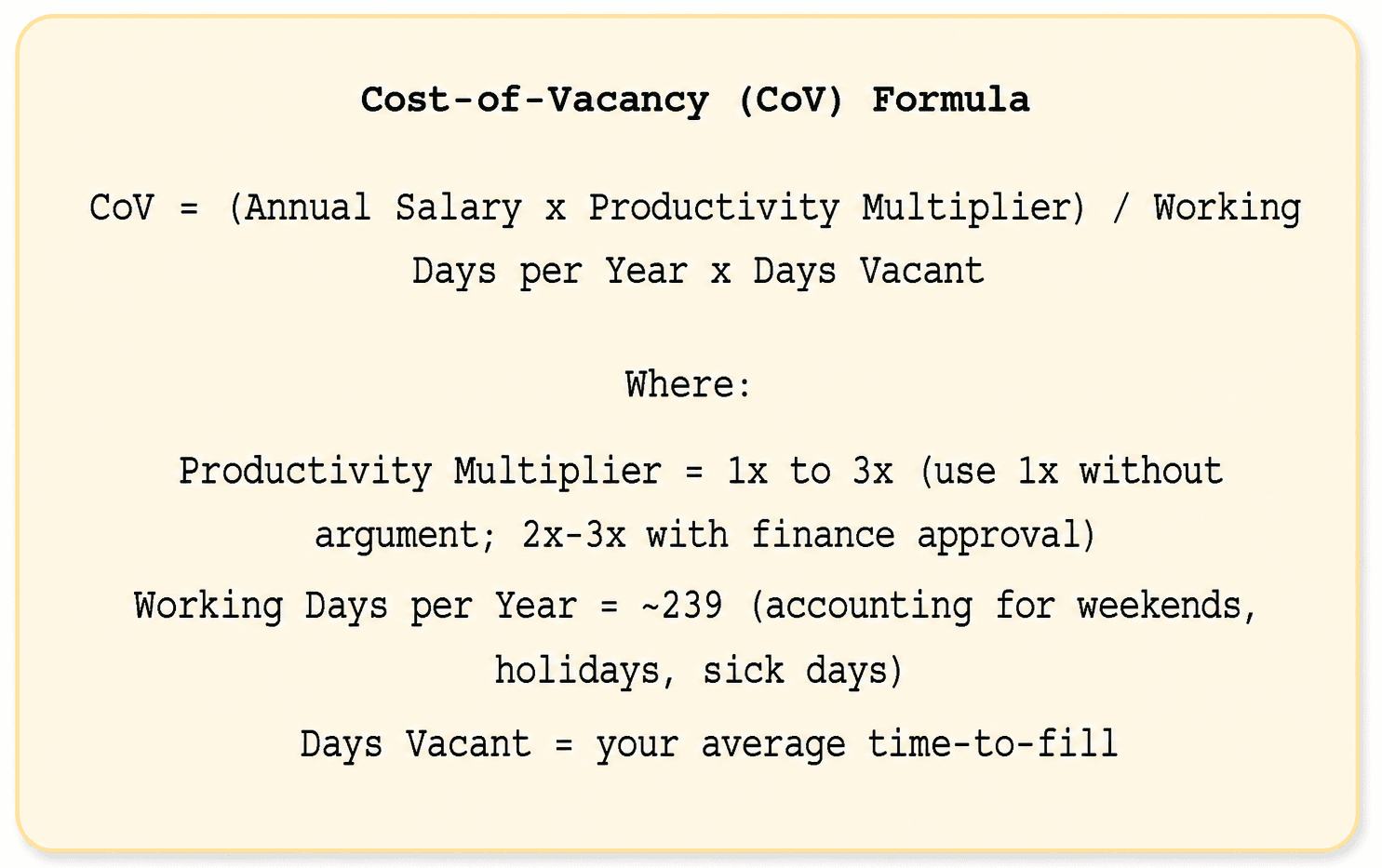
• Cost-of-Vacancy = (Annual Salary × Productivity Multiplier) ÷ Working Days × Days Vacant.
• AI-powered hiring automation reduces time-to-fill by 25–70% and cost-per-hire by 20–30%.
• 87% of companies now use AI recruitment tools; 93% of recruiters plan to increase AI usage in 2026 (DemandSage, 2026).
TL;DR: An unfilled role costs your organization between $500 and $7,000+ per day depending on seniority. With the average hire taking 44 days (SHRM, 2025), a single vacancy can drain $22,000–$308,000 before day one. AI assessment tools compress that timeline by up to 70%, turning your biggest hidden cost into measurable savings.
What Does an Empty Seat Actually Cost Your Organization?
SHRM data shows that every open position costs organizations between $4,000 and $9,000 per month in lost productivity, overtime for overburdened colleagues, and project delays (SHRM/Mitratech, 2025). That range is wide for a reason: the true cost depends on role seniority, revenue impact, and how interconnected the position is to other teams.
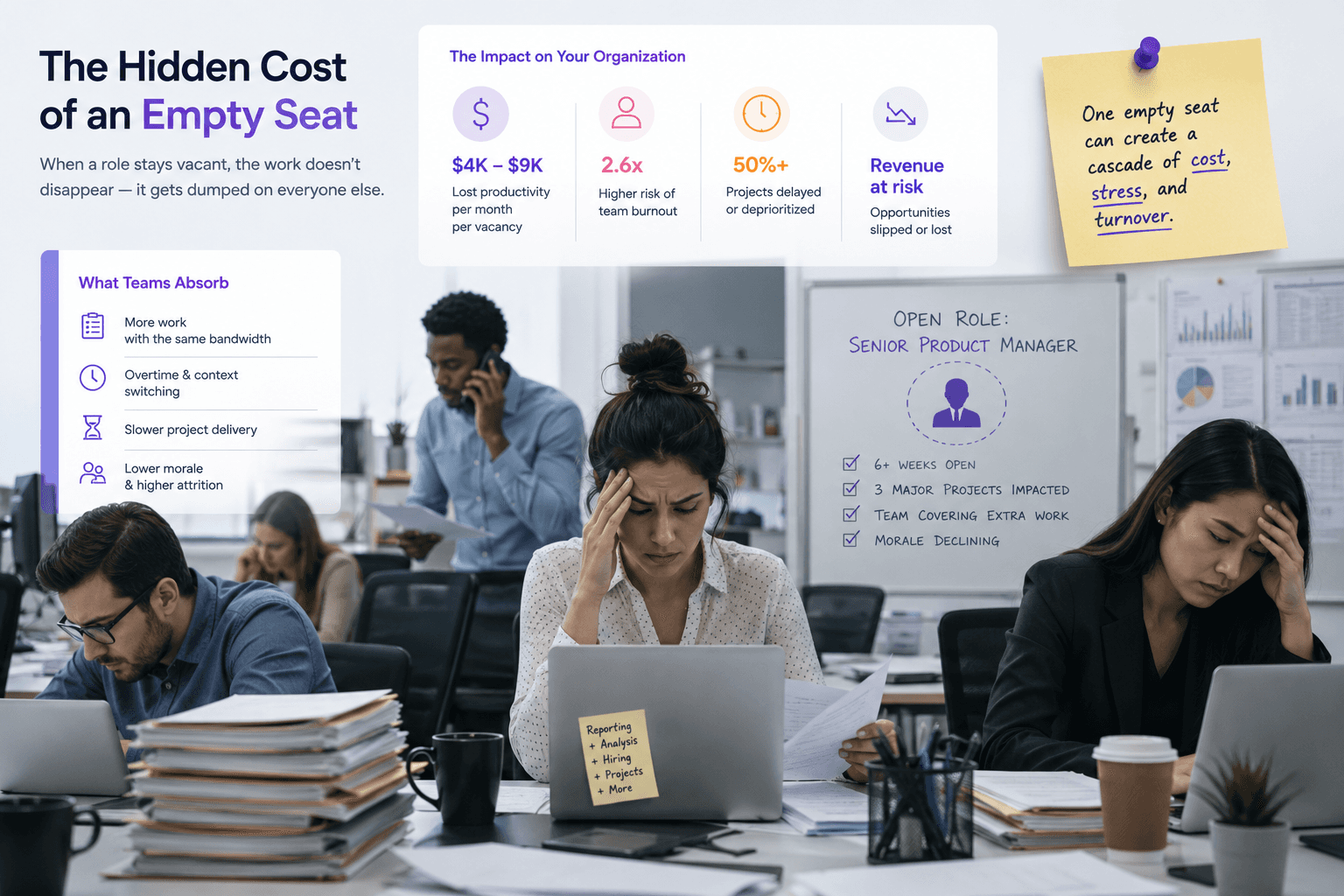
Here’s what most CHROs miss. The salary savings from an unfilled position are visible on a balance sheet. The revenue lost, the projects delayed, the remaining employees burning out, those don’t appear on any line item. Dr. John Sullivan frames it memorably: if an airline bought a 747 and let it sit on the runway for two months because they didn’t have a pilot, the CFO would lose sleep. But when a $150,000 engineering role sits empty for 73 days, the same CFO often sees it as cost savings.
It’s not savings. It’s silent, compounding loss. When one person leaves, the remaining team absorbs the workload. SHRM research indicates that prolonged vacancies lead to burnout, which triggers more turnover, a vicious cycle where one empty seat eventually creates two or three. Revenue-generating roles make the math even more brutal. An unfilled sales position producing $200,000 annually costs over $16,000 per month in missed pipeline (VA Masters/industry analysis, 2026).
Organizations lose between $4,000 and $9,000 per month for every unfilled position, accounting for productivity decline, overtime costs, and cascading project delays (SHRM, 2025). For revenue-generating roles, the figure can exceed $16,000 monthly, a cost most hiring dashboards never capture.
And the pain doesn’t stop at dollars. When vacancies drag past 60 days, remaining team members don’t just work harder, they start questioning whether leadership cares. Are we ever going to fill this role? That erosion of trust accelerates attrition in ways no engagement survey will catch in time.
How Do You Calculate the Cost-of-Vacancy? The Formula Every CHRO Needs
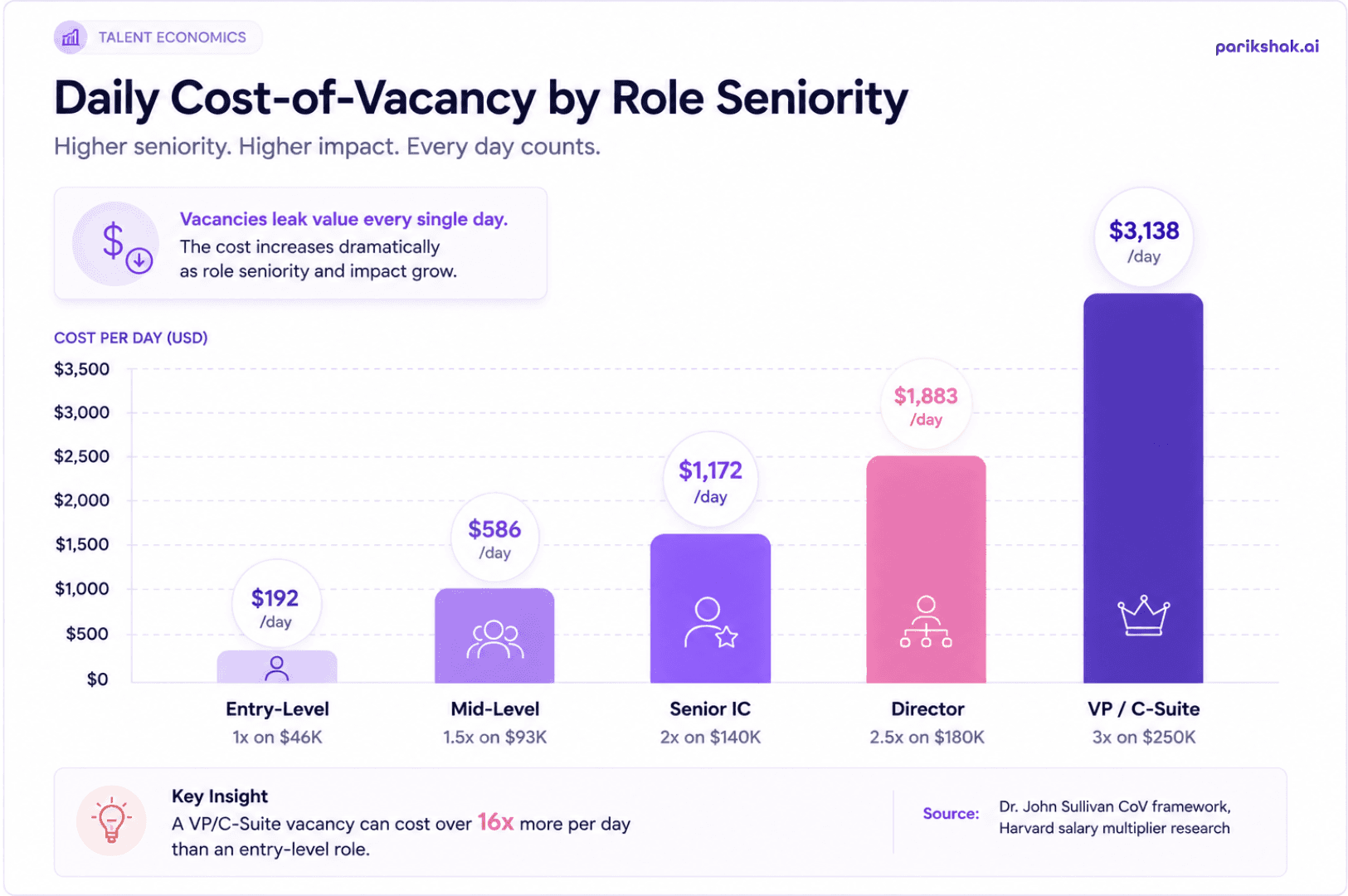
A Harvard University study found that the average employee’s value to their organization falls between 1x and 3x their annual salary, with many analysts converging on the 3x figure as most accurate for knowledge workers and leadership roles (Dr. John Sullivan, ERE Media). That multiplier is the engine behind every serious CoV calculation.
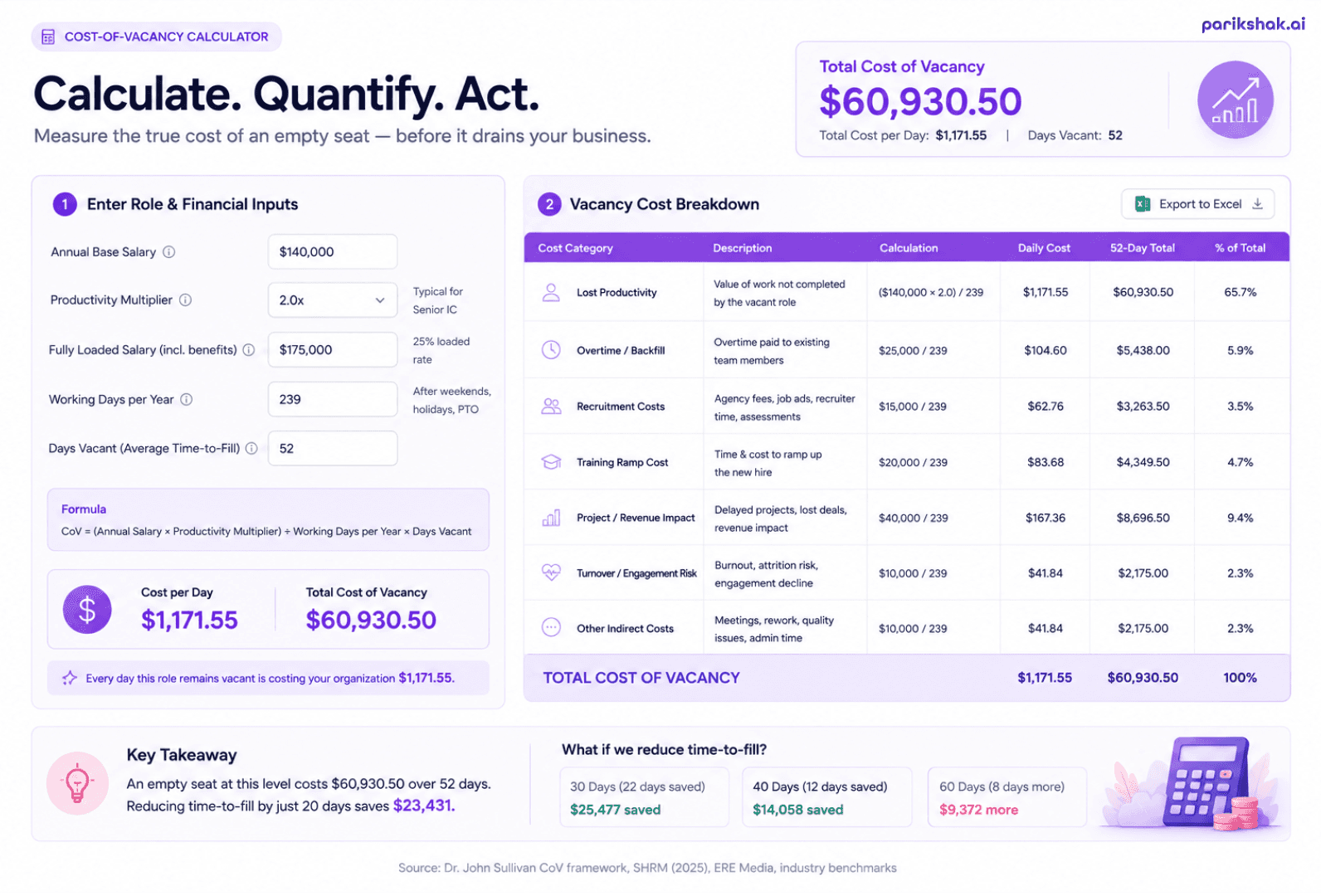
Here’s the formula, broken into components anyone can plug their own numbers into:
Let’s walk through a real example. Suppose you’re trying to fill a senior product manager role with an annual salary of $140,000. You use a conservative 2x multiplier. Your company’s average time-to-fill is 52 days.
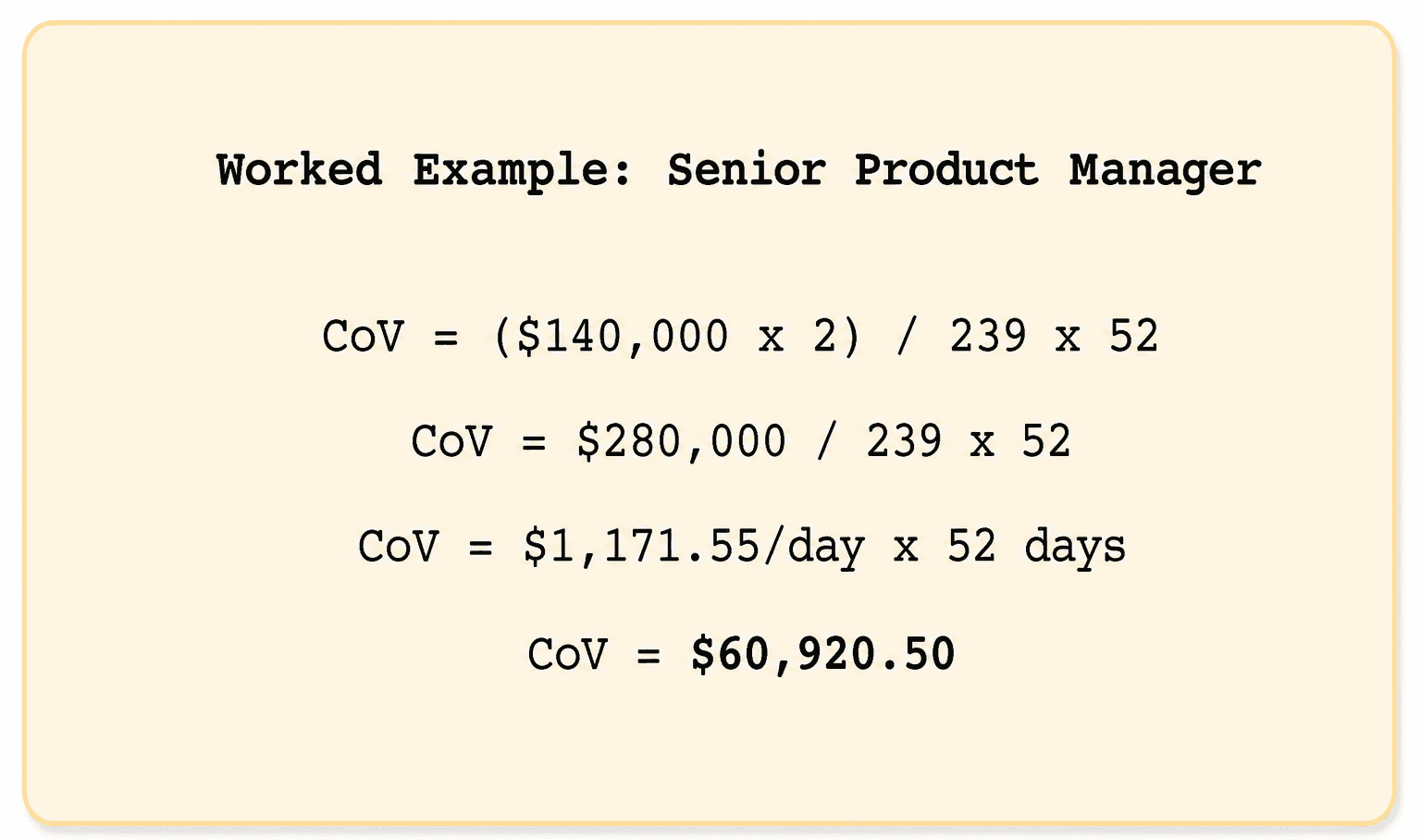
That’s nearly $61,000 in lost value from a single vacancy. Multiply that across 15 or 20 open positions, a typical load for a mid-market company, and you’re looking at north of $900,000 in vacancy costs per quarter. That number gets attention in a boardroom.
For revenue-generating roles like sales, the math shifts even further. Dr. Sullivan recommends a direct revenue-loss model: take the average annual revenue a person in that role generates, divide by working days, and multiply by days vacant. A salesperson carrying a $1.2M annual quota? That’s roughly $5,021 per day walking out the door. Over a 44-day fill cycle, you’ve lost $220,920 in potential revenue from one empty desk.
Using the salary-multiplier method developed by Dr. John Sullivan and validated by Harvard research, a single senior-level vacancy costs organizations $1,000–$3,000+ per day. Over a 44-day average fill cycle, that translates to $44,000–$132,000 in lost productivity per unfilled role.
Why Is Your Time-to-Fill Getting Worse, Not Better?
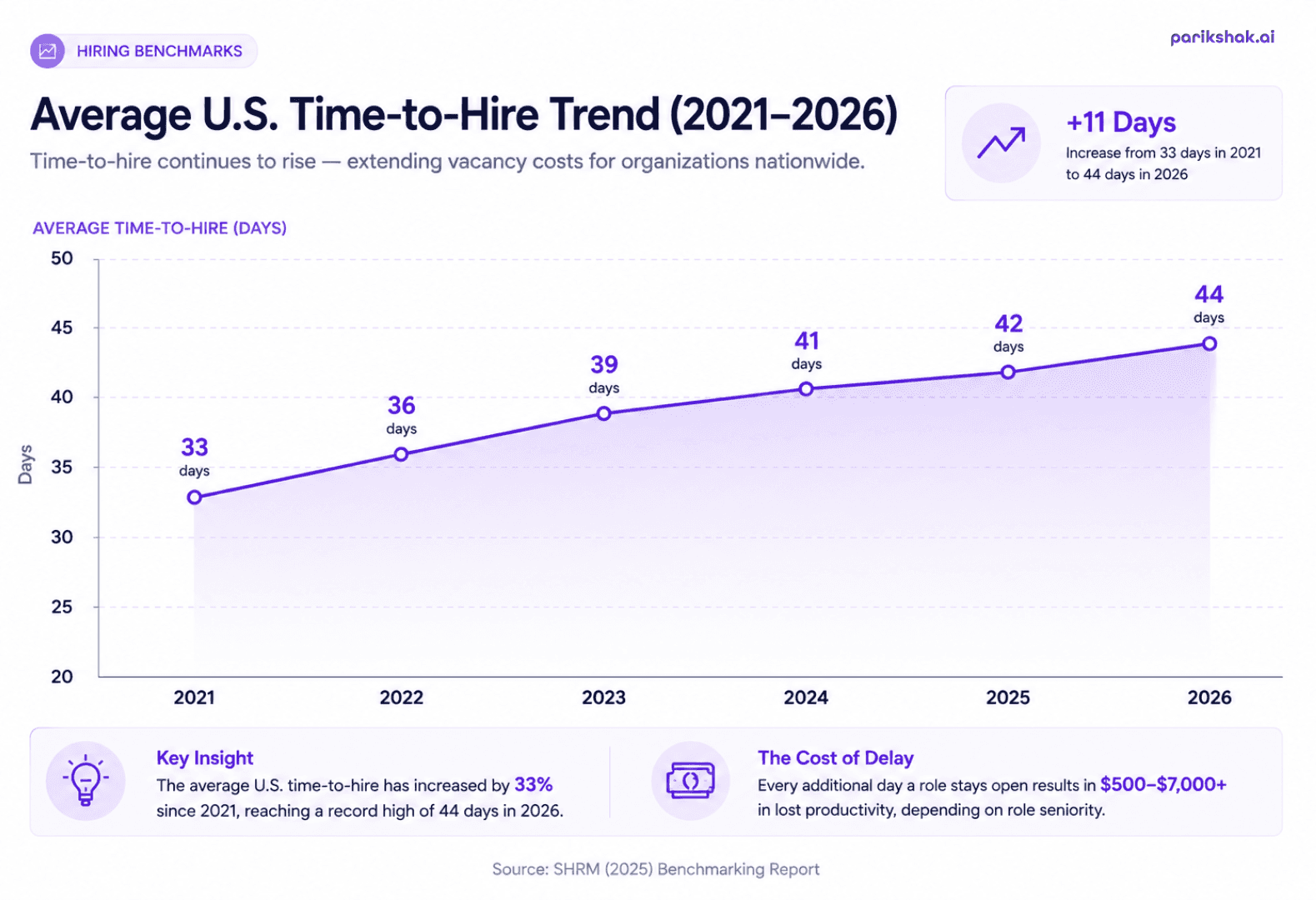
U.S. average time-to-hire has climbed 24% since 2021, rising from 33 days to 41 days, according to Employ’s 2025 recruiting benchmarks report analyzing over 140 million applications. SHRM’s parallel data puts time-to-fill — a broader measure that includes the pre-sourcing lag — at approximately 44 days. In some industries, it’s far worse: government agencies routinely exceed 55 days, and healthcare organizations average 42–49 days.
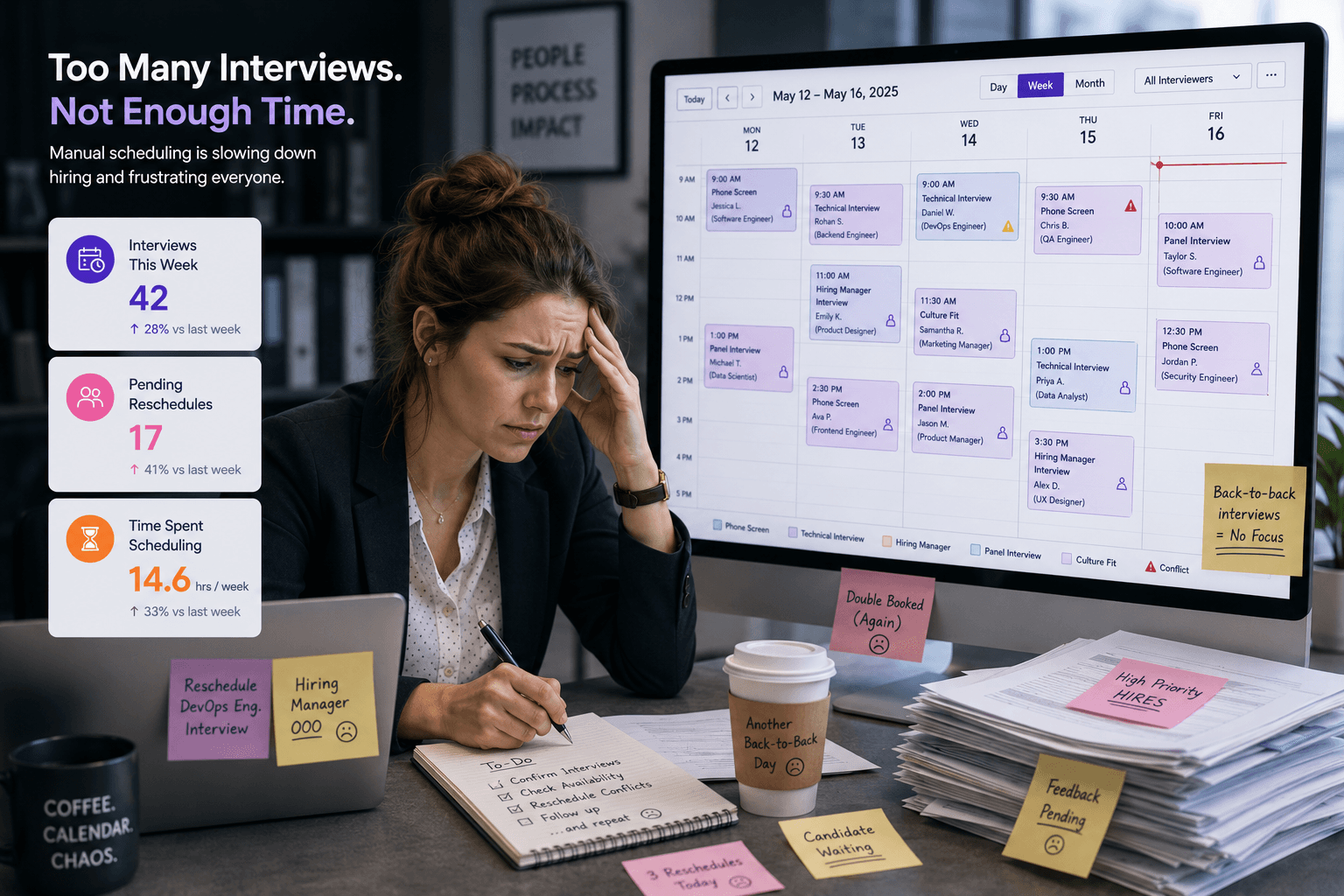
What’s driving the increase? Interview volume is the hidden tax. Hiring teams now conduct an average of 20 interviews per hire — a 42% jump from 14 interviews in 2021 (GoodTime, 2026). More interviews mean more scheduling, more feedback loops, and more calendar days burning before anyone signs an offer letter.
Meanwhile, the skills-based hiring shift — moving away from degree requirements toward
competency assessments — adds evaluation time, especially when those assessments require manual review. It’s a well-intentioned move that, without automation, actually makes the vacancy problem worse.
The compounding problem? Fifty-seven percent of job seekers lose interest if a hiring process feels too long (SHRM, 2025). So your slow process doesn’t just cost you money during the vacancy, it costs you the best candidates, who accept offers elsewhere. You then re-fill with whoever’s left. Dr. Sullivan calls this the double penalty: slow hiring leads to both higher vacancy costs and lower quality of hire.
GoodTime’s 2025 Hiring Insights Report found that talent acquisition teams achieved just
47.9% of their hiring goals in 2024 — the lowest attainment rate in four years of tracking. By 2025, 90% of companies missed their hiring goals entirely. The machinery is breaking down, and most organizations are trying to fix it by adding more interviewers, not by rethinking the process.
Interview volume has risen 42% since 2021, with teams now averaging 20 interviews per
hire (GoodTime, 2026). This scheduling overhead is a primary driver of the 24% increase inaverage time-to-hire, and each additional day compounds Cost-of-Vacancy losses.
How Does AI Hiring Automation Compress the Timeline?
AI recruitment tools reduce cost-per-hire by 20–30% and time-to-shortlist by up to 75%,
according to a 2025 benchmark study by Ideal (now Ceridian). The gains aren’t theoretical. A 2025 HRTech Outlook survey found that 78% of companies using AI in talent acquisition reported a 40% reduction in time-to-hire. Some organizations report compressing timelines from 27 days to just 7 (AllAboutAI, 2025).
Where exactly does the time go, and where does AI claw it back? Three stages account for the lion’s share of delay:
Screening and Shortlisting
Manual resume review is the original bottleneck. A recruiter managing 20 requisitions
simultaneously, the SHRM median, simply can’t give 426 applicants the careful read each deserves. AI screening tools filter and rank candidates against role-specific criteria in minutes, not weeks. The best platforms use structured scoring rubrics, not keyword matching, to surface candidates who actually fit the role’s competency requirements.Assessment and Evaluation
This is where the old model truly collapses. Manual interviews take weeks to schedule, hours to conduct, and days to debrief. Modern AI assessment platforms run structured evaluations, video, audio, text, code, asynchronously, scoring candidates against rubrics in real time. Teams using structured, AI-supported interviews see 24–30% higher assessment consistency (Harvard Business Review, 2024). That’s not just faster, it’s fairer.Scheduling and Coordination
Calendar ping-pong is a hidden time killer. AI scheduling tools sync calendars automatically and offer candidates self-service booking. Mitratech clients report saving 4–8 days just by automating this single step (Mitratech, 2025). Over a 44-day timeline, that’s an 18% reduction from one fix.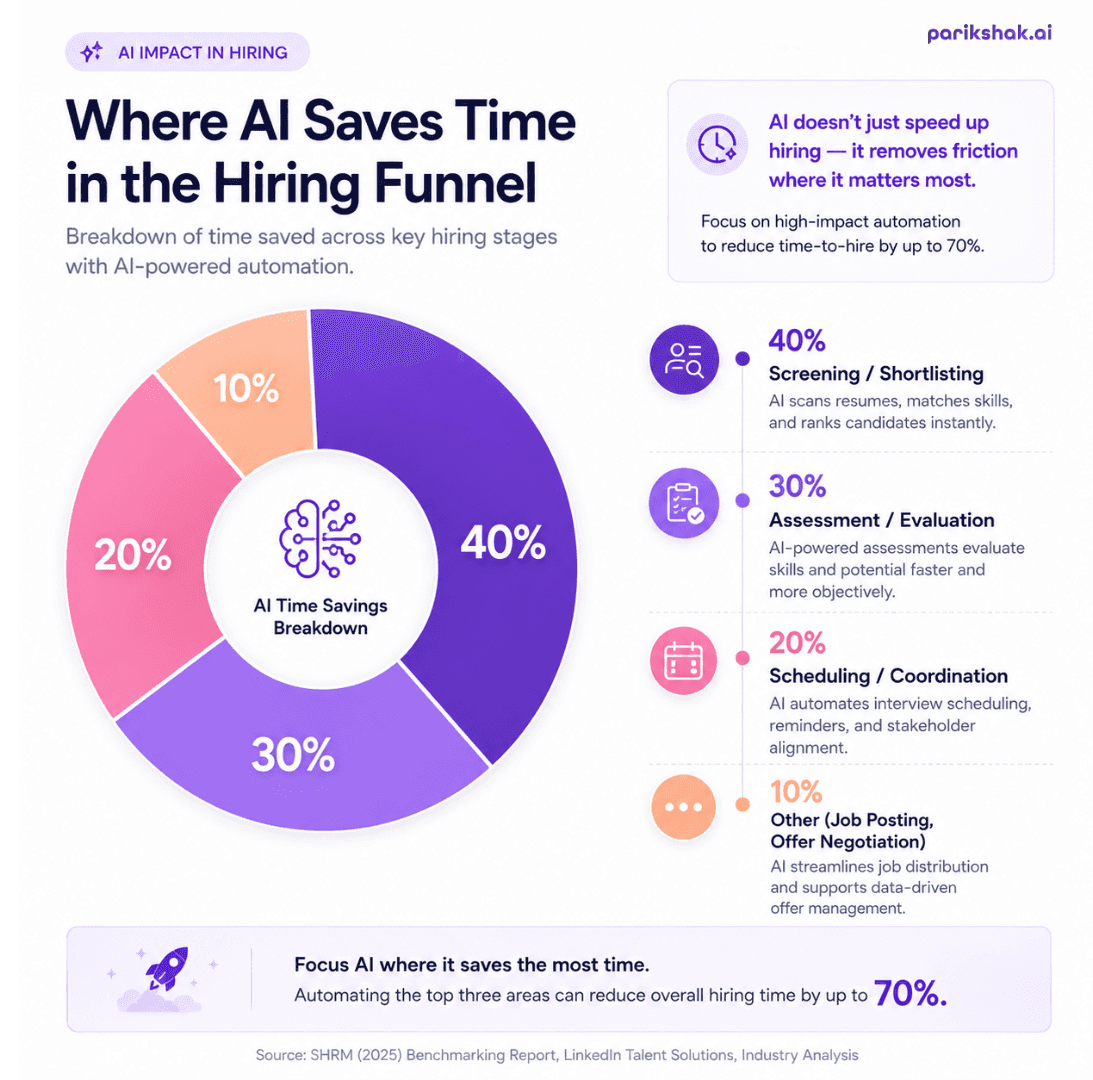
When we built Parikshak.ai’s assessment engine, we found that the single biggest time sink wasn’t sourcing or screening — it was the scheduling-to-evaluation loop. Candidates waited days for interview slots, completed interviews that produced subjective notes rather than structured scores, and then waited days more for debrief. Collapsing that loop into an asynchronous, AI-scored assessment cut the evaluation stage from 12 days to under 48 hours in early customer deployments.AI screening reduces time-to-shortlist by 75% (Ideal/Ceridian, 2025), while structured
AI-supported interviews improve assessment consistency by 24–30% (Harvard Business Review, 2024). Combined, these gains can compress a 44-day hiring cycle to under two weeks.
What’s the Financial Impact of Cutting Time-to-Fill in Half?
If you have 10 open positions with an average time-to-fill of 60 days, and each vacancy costs $6,500 per month, you’re losing $43,000 per month in vacancy costs $130,000 over that 60-day period (recruitment benchmarks analysis, 2025). Cut that time-to-fill by half, and you save $65,000 on those 10 positions alone.
The math scales predictably. Let’s model three scenarios for a company with 25 open positions and an average role salary of $95,000, using a 2x productivity multiplier:
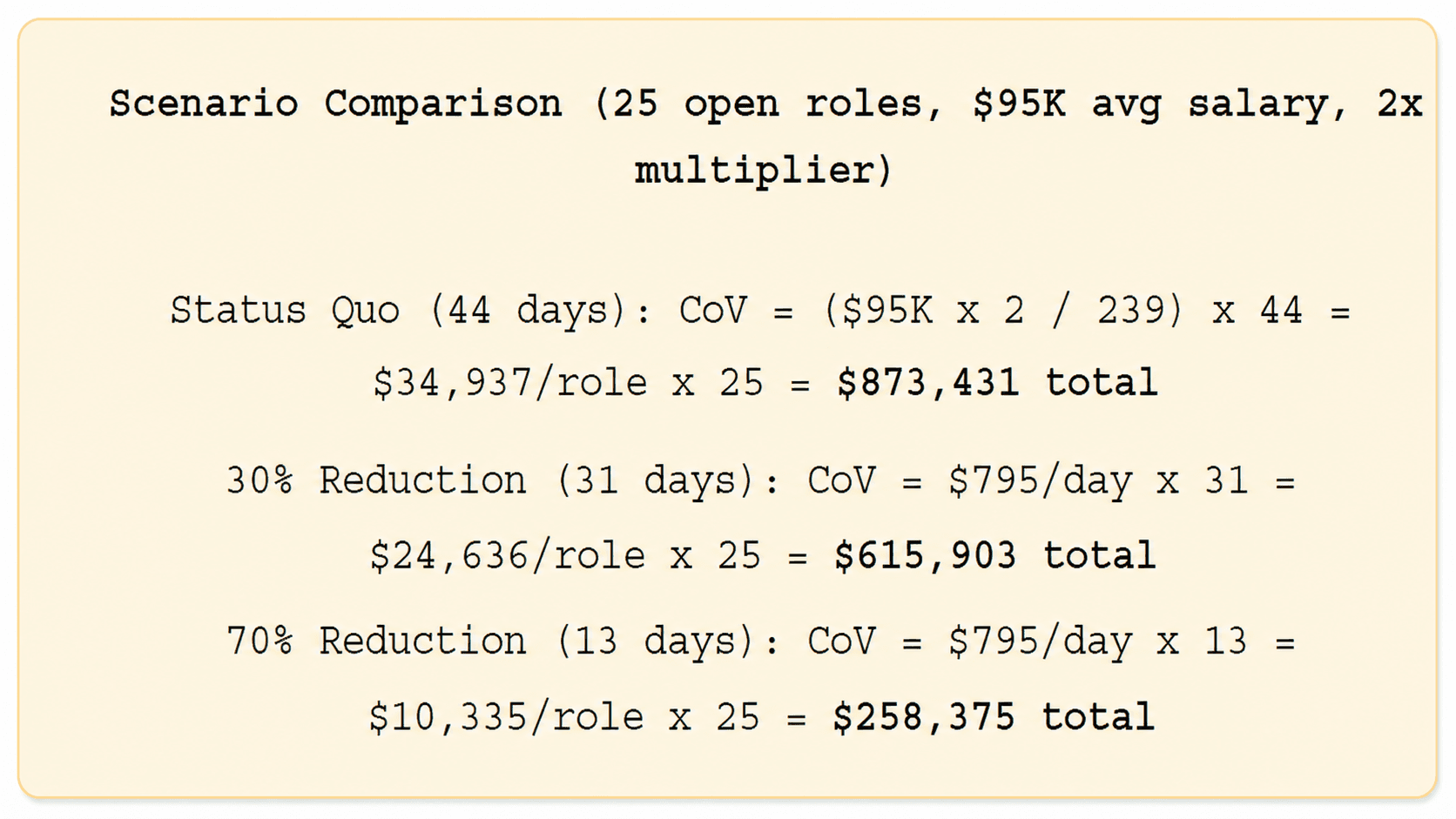
The difference between the status quo and a 70% reduction? $615,056 in recovered productivity per quarter. That’s the kind of number that transforms a CHRO’s next budget conversation. You’re not asking for money, you’re showing leadership how much they’re already losing.
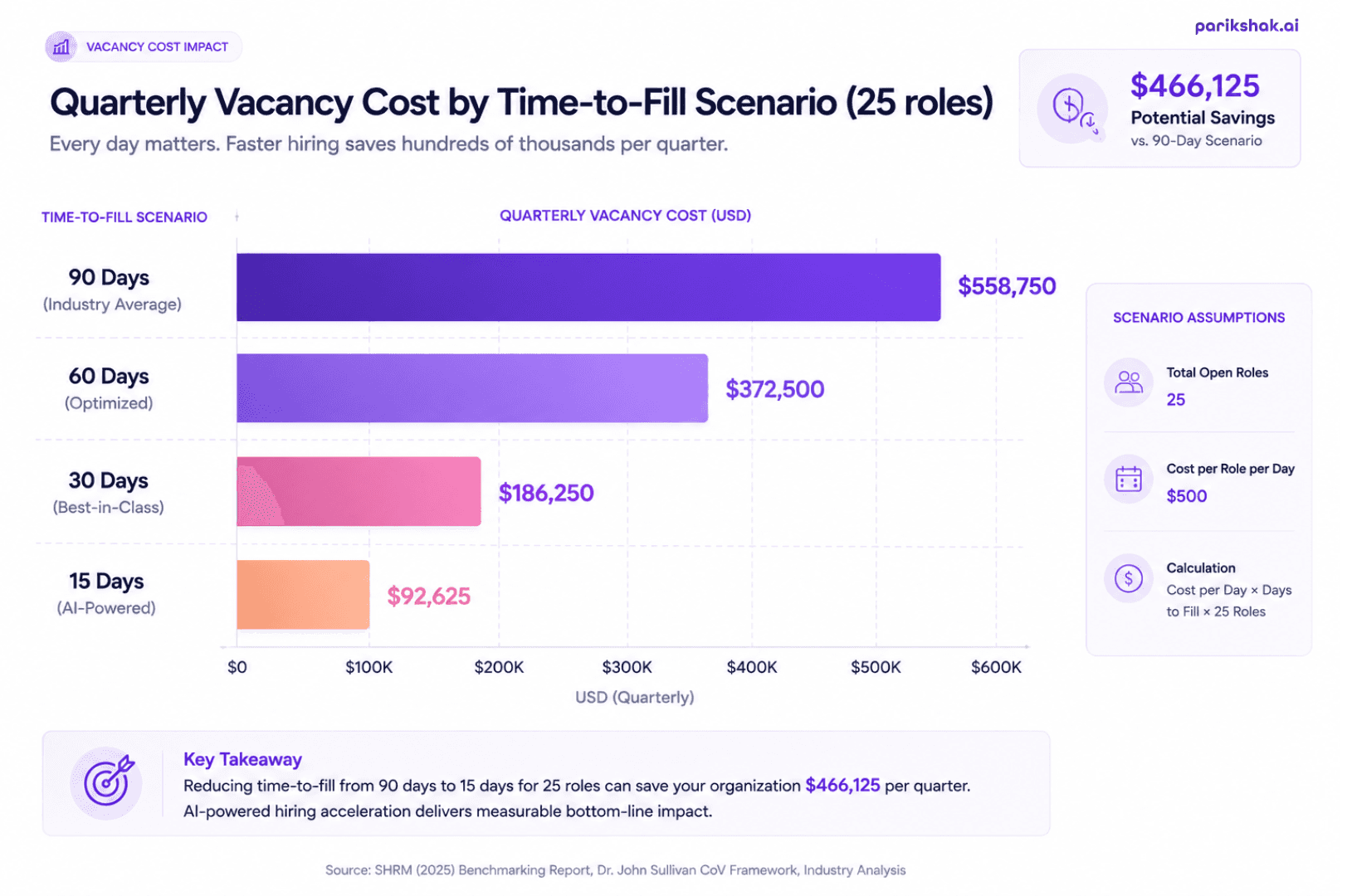
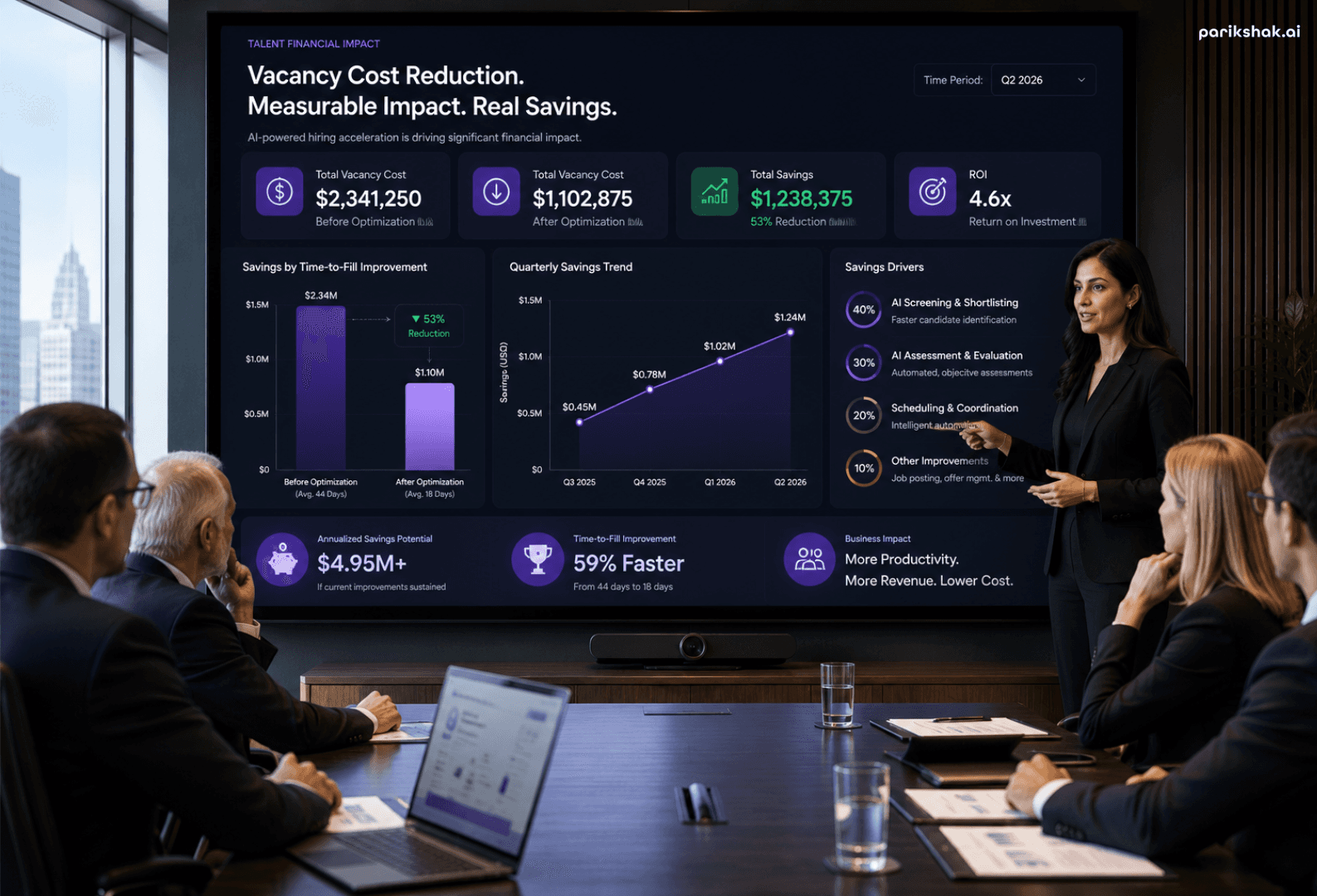
Here’s a detail that rarely appears in vendor marketing: the savings from faster hiring don’t just come from shorter vacancy periods. They also come from better hire quality. When you move fast with structured scoring, you capture the top candidates before they accept competing offers. SHRM’s own data shows that 57% of job seekers abandon processes they perceive as too slow. Every week you shave off isn’t just cost avoidance, it’s talent capture.
A company with 25 open roles at $95,000 average salary loses $873,431 per quarter at the current 44-day average fill rate. AI-powered automation that compresses time-to-fill by 70% recovers over $615,000 quarterly, a 2.4x return on most AI recruitment platform costs.
What Should a Modern, Low-Vacancy Hiring Process Look Like?
Eighty-seven percent of companies now use AI recruitment tools, and 93% of recruiters plan to increase their AI usage in 2026 (DemandSage, 2026). But adoption alone isn’t the goal. The organizations seeing the biggest CoV reductions share a common architecture, one that replaces sequential bottlenecks with parallel, automated workflows.
What does that architecture actually look like? First-generation AI hiring tools focused on video recording and basic keyword screening. They were faster tape recorders, not assessment engines. The next wave treats every candidate interaction as structured data: scored against role-specific rubrics, evaluated across multiple formats, and delivered to hiring managers as ranked, explainable recommendations rather than a pile of resumes.
When evaluating AI interview and assessment platforms, look for these capabilities:
• Rubric-based scoring- Not keyword matching. Candidates evaluated against specific competencies defined for each role, producing comparable, bias-resistant scores.
• Multi-format assessment- Video, audio, text, and code evaluation in a single platform. Different roles require different evidence. A one-format tool creates blind spots.
• Explainable AI decisions- If the platform can’t tell you why it scored a candidate a 7/10, you can’t defend the decision under regulatory scrutiny (EU AI Act compliance is phasing in through 2027).
• Asynchronous evaluation- Candidates complete assessments on their schedule. No scheduling bottleneck, no timezone friction, no 4–8 day calendar-sync delay.
• Transparent pricing- Enterprise-gated pricing models hide costs until you’re deep in a sales cycle. Modern platforms publish what they charge.
Use your current workflow as the baseline, then measure how structured assessment packs affect time-to-shortlist after implementation.
Teams should compare time-to-shortlist before and after implementation; results depend on workflow configuration, role complexity, candidate availability, and the organisation’s starting process.
Here’s the counterintuitive insight most vendors won’t share: AI assessment tools don’t just make hiring faster. They make hiring managers more decisive. When a platform delivers rubric-scored, apples-to-apples candidate comparisons, the hemming and hawing evaporates. Structured data compresses the decision-to-offer gap even more than it compresses screening time.
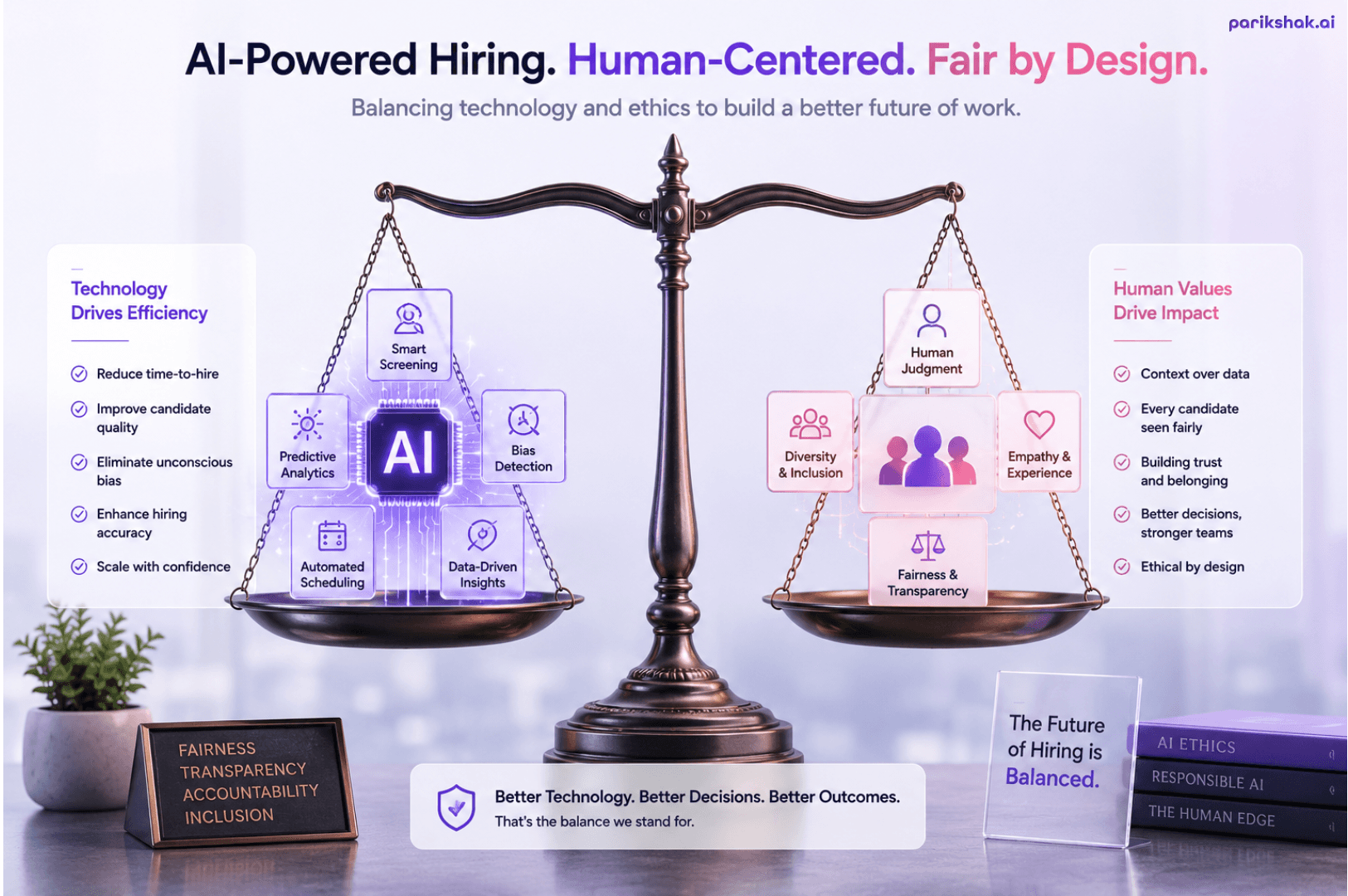
Does Faster Hiring Mean Cutting Corners on Fairness?
Forty percent of HR leaders cite bias and fairness as their top AI hiring concern (Mercer, 2025). It’s a valid worry. Amazon famously scrapped an AI recruiting tool in 2018 after discovering it penalized resumes mentioning women. The industry has made real progress since, but the concern remains front and center.
Speed and fairness aren’t opposing forces, though. They’re complementary — when the speed comes from structured evaluation rather than cutting steps. NYC Local Law 144 now requires bias audits for automated hiring tools. Illinois and Maryland have enacted their own AI hiring laws. The EU AI Act’s grace periods for high-risk AI (which includes recruitment) phase in through 2026–2027.
The platforms that survive this regulatory wave will be those with built-in explainability. If your AI tool can’t produce a score-level explanation for every candidate decision, it’s a compliance liability, not a time saver. Twenty-nine percent of organizations now audit their AI hiring tools (AdAI Research, 2026). That number is climbing fast.
Structured evaluation actually reduces bias compared to unstructured interviews. When every candidate is measured against the same rubric, interviewer subjectivity shrinks. Teams using structured, AI-supported interviews see 24–30% higher assessment consistency (Harvard Business Review, 2024). That consistency is what compliance officers want to see.
NYC Local Law 144, Illinois, Maryland, and the EU AI Act collectively require transparency and bias audits for AI-driven hiring decisions. Structured, rubric-based AI assessment tools meet these requirements by design — and deliver 24–30% higher scoring consistency than unstructured alternatives (Harvard Business Review, 2024).
Time Is Money. Parikshak Saves Both.
You’ve seen the formula. You’ve run the numbers. Now the question is whether you keep bleeding $500–$7,000 per day per vacancy, or you automate the stages that eat the most time. Parikshak.ai’s AI-powered assessment platform handles structured scoring, multi-format evaluation, and async candidate assessment out of the box — so your team spends hours, not weeks, moving from applicant to shortlist.
Want to see what your vacancy costs look like with a compressed timeline? Book a freewalkthrough and bring your time-to-fill data. We’ll calculate the savings together.
Stop Treating Vacancies as Cost Savings
The cost of an empty seat is real, measurable, and almost certainly higher than your organization currently estimates. The formula is straightforward. The data is abundant. And the technology to compress 44-day hiring cycles into single-digit timelines exists today.
Here's what to do next:
• Calculate your actual CoV using the salary-multiplier formula and your current time-to fill data.
• Identify the three stages where your hiring process loses the most days (usually screening, assessment, scheduling).
• Evaluate AI assessment platforms against the five criteria above: rubric-based scoring, multi-format assessment, explainable decisions, async evaluation, and transparent pricing.
• Present the financial case to your CFO using the scenario model in this article.
Platforms like Parikshak.ai are built around the premise that assessment shouldn't be a bottleneck, it should be the fastest, most defensible stage in your hiring funnel. The organizations that figure this out first won't just hire faster. They'll hire better, retain longer, and outperform the competition that's still running manual processes.
Time is money. How much longer can you afford to lose both?
Related Blogs

What Are the Hidden Costs of Human-Led Technical Screening?

5 Metrics That Define AI-Driven Hiring Success for HR Teams and Startups

Why Hiring Deserves Trustworthy AI: The Case for Human-First Recruitment Technology