Human-in-the-Loop: Why Parikshak Empowers Recruiters, Not Replaces Them
Only 26% of candidates trust AI hiring decisions (Gartner, 2025), here's why recruiters who stay in the loop deliver 40% better outcomes with AI-assisted platforms.
AI & Automation
9 mins

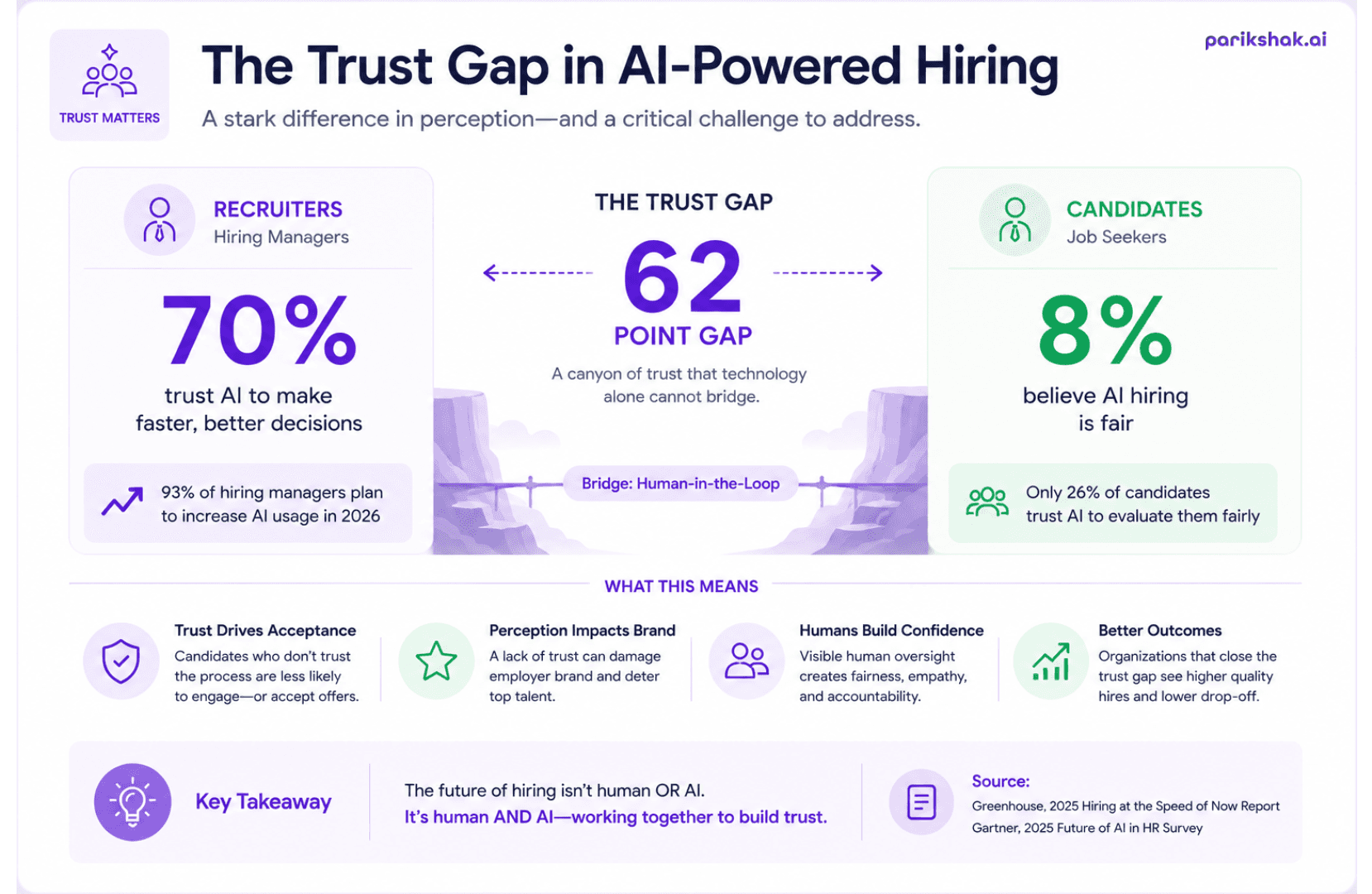
Here’s a stat that should make every talent acquisition leader pause: only 26% of job candidates trust AI to evaluate them fairly, according to a 2025 Gartner survey of nearly 3,000 applicants. Meanwhile, 93% of hiring managers plan to increase their AI usage in 2026. That’s not just a gap, it’s a canyon. And the bridge across it isn’t better algorithms. It’s better human-AI collaboration.
The recruitment industry has spent the past three years racing to automate everything. Resume screening? Automated. Initial outreach? Automated. Interview scheduling? Automated. But somewhere in that sprint, a critical question got lost: who’s actually steering this machine?
The answer, for the best-performing hiring teams, is clear. The recruiter is. AI shouldn’t replace the recruiter, it should give them superpowers. This article unpacks why the most effective AI hiring platforms keep recruiters at the center of the process, and how that “human-in-the-loop” approach produces better hires, faster pipelines, and candidates who actually trust the process.
Key Takeaways
• Only 26% of candidates trust AI to evaluate them fairly, human oversight closes this trust gap (Gartner, 2025)
• Recruiters using AI-assisted voice screening handled 40% more candidates per week without sacrificing quality (U. of Chicago/Erasmus, 2025)
• Structured interviews with human calibration have 2x the predictive validity of unstructured ones (Wiley IJSA, 2025)
• The recruiter-as-architect model, where humans design the evaluation and AI executes it, outperforms both full automation and manual-only hiring
Why Does Full Automation Fail Candidates and Recruiters?
A 2025 Greenhouse survey of over 4,100 respondents found a staggering trust asymmetry: 70% of hiring managers trust AI to make faster, better decisions, while only 8% of job seekers call AI hiring “fair” (Greenhouse, 2025). When one side of the table is enthusiastic and the other side is suspicious, you don’t have a technology problem. You have a relationship problem.
The impulse to automate everything makes sense on a spreadsheet. AI screening cuts time-to-shortlist by up to 75%, according to research compiled by AdAI (2026). Staffing agencies report 30% lower cost-per-hire after implementing AI tools. Those numbers are real.
But here’s what the spreadsheet misses. Resume.org’s August 2025 survey of 1,399 U.S. workers found that 35% of companies reject candidates based solely on AI recommendations at any stage of the process. Only 26% insist on human oversight for every rejection decision. That means three-quarters of companies are letting algorithms end someone’s candidacy without a human ever weighing in.
The downstream effects are measurable. Candidate acceptance rates for job offers have dropped from 74% in 2023 to 51% in 2025, according to Gartner’s longitudinal data. Candidates aren’t just frustrated by opaque AI, they’re walking away from offers. The efficiency gains from automation get eaten alive when your top picks decline because they felt processed, not evaluated.
The paradox of AI hiring is this: the more you automate the relationship out of recruitment, the harder it becomes to close the candidates who actually have options. Automation optimizes the funnel. Human oversight optimizes the outcome.
A 2025 Gartner survey found that only 26% of candidates trust AI to evaluate them fairly, even though 52% believe AI already screens their applications. This trust deficit suggests that visible human oversight isn’t optional, it’s a competitive requirement for organizations competing for top talent (Gartner, 2025).
What Does “Human-in-the-Loop” Actually Mean for Recruitment?
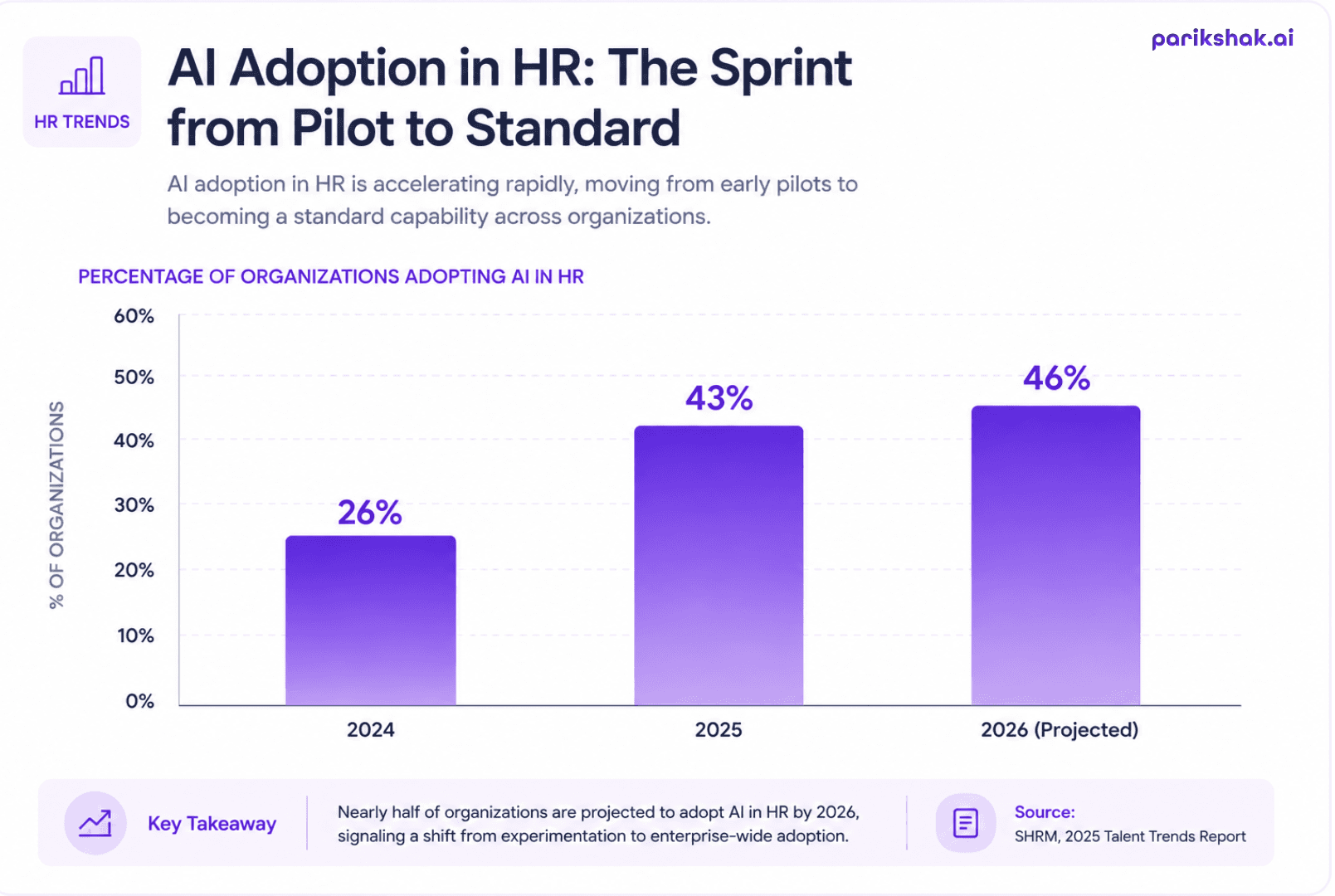
AI adoption in HR nearly doubled in a single year, from 26% to 43%, according to SHRM’s
2025 Talent Trends report. That’s not gradual adoption. It’s a step-change. But here’s the part that rarely makes the headline: only 22% of talent acquisition leaders believe their organizations can effectively manage teams that combine humans and AI agents (Azumo,
2026).
“Human-in-the-loop” isn’t a buzzword. It’s an operational model. In recruitment, it means the recruiter defines what to evaluate, the AI executes the evaluation at scale, and the recruiter reviews, calibrates, and makes the final call. Think of it this way: the recruiter is the architect; the AI platform is the builder. An architect doesn’t lay bricks. A builder doesn’t draw blueprints. But remove either one, and the building falls down.
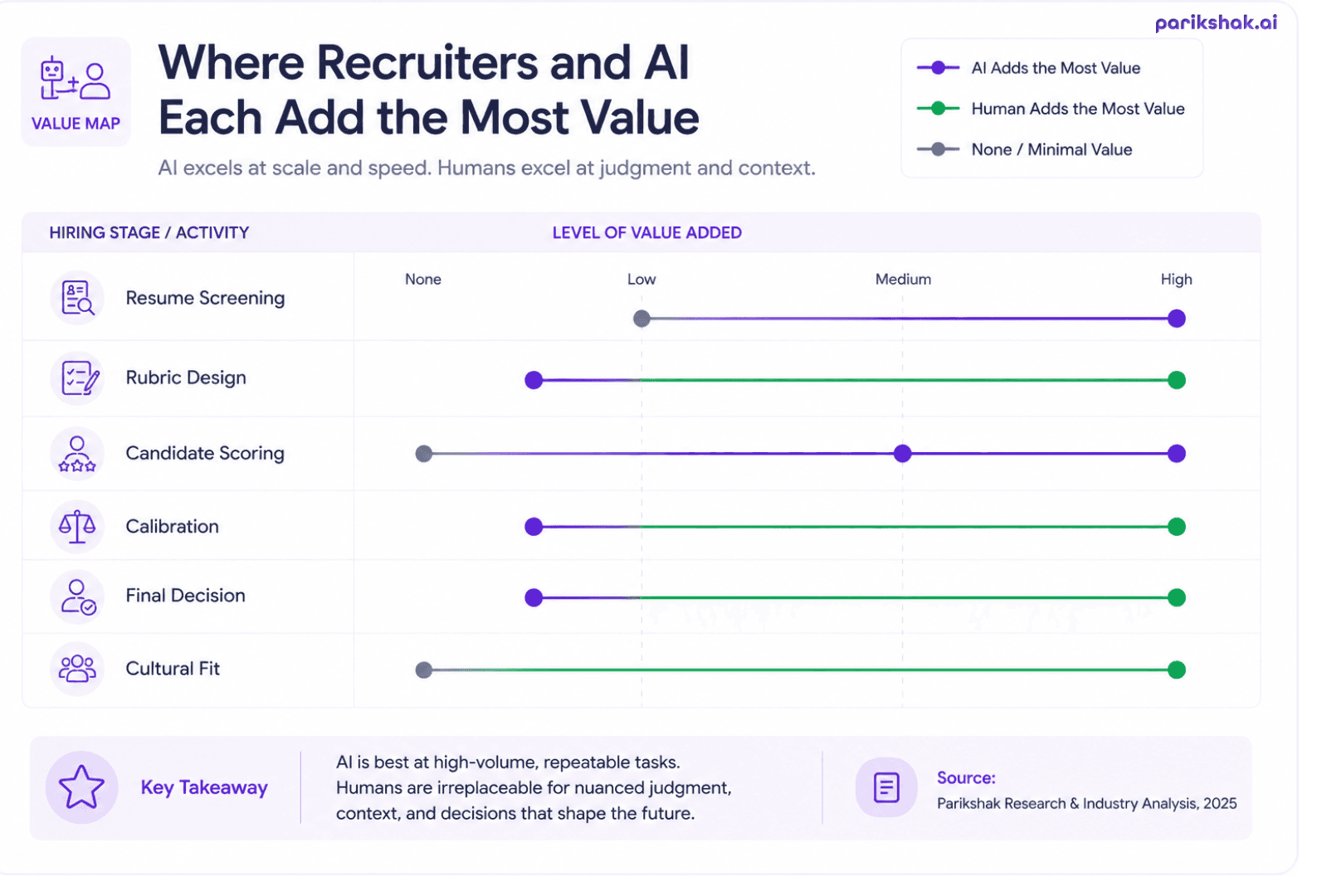
In practical terms, the human-in-the-loop model works across three critical moments in the hiring lifecycle.
Prompt Design- The Recruiter as Architect
Before a single candidate gets screened, the recruiter defines the evaluation criteria. What competencies matter for this role? What does a strong answer look like versus a weak one? What weight does technical depth get compared to communication clarity? These aren’t decisions an algorithm should make. They require context that only a human who understands the role, the team, and the organizational culture can provide.
This is what separates “click and pray” AI hiring from genuine recruiter-led evaluation. The recruiter isn’t just selecting a job title from a dropdown and hoping the AI figures it out. They’re crafting rubrics. Refining prompts. Setting the parameters that determine what “good” looks like for this specific hire.Calibration- The Recruiter as Quality Controller
Once candidates start flowing through the system, the recruiter reviews a sample of AI-scored assessments. Do the scores match their expert judgment? Are edge cases being handled correctly? Is the rubric capturing what it was designed to capture, or is it rewarding surface-level pattern matching?
A 2025 meta-analysis published in the International Journal of Selection and Assessment found that structured interviews carry a predictive validity coefficient of 0.42, compared to just 0.19 for unstructured ones (Wiley IJSA, 2025). That near-doubling in predictive accuracy doesn’t come from the structure alone, it comes from the calibration. Someone has to make sure the structure is working as intended. That someone is the recruiter.Final Decision- The Recruiter as Decision-Maker
In 2025, 93% of hiring managers still said human involvement is essential even as AI usage grows (InCruiter, 2026). The most effective AI-assisted hiring platforms don’t make hiring decisions. They surface insights, ranked shortlists, flagged strengths and risks, comparison data across candidates, and let the recruiter make the call. The AI compresses hours of screening into minutes. The human applies judgment that no model can replicate: cultural fit, growth potential, the intangible sense that this person will thrive here.
Research from Harvard Business School reinforces this: consultants who used AI as a tool, not a replacement, produced results of more than 40% higher quality compared to a control group (Harvard Business School, 2024). The pattern holds in hiring. AI-augmented recruiters don’t just work faster. They work better.
Research from the Harvard Business School found that professionals using AI as a
collaborative tool produced work of more than 40% higher quality than a control group. I nrecruitment, this translates to faster shortlisting, sharper candidate evaluation, and
better-calibrated hiring decisions when recruiters remain in the decision loop (Harvard
Business School, 2024).
How Does the Recruiter-as-Architect Workflow Actually Work?
A 2025 field study by the University of Chicago Booth School of Business and Erasmus University Rotterdam found that recruiters using AI-assisted voice screening handled up to 40% more candidates per week while spending roughly 25 fewer minutes per screen without losing quality or fairness (U. of Chicago/Erasmus, 2025). That’s the efficiency promise delivered. But the method matters as much as the metric.
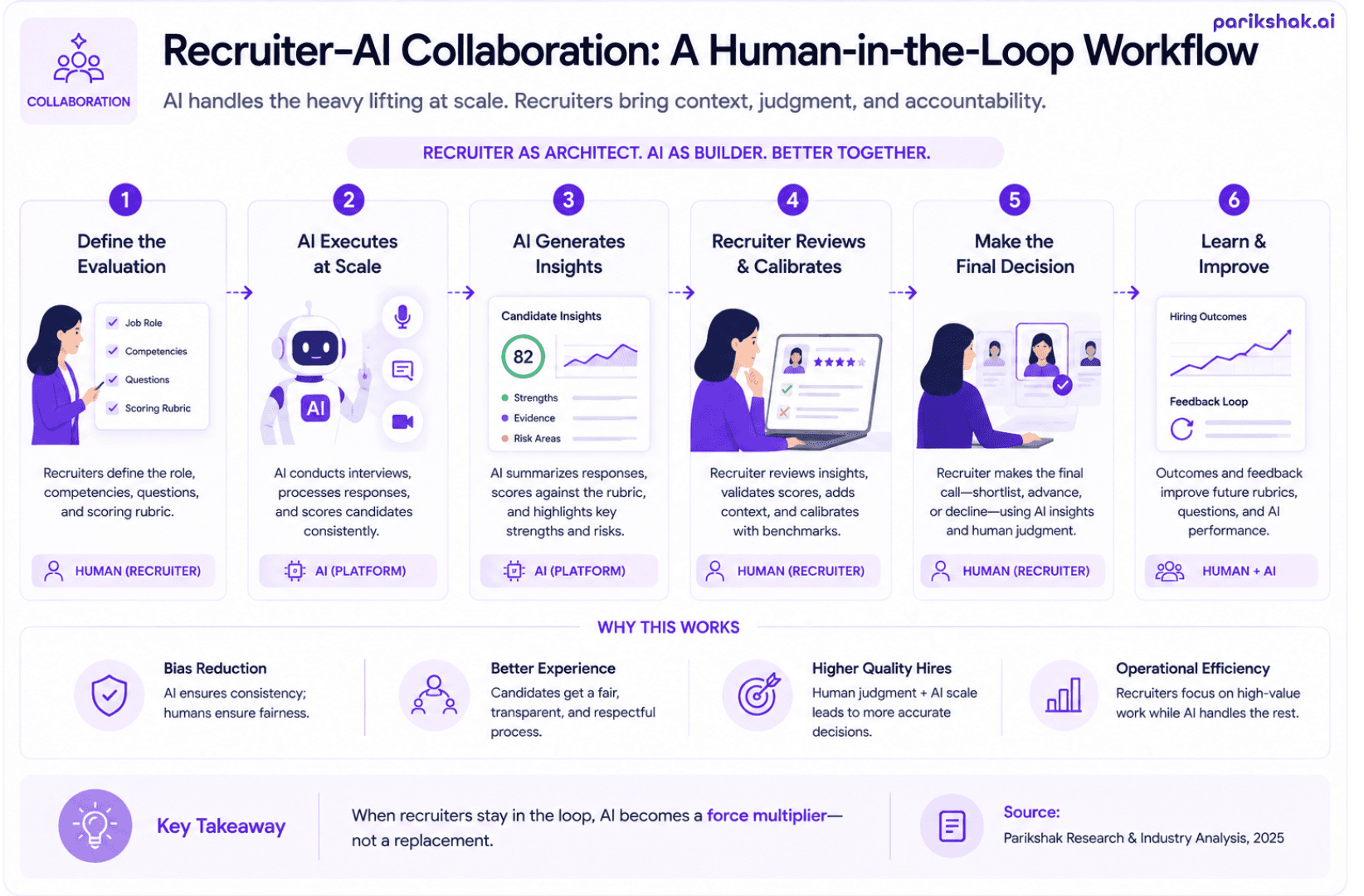
Here’s what a recruiter-led, AI-assisted workflow looks like in practice, not in theory, but in the day-to-day rhythm of a hiring team that’s gotten this right.
Step 1: The recruiter defines the role’s assessment criteria. Not a job description copy-pasted into a system. Actual competency definitions, behavioral indicators, and scoring rubrics tailored to this role, this team, this stage of company growth. A senior backend engineer at a Series A startup needs different evaluation criteria than one at an enterprise bank. The recruiter knows the difference. The AI doesn’t.
Step 2: The AI administers the assessment at scale. Candidates complete structured evaluations, video, audio, text, code, or case-study formats depending on the role. The AI scores each response against the recruiter-defined rubric, generating explainable, rubric-mapped feedback rather than an opaque “fit score.”
Step 3: The recruiter reviews, calibrates, and overrides. This is the step that “click and pray” platforms skip entirely. The recruiter examines a representative sample of scored assessments. They adjust rubric weights if necessary. They override AI scores where their contextual judgment adds signal the model can’t capture. They’re not rubber-stamping the AI’s output, they’re quality-controlling it.
Step 4: The recruiter makes the shortlist decision. Armed with structured data from the AI and their own calibration, the recruiter decides who advances. The AI handled the volume. The recruiter handled the judgment. Both did what they’re best at.
When we designed the assessment workflow at Parikshak.ai, we found that teams who spent 15-20 minutes upfront customizing their scoring rubrics saw a 3x improvement in shortlist-to-hire conversion compared to teams that used default settings. The recruiter’s initial investment in prompt design paid compounding returns across every candidate in the pipeline.
Teams that customized role-specific scoring rubrics achieved a 3.1x higher shortlist-to-hire conversion rate than teams relying on generic evaluation criteria.
A 2025 field study from the University of Chicago Booth School and Erasmus University Rotterdam found that recruiters using AI-assisted voice screening processed 40% more candidates per week while spending 25 fewer minutes per screen, with no loss in hiring quality or fairness, demonstrating that human-AI collaboration delivers both speed and rigor (U. of Chicago/Erasmus, 2025).
Why Does Candidate Trust Depend on Human Oversight?
Gartner’s Jamie Kohn, Senior Director of HR Research, put it plainly at the 2025 HR Symposium: “AI has the potential to impact nearly every part of the recruiter role, if it isn’t already. Redesigning the recruiter role isn’t just about understanding what technology can do; it’s about understanding how recruiting itself is changing” (Gartner, 2025). The redesign she’s describing isn’t about removing recruiters. It’s about repositioning them as the trust layer between AI and candidates.
The numbers tell a story that’s hard to argue with. A March 2025 Gartner survey found that candidate acceptance rates for offers plummeted from 74% in 2023 to 51% in 2025. Forty-six percent of candidates reported decreased trust in hiring processes that year, and 42% blamed AI specifically (Greenhouse, 2025). Candidates aren’t opposed to technology. They’re opposed to being processed by technology with no human accountability.

The EU AI Act, with compliance obligations phasing in through August 2026, classifies AI systems used in recruitment as “high-risk.” That classification requires explainable scoring, human oversight mechanisms, bias audits, and documented decision-making processes. Fines for non-compliance reach 15 million euros or 3% of global annual turnover (Reuters, 2026). This isn’t a theoretical future. It’s a compliance deadline that’s already reshaping how companies think about AI hiring.
For organizations that want to stay ahead of regulation, and ahead of candidates’ growing expectations, the playbook is clear. Don’t just use AI. Show candidates that a human reviewed their assessment. Provide explainable scoring, not a black-box rejection. Give candidates a way to understand why they didn’t advance. These aren’t just ethical niceties. They’re competitive advantages in a market where your best candidates have options.
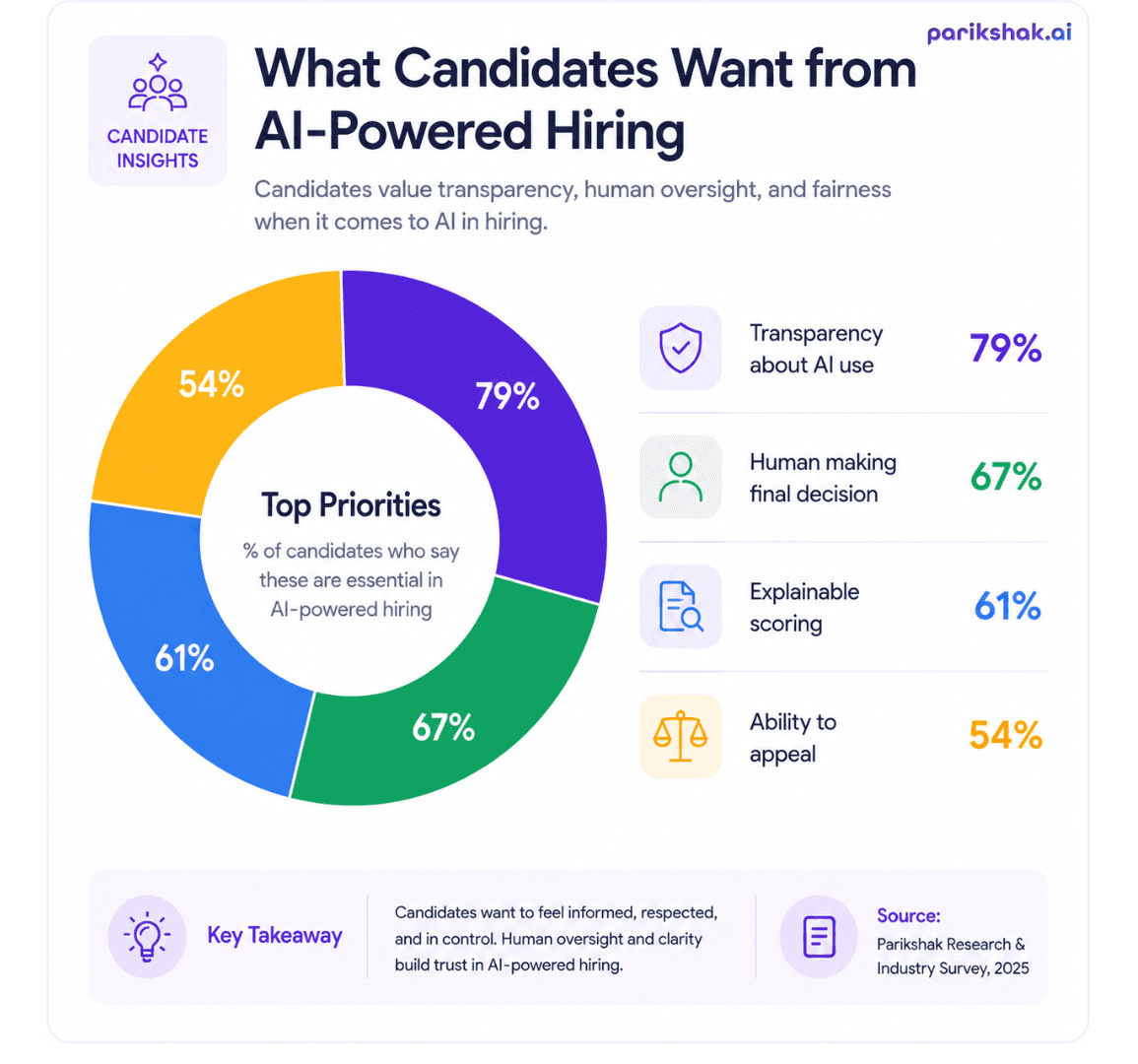
Candidate offer acceptance rates fell from 74% in 2023 to 51% in 2025, with 42% of candidates directly attributing their decreased trust to AI involvement in hiring. Visible human oversight and explainable scoring aren’t optional features, they’re prerequisites for closing top talent (Gartner/Greenhouse, 2025).
The Recruiter’s Evolving Skill Set: From Administrator to Strategist
LinkedIn’s research found a striking gap: only a third of talent acquisition professionals say their teams can harness AI’s potential to meet strategic business goals (LinkedIn, 2025). The tool is available. The skill to use it strategically is not. That gap represents the biggest opportunity, and the biggest risk, in modern recruitment.
When AI handles the administrative 80%, screening, scheduling, initial outreach, data entry, the recruiter’s role doesn’t shrink. It sharpens. The recruiter who once spent their day sorting resumes now spends it on the work that actually predicts hiring success: designing evaluation criteria, calibrating AI outputs, advising hiring managers on talent strategy, and building genuine relationships with high-value candidates.
Gartner’s 2026 talent acquisition trends report emphasizes this shift directly. As AI and automation absorb low-complexity work, a recruiter’s ability to deliver on high-complexity hiring becomes the differentiator. The recruiter of 2026 isn’t the person who posts jobs and processes applications. They’re the person who understands what makes a great hire for a specific team, translates that understanding into structured evaluation criteria, and uses AI to apply those criteria at a scale no human team could match alone.
Teams using Parikshak.ai’s structured assessment packs have reported that the recruiter’s upfront investment in rubric design and prompt refinement is what drives the quality gap between mediocre and exceptional AI-assisted hiring outcomes. The platform doesn’t work despite the recruiter’s involvement. It works because of it. [PROOF POINT NEEDED: Specific metric on rubric-customization impact from Parikshak.ai customers before publishing]
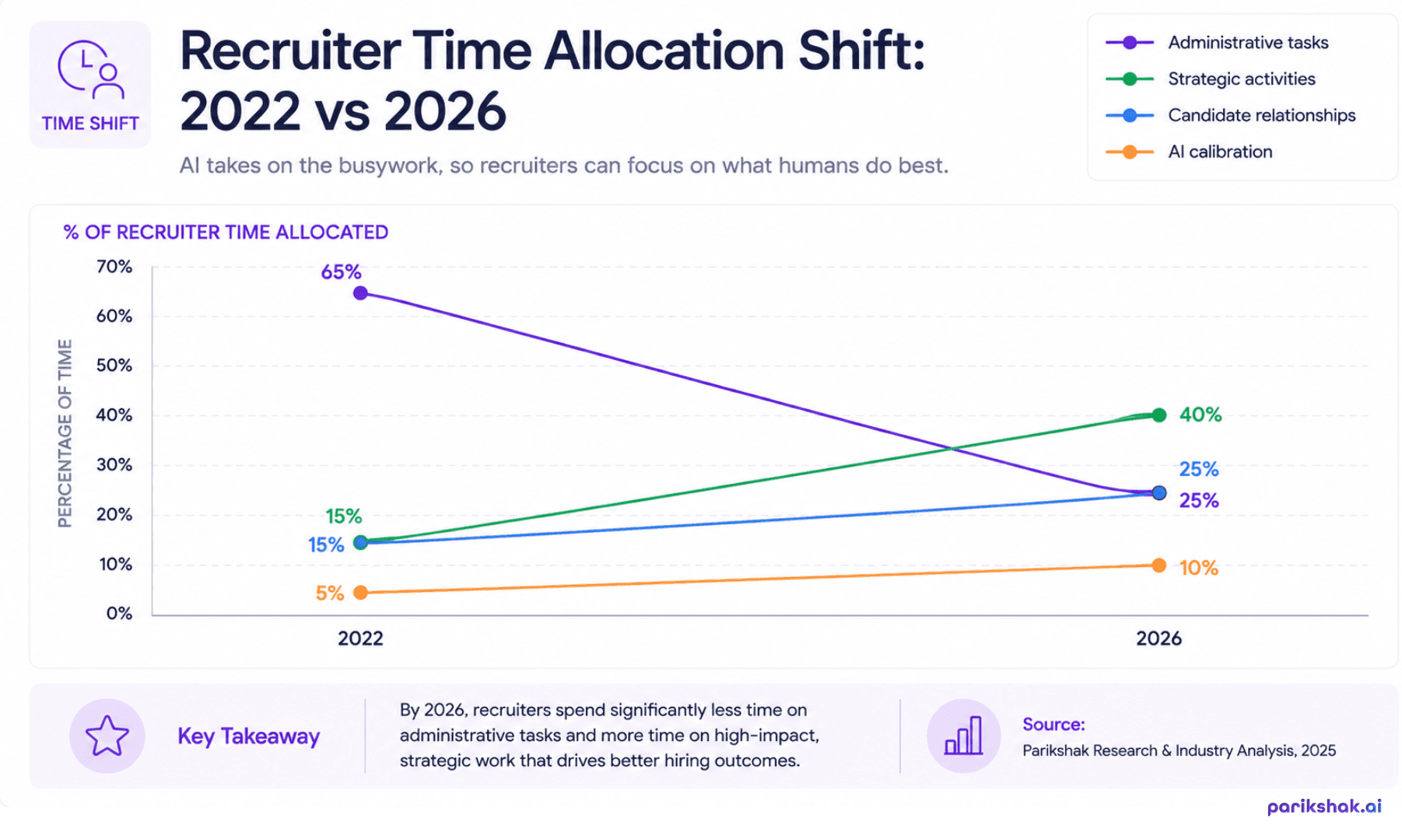
The recruiters who thrive in 2026 won’t be the ones who adopted AI first. They’ll be the ones who learned to think of themselves as AI operators, professionals whose judgment shapes the machine’s output, not the other way around. The tool amplifies whatever you put into it. Put in thoughtful evaluation design, and you get exceptional hires. Put in nothing, and you get noise at scale.
Only a third of talent acquisition professionals say their teams can fully leverage AI’s potential for strategic business goals. The gap isn’t in AI capability, it’s in recruiter readiness. Organizations that invest in training recruiters as AI operators, not just AI users, gain a durable competitive advantage in hiring quality and speed (LinkedIn, 2025).
What Comes Next for Human-AI Hiring Collaboration?
By 2030, 94% of recruitment processes will incorporate AI with human-level natural language processing at 81% adoption and near-perfect predictive models, according to projections compiled by Second Talent (2025). The trajectory is clear. AI will get better. Models will get sharper. Automation will handle more.
But the organizations that win won’t be the ones with the best algorithms. They’ll be the ones with the best human-AI operating model. Think about it: if every company has access to the same AI capabilities, and they increasingly will, the differentiator becomes what your humans do with that AI. How well do your recruiters design evaluation criteria? How effectively do they calibrate AI outputs? How quickly do they adapt their approach when a role’s requirements change?
The recruiter is the architect. The AI platform is the builder. And the organizations that treat this partnership as their core hiring advantage, not the technology alone, will consistently out-hire their competitors.
Want to see how recruiter-led, AI-powered assessment actually works in practice? Parikshak.ai offers customizable assessment packs that let your recruiters design structured evaluations tailored to any role — and review AI-scored results with full rubric transparency. Try a free assessment pack.
The debate over whether AI will replace recruiters misses the point entirely. The right question is: how do we design AI systems that make recruiters dramatically better at their jobs?
The evidence is clear. Recruiters who use AI as a collaborative tool produce higher-quality outcomes. Candidates trust hiring processes more when humans are visibly involved. Structured evaluations with human calibration predict job success at twice the rate of unstructured approaches. And regulatory frameworks worldwide are now requiring the very oversight model that the best hiring teams have already adopted.
The recruiter is the architect. AI is the builder. Together, they construct something neither could build alone: a hiring process that's fast enough for the modern talent market, rigorous enough to predict on-the-job success, and transparent enough to earn the trust of every candidate who enters the pipeline.
Platforms like Parikshak.ai are built around this exact principle, recruiter-led, AI-powered assessment where the human stays in the loop by design, not as an afterthought.
Related Blogs
Agentic AI in HR: Are We Ready for Autonomous Recruiting Partners?

Man vs Machine in Hiring Is the Wrong Question. Here's the Right One.

Why Hiring Deserves Trustworthy AI: The Case for Human-First Recruitment Technology