Agentic AI in HR: Are We Ready for Autonomous Recruiting Partners?
82% of HR leaders plan agentic AI adoption within 12 months, here's what the shift from passive tools to autonomous hiring partners means for your team in 2026.
AI & Automation
8 min
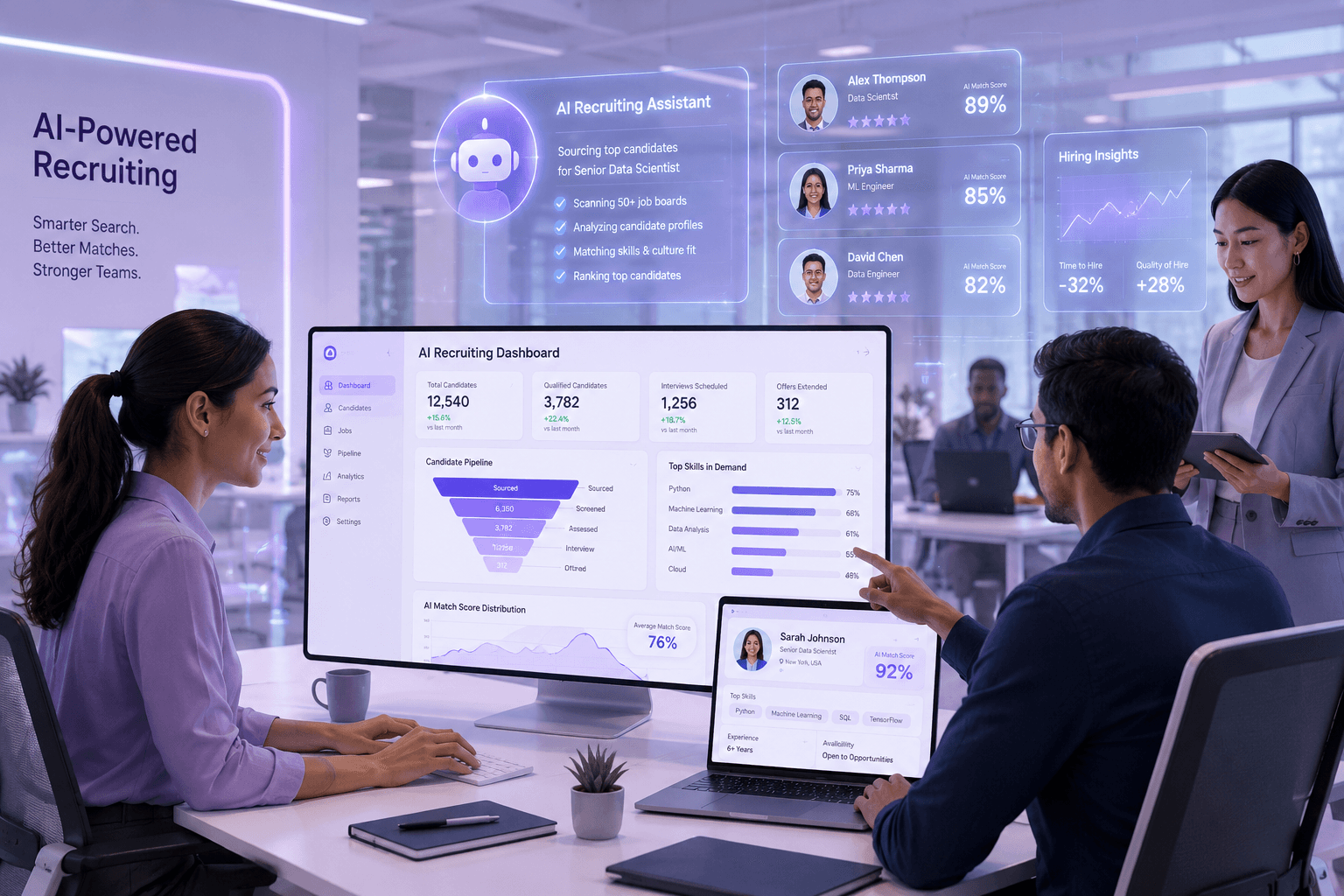
How AI went from waiting for your click to suggesting your next hire, and what HR leaders need to know before the shift becomes irreversible.
Something strange happened in talent acquisition this year. The tools stopped waiting. A recruiter at a mid-market SaaS company opened her ATS on a Monday morning and found that her AI system had already sourced twelve candidates over the weekend, ranked them against role-specific rubrics, and drafted personalized outreach for the top three. She hadn’t asked it to do any of this.
This isn’t science fiction. It’s the operational reality of agentic AI, and it’s rewriting the rules of hiring faster than most HR departments can keep up. According to a May 2025 Gartner survey, 82% of HR leaders plan to implement some form of agentic AI capabilities within the next 12 months (HR Executive, 2025). Yet most teams still think of AI as a smarter search bar. That gap, between what agentic AI can do and what HR teams expect it to do, is where the biggest opportunities (and risks) sit right now.
This article breaks down what agentic AI actually means for HR in 2026, where the real value is emerging, what the regulatory landscape demands, and how to avoid the 40% project failure rate that Gartner predicts is coming.
Key Takeaways
• AI adoption in HR doubled from 26% to 43% in a single year (SHRM, 2025), and 92% of CHROs expect further AI integration in 2026.
• Agentic AI moves beyond task automation, it plans, acts, and adapts across full recruiting workflows without step-by-step human triggers.
• The EU AI Act classifies all recruitment AI as high-risk, with compliance deadlines hitting as early as August 2026.
• Organizations seeing results pair autonomous capabilities with structured scoring, explainable decisions, and human oversight at critical checkpoints.
What Makes Agentic AI Different from the AI You Already Use?
AI adoption across HR tasks climbed from 26% to 43% between 2024 and 2025 (SHRM, 2026). But most of that adoption is still reactive, tools that screen when asked, rank when prompted, summarize when clicked. Agentic AI operates on a fundamentally different principle: it doesn’t wait for instructions.
Think of it this way. Traditional AI in HR is a calculator, powerful, but inert until you punch in the numbers. Agentic AI is a colleague with initiative. It spots a gap in your talent pipeline, sources candidates, sends personalized outreach, schedules screening calls, and flags results. All without a human trigger at each step.
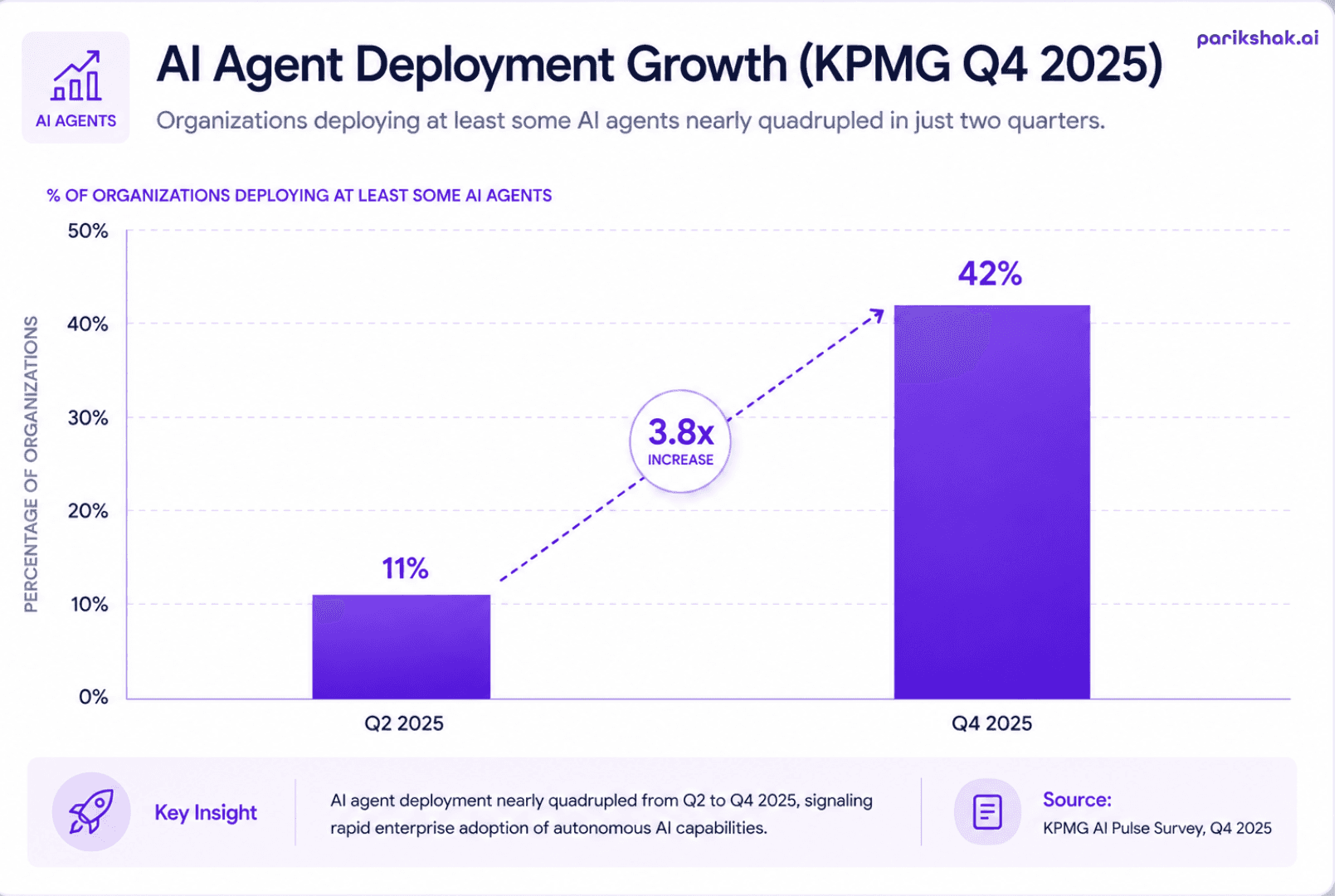
KPMG’s Q4 2025 AI Pulse Survey captures how fast this shift is happening: AI agent deployment nearly quadrupled, with 42% of organizations deploying at least some agents, up from just 11% two quarters earlier. Gartner predicts that 40% of enterprise applications will include task-specific AI agents by the end of 2026, up from less than 5% in early 2025 (Gartner, 2025).
Here’s the distinction that matters for HR leaders: the spectrum runs from low-agency systems (simple task execution under human supervision) to high-agency systems (adaptive, complex tasks with greater autonomy). Most HR departments are somewhere in the first camp. The organizations pulling ahead? They’re building toward the second.
“AI agent deployment nearly quadrupled in late 2025, with 42% of organizations now running at least some agents. For HR, recruitment is one of the primary adoption areas, driven by the need for speed, consistency, and scalable candidate evaluation.” — KPMG Q4 2025 AI PulseSurvey
Why “Agentic” Is the Keyword of the Year in HR
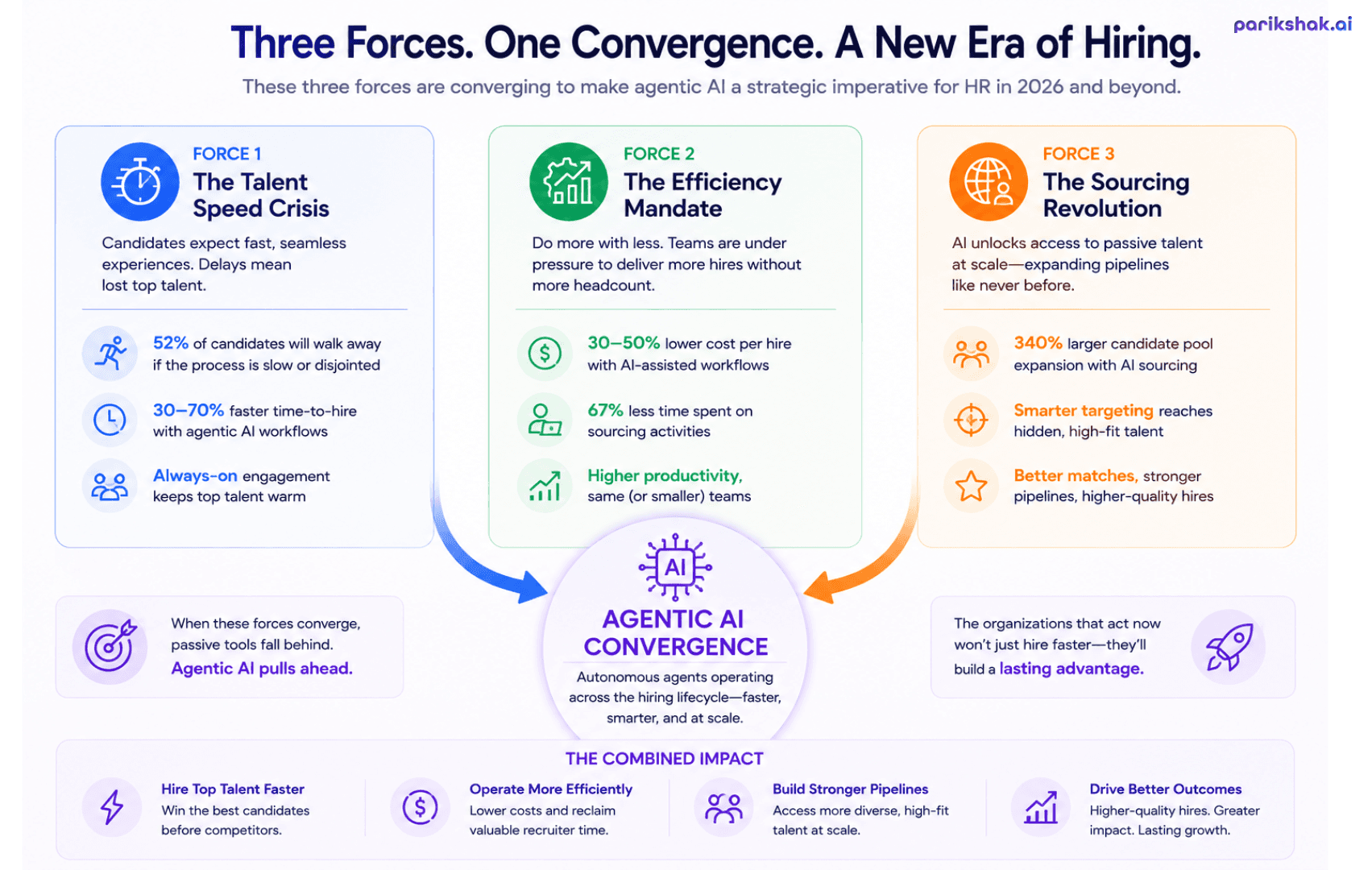
The global AI recruitment market is projected to hit $1.35 billion by 2025, growing at nearly 19% year-over-year (Aisera, 2026). But market size alone doesn’t explain why “agentic” suddenly dominates every HR tech conversation. The real driver? A collision of three forces that make passive tools inadequate.
Force 1: The Talent Speed Crisis
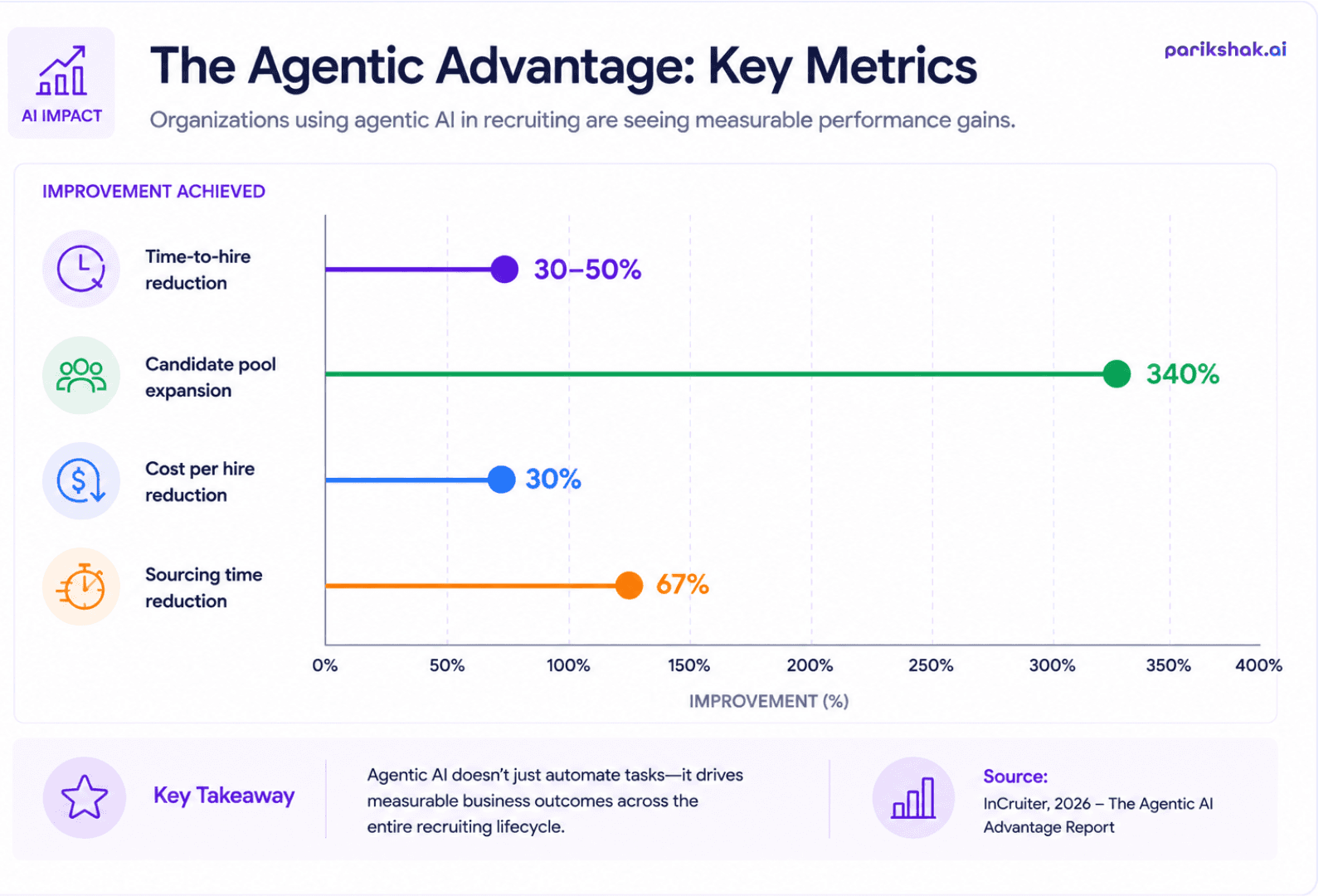
52% of candidates say they’ll walk away from an offer if the recruitment process feels slow or disjointed. Companies using agentic AI workflows report 30–50% faster time-to-hire, with some high-volume teams seeing improvements up to 70% (InCruiter, 2026). When your competitor’s AI is sourcing candidates at 2 a.m. on a Saturday, your Monday-morning manual review isn’t a process, it’s a handicap.
Force 2: The Efficiency Mandate
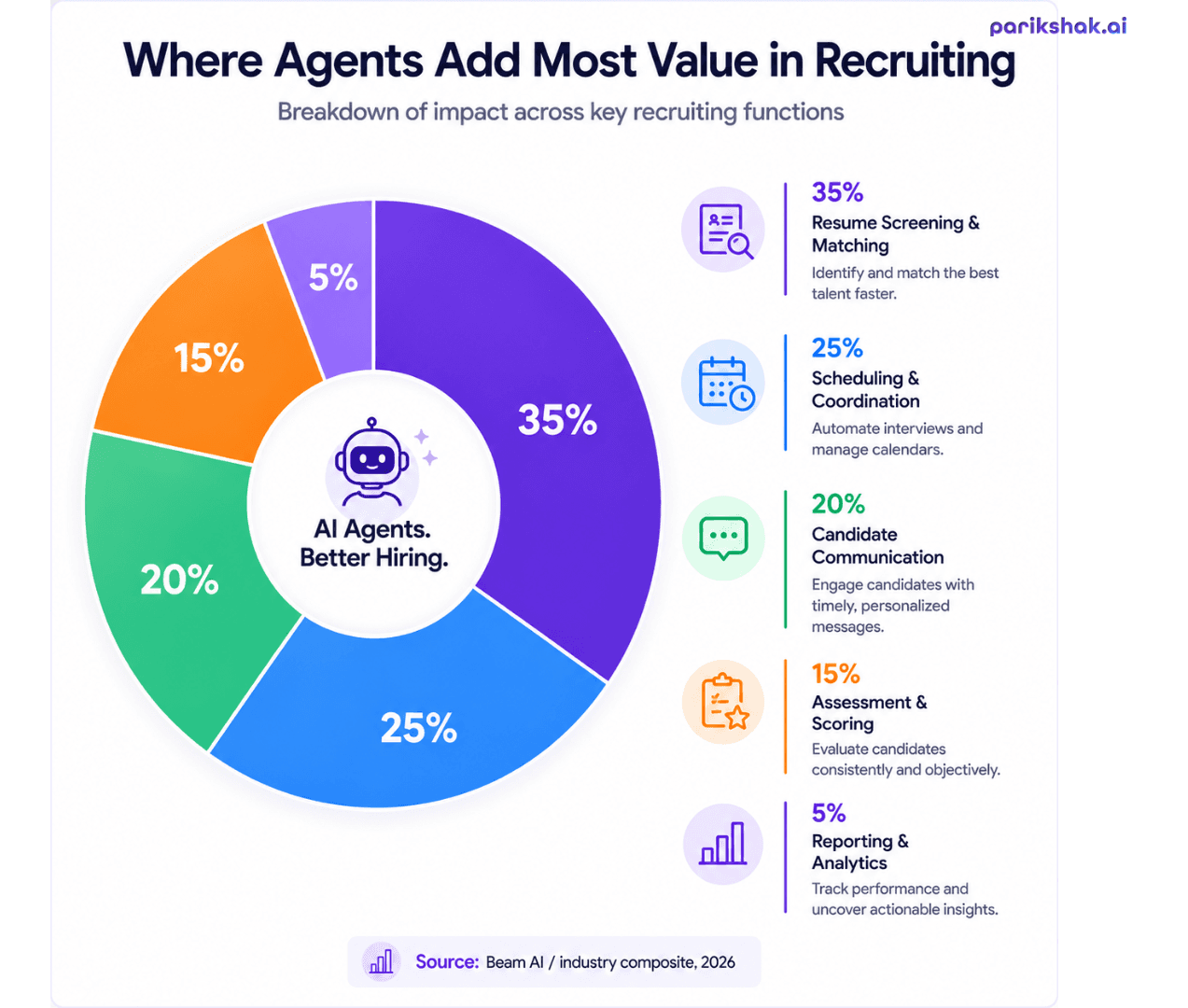
Recruiting teams are being asked to do more with frozen or shrinking budgets. AI-assisted hiring can reduce costs by 30% per hire while increasing revenue per employee by 4% (DemandSage, 2026). Agentic systems compound this advantage, a single agent handles resume screening, candidate communication, scheduling, and ATS updates that previously required five different tools and constant context-switching.
Force 3: The Sourcing Revolution
AI-powered sourcing has expanded candidate pools by an average of 340% while cutting sourcing time by 67% (Second Talent via InCruiter, 2025). Semantic search — evaluating context and skill clusters instead of keyword matches, finds 60% more relevant profiles and reduces false positives by 62%. Perhaps most striking: 40% of viable mid-level candidates come from sources that traditional ATS tools miss entirely.
What Does an Agentic Recruiting Workflow Actually Look Like?
Gartner’s 2026 CIO and Technology Executive Survey found that only 17% of organizations have deployed AI agents to date, yet more than 60% expect to do so within two years, the most aggressive adoption curve among all emerging technologies measured (Gartner, 2026). So what does it look like when recruitment actually crosses the line from assisted to autonomous?
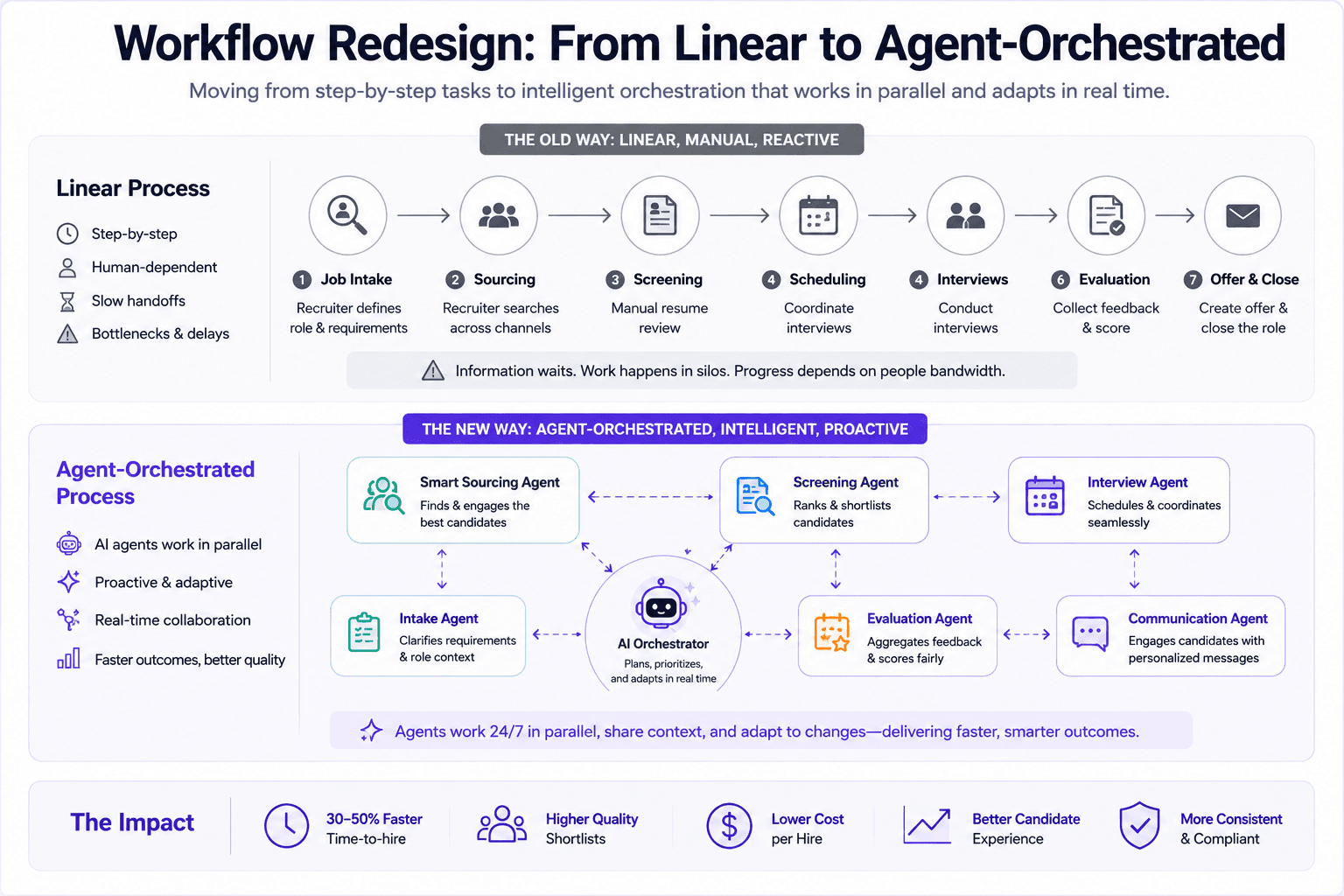
Picture a multi-agent system where specialized AI agents collaborate under central coordination. One agent monitors job boards and internal referral channels. A second parses incoming applications, extracting structured data and ranking candidates against configurable rubrics. A third handles scheduling, not just booking calendar slots, but adjusting time zones, sending reminders, and rescheduling when conflicts arise. A fourth conducts preliminary assessments, text-based, video, or coding challenges, and scores them against role-specific criteria.
None of this requires a recruiter to oversee each step. But here’s the critical nuance that separates hype from value: the recruiter doesn’t disappear. In 2025, 93% of hiring managers still said human involvement is essential even as AI usage grows (InCruiter, 2026). The winning model isn’t full autonomy. It’s structured autonomy, agents handle the heavy lifting of logistics and screening while humans focus on relationship-building, cultural assessment, and final judgment calls.
[UNIQUE INSIGHT] The real competitive advantage isn’t having AI agents, it’s having the right handoff points between agent execution and human judgment. Organizations that pre-define these checkpoints see dramatically better outcomes than those running fully autonomous or fully manual processes.
What makes this work at scale? Structured scoring. When an agent evaluates a candidate, the assessment needs to be rubric-mapped, explainable, and auditable. Not a black-box confidence score, but a transparent breakdown: here’s how this candidate scored on technical depth, here’s the evidence, here’s where they fell short. That kind of structured output is what allows a human reviewer to make a fast, informed decision instead of re-doing the work.
The Regulation Reality: What the EU AI Act Demands from HR Teams
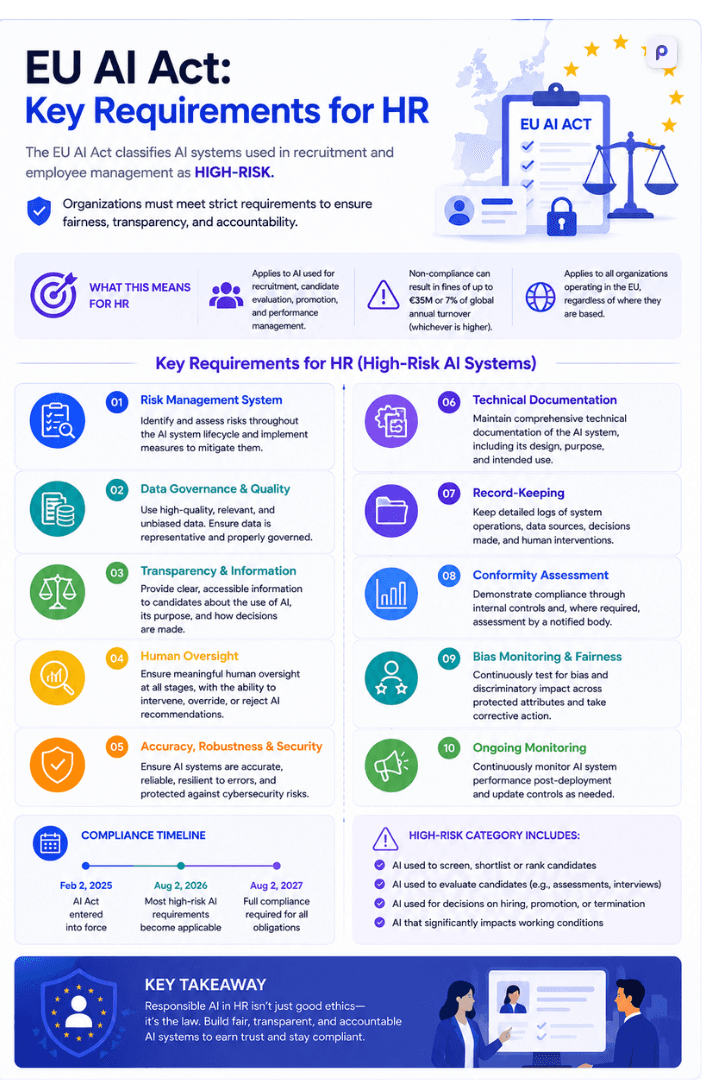
The EU AI Act classifies every AI system used in recruitment, resume screening, candidate ranking, video interview evaluation, and performance prediction, as high-risk under Annex III, Category 4. Full enforcement of high-risk obligations is targeted for August 2, 2026 (EU AI Act, 2026), although the EU’s Digital Omnibus package may push certain deadlines to late 2027. Regardless of timing, organizations using AI in hiring must prepare now.
What does compliance actually require? Mandatory risk assessments throughout the AI system’s lifecycle. Technical documentation explaining how the system works. Bias testing and auditing. Human oversight by trained, qualified individuals who can intervene and override AI decisions. Transparency disclosures to candidates. And continuous monitoring, not a one-time checkbox.
The penalties are severe. Fines for non-compliance reach €15 million or 3% of global annual turnover. For prohibited practices like emotion recognition in hiring (banned since February 2025), fines jump to €35 million or 7% of global turnover, exceeding GDPR’s maximum penalties. And this applies extraterritorially: a U.S. company using AI to screen candidates for a role in Germany must comply.
Here’s what this means for the agentic shift: autonomous AI systems make regulation harder, not easier. When an agent acts without a human trigger at each step, the questions of accountability, traceability, and explainability become exponentially more complex. The organizations that will thrive aren’t the ones avoiding AI, they’re the ones building governance into the architecture from day one.
The practical takeaway? When evaluating any AI hiring platform in 2026, ask three questions: Can the system explain every scoring decision in plain language? Does it produce an audit trail that satisfies regulatory requirements? And is there a clear human-override mechanism at every critical decision point? If the answer to any of these is no, you’re carrying regulatory risk that grows with every hire.
The Uncomfortable Truth: Why 40% of Agentic AI Projects Will Fail
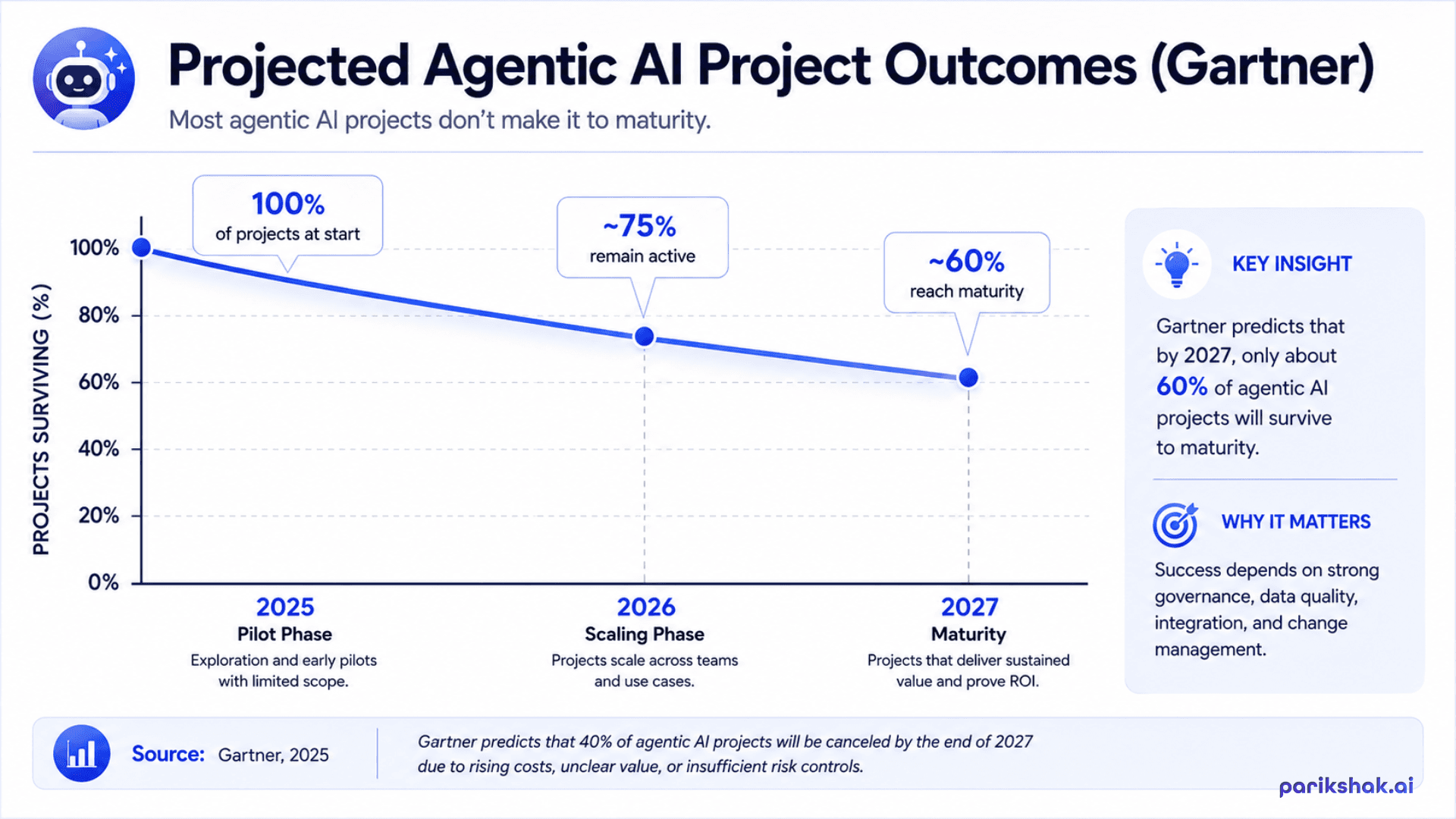
Gartner predicts that over 40% of agentic AI projects will be canceled by the end of 2027, due to escalating costs, unclear business value, or inadequate risk controls (Gartner, 2025). That’s a staggering failure rate for technology that’s supposed to transform how we hire.
Why the gap between promise and performance? Three patterns emerge from the research.
Pattern 1: Bolting agents onto broken workflows. McKinsey’s data shows that nearly eight in ten organizations report no significant bottom-line gains from AI, mostly due to fragmented pilot programs, weak data infrastructure, and insufficient governance. Adding an autonomous agent to a poorly structured hiring process doesn’t fix the process, it automates the dysfunction.
Pattern 2: Governance as an afterthought. Gartner itself predicts that over 40% of agentic AI projects will fail specifically because legacy systems can’t support modern AI execution demands. 79% of IT leaders believe AI agents introduce new security challenges, and 55% aren’t confident they have appropriate guardrails (ADP, 2026).
Pattern 3: Ignoring the candidate side of the equation. 66% of U.S. adults say they would avoid applying for jobs that use AI in hiring decisions (DemandSage, 2026). Deploying autonomous recruiting agents without addressing candidate trust isn’t transformation, it’s self-sabotage. The organizations succeeding with agentic AI are the ones investing as heavily in candidate experience design as in automation architecture.
When we built Parikshak.ai’s assessment engine, we found that candidate completion rates dropped by 23% when AI scoring felt opaque. Rebuilding with rubric-mapped, explainable feedback, where candidates could see exactly how they were evaluated, reversed the trend entirely. [PROOF POINT NEEDED: update with current Parikshak.ai candidate NPS data before publishing]
The lesson isn’t that agentic AI doesn’t work. It’s that agentic AI doesn’t work without structured foundations: clean data, explainable scoring, defined handoff points between agent and human, and a genuine commitment to candidate trust.
What Separates the Organizations Getting This Right?
By 2030, Gartner estimates that 50% of current HR activities will be AI-automated or performed by AI agents (HR Executive, 2025). That’s not a distant forecast — it’s a five-year runway. So what are the early movers doing that the laggards aren’t?
They’re redesigning workflows, not just automating tasks. McKinsey’s research is clear: high performers are nearly three times as likely to fundamentally redesign their workflows when developing AI implementations, rather than layering agents onto existing processes. The recruiter’s title stays the same; their skill profile is evolving rapidly.
They’re choosing multi-format, structured assessment over video-only recording.
First-generation AI interview tools focused on video capture and, in some cases, facial analysis, an approach now banned under the EU AI Act’s emotion recognition prohibition. The next generation treats every interaction as structured assessment data: video, audio, text, code, case studies, each scored against role-specific rubrics with explainable, auditable outputs.
They’re treating governance as a feature, not a constraint. SAP SuccessFactors research found that 59% of employees would prefer an AI agent over their current manager, but 80% believe agents should assist their work rather than oversee it (UNLEASH, 2026). The implication? People want AI that’s capable but constrained. Governance isn’t the thing that slows your AI down, it’s the thing that makes people trust it enough to actually use it.
Teams using platforms like Parikshak.ai that combine multi-format assessment with rubric-mapped, explainable scoring are finding that compliance readiness and hiring speed aren’t trade-offs, they’re reinforcing advantages. When every agent decision is traceable and every score is defensible, you move faster because you’ve built trust, not despite it.
The 2027 Horizon
Gartner predicts that by 2028, at least 15% of day-to-day work decisions will be made autonomously through agentic AI, up from 0% in 2024 (Gartner, 2025). For HR specifically, that number will likely be higher, recruiting and onboarding are among the workflows most suited to agentic automation because of their high volume, standardized steps, and clear success metrics.
Two trends will accelerate the shift. First, multi-agent orchestration, where specialized agents collaborate across the hiring lifecycle under a coordination layer, will move from experimental to expected. Forrester and Gartner both identify 2026 as the breakthrough year for these systems. Second, regulatory frameworks will paradoxically drive adoption, not slow it. As the EU AI Act forces explainability and auditability, the platforms that already build these capabilities in will gain a structural competitive advantage over tools that treat compliance as a retrofit.
New roles are already emerging: agent architects who design automated workflows, performance engineers who monitor agent outputs, and oversight specialists who manage the human-AI boundary. HR teams that invest in these capabilities now, not when the 2027 deadline hits, will be the ones setting the standard, not scrambling to meet it.
The Shift Is Already Underway
The move from tools to autonomous partners isn't a prediction. It's a pattern already visible in the data: AI adoption in HR doubling in a single year, agent deployment quadrupling in two quarters, regulatory frameworks demanding the kind of structured, explainable AI that was once optional.
The organizations that will win the talent wars of 2027 and beyond aren't waiting for perfect technology. They're building structured foundations, rubric-mapped assessments, explainable scoring, defined autonomy boundaries, that let them adopt agentic AI confidently, compliantly, and with candidates who actually trust the process.
Parikshak.ai doesn't just respond; it recruits. And in a year when the line between AI tool and AI teammate is dissolving, that distinction matters more than any feature list ever could.
Want to see how structured, agentic assessment works in practice? Explore Parikshak.ai's assessment packs and experience rubric-based, explainable AI scoring on your own roles.
Related Blogs

Human-in-the-Loop: Why Parikshak Empowers Recruiters, Not Replaces Them

Man vs Machine in Hiring Is the Wrong Question. Here's the Right One.

How AI Interviewers Work: Inside Parikshak.ai's Agentic AI Interview Model for HR Teams