What Are the Hidden Costs of Human-Led Technical Screening?
Engineering teams spend 40+ dev hours per hire on screening. At $150/hr fully loaded, that's $6,000+ in hidden costs before a single offer letter is signed. Here's the real math.
Hiring Strategy
10 min
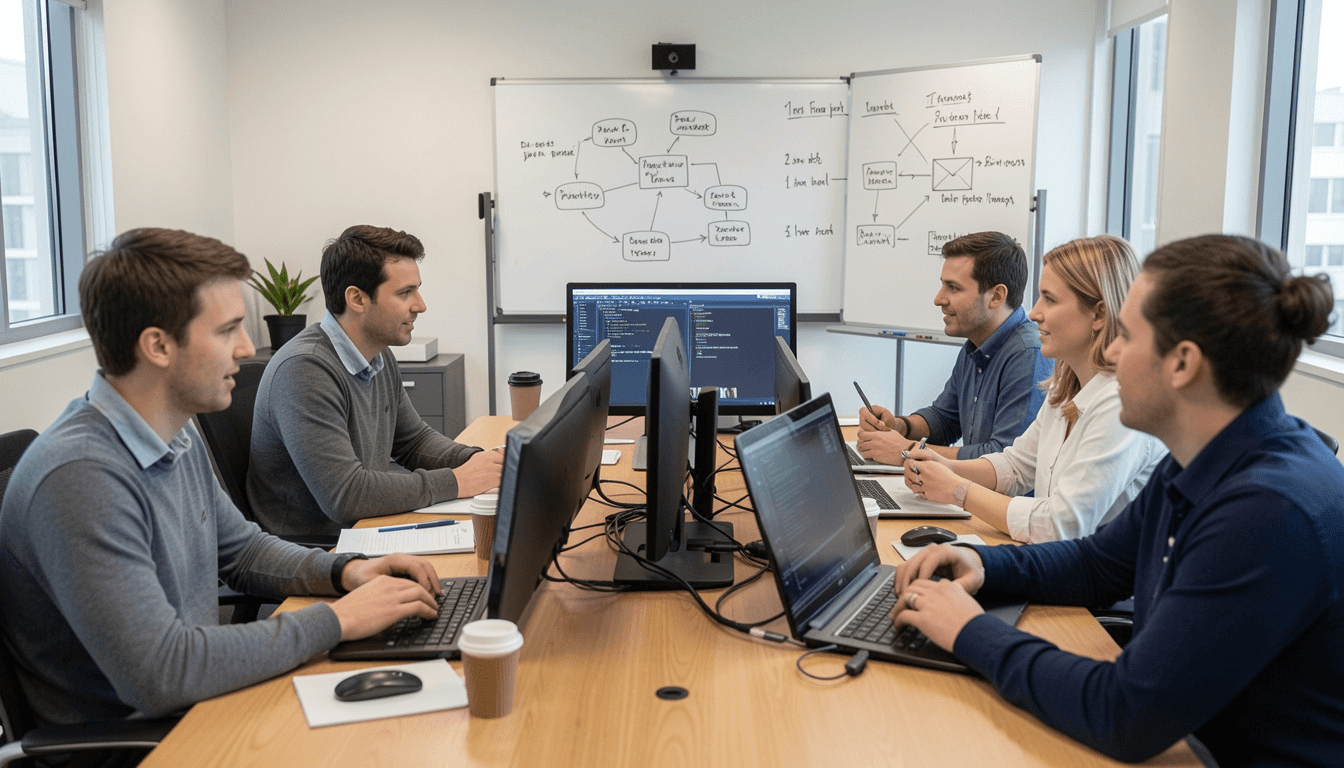
Your $100,000-a-year engineers aren’t just writing code. They’re spending a significant portion of their week evaluating strangers. Teams spend an average of 40 developer hours per hire on interviewing alone (CodeSignal, 2024), and 86% of that hiring burden falls directly on the engineering team. At a fully loaded cost of $350/hour for senior engineering time, a single hire consumes $22,750 in internal time before a recruiter even sends the offer letter (TeamCalc, 2025).
That number doesn’t account for context-switching losses, bad-hire fallout, or the opportunity cost of delayed product roadmaps. It doesn’t include the 23 minutes and 15 seconds it takes a developer to regain deep focus after every single interview interruption (UC Irvine). And it definitely doesn’t capture the quiet resentment building on your team when your best architects are stuck running coding screens instead of shipping features.
This article breaks down the real financial math behind human-led technical screening. We’ll look at the data, walk through the formulas, and explore what modern hiring teams are doing differently to protect their most expensive resource: engineering time.
Key Takeaways
Engineering teams average 40 developer hours and $22,750 in internal costs per hire (CodeSignal; TeamCalc, 2025).
Each interview interruption costs 23+ minutes of deep focus recovery, consuming up to 40% of productive time.
A bad senior engineering hire costs roughly $78,000 in direct and indirect losses (DistantJob, 2026).
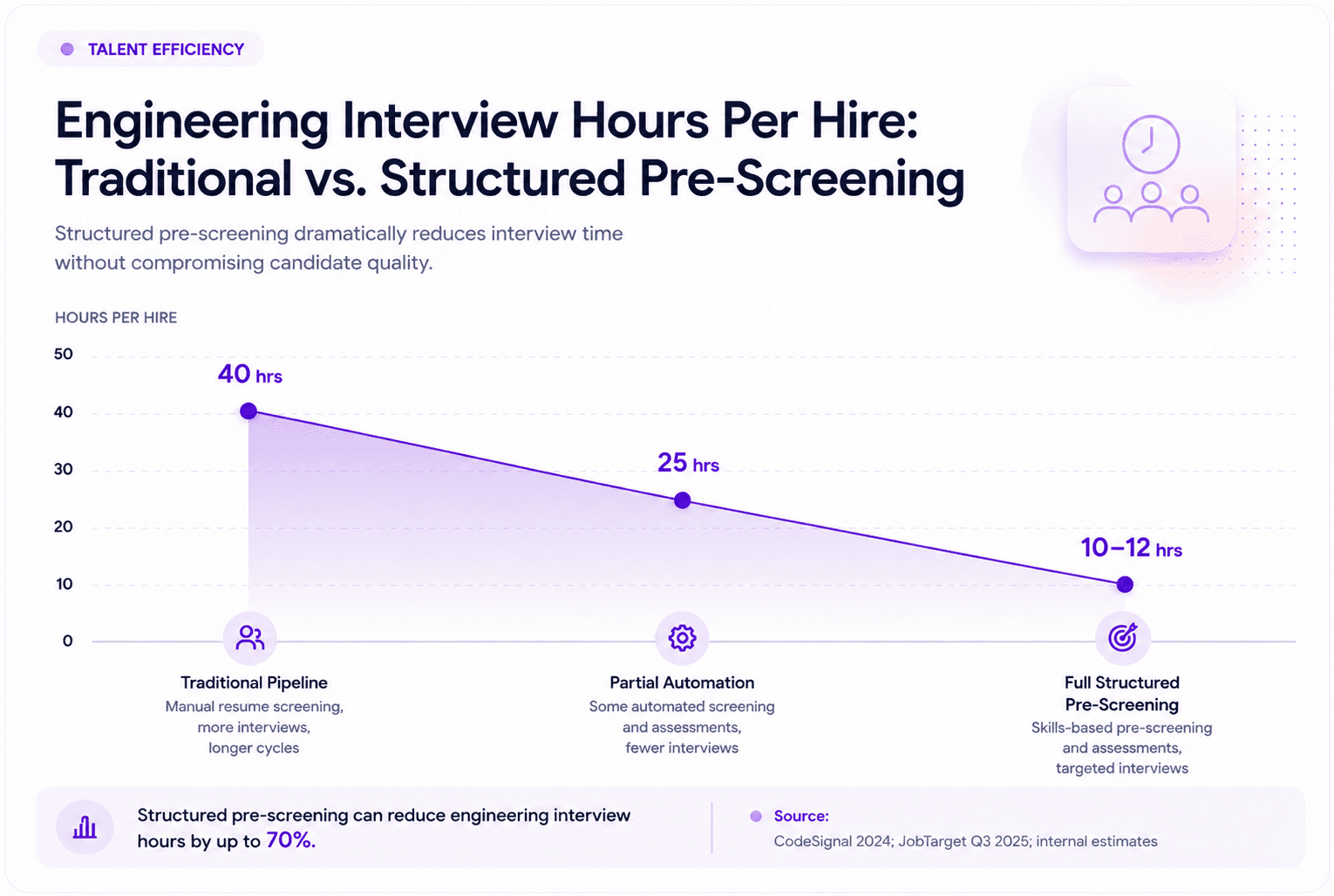
Structured, AI-assisted screening can recover 60-80% of engineering interview hours while improving hire quality.
How Much Engineering Time Does Technical Screening Actually Consume?
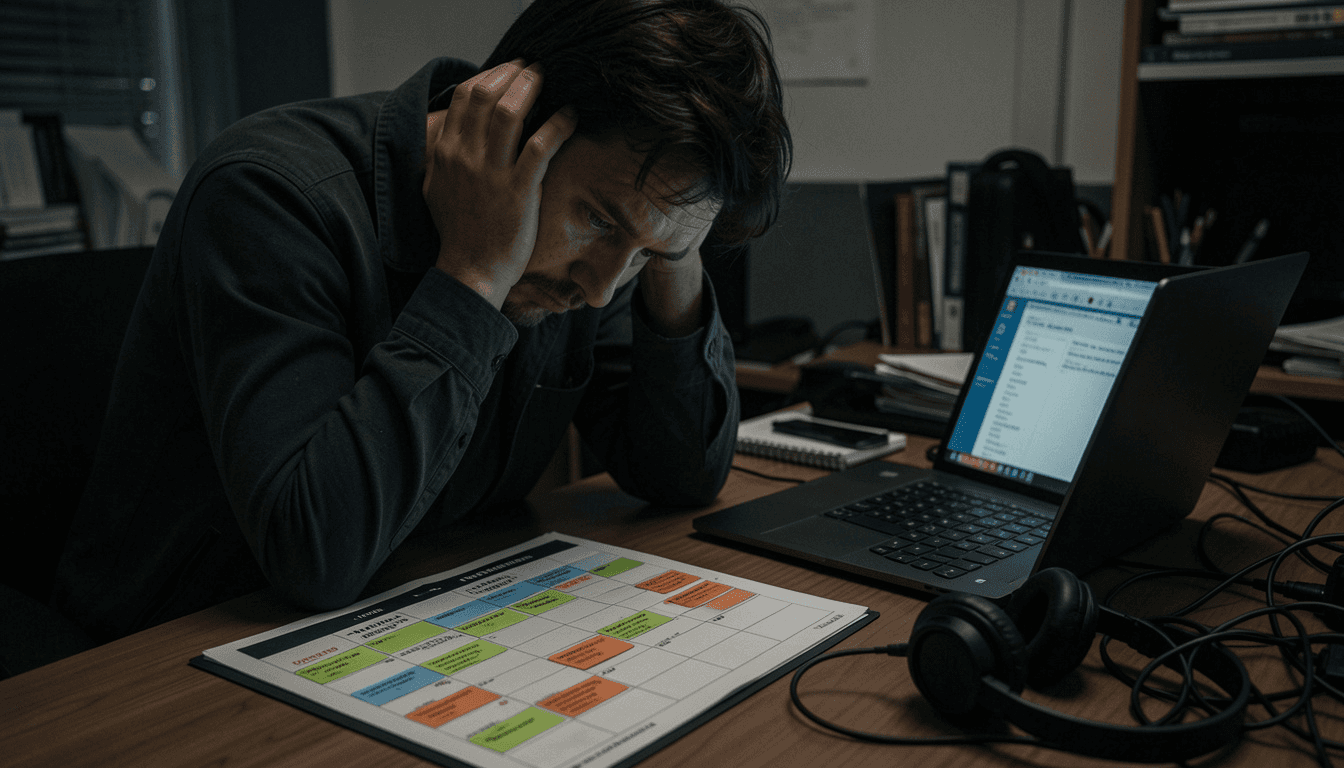
Engineering roles now require an average of 24.7 interview hours per hire, nearly three times the 8.9 hours for customer support positions (Ashby 2026 Talent Trends Report). That’s not a typo. Each engineering hire demands roughly three full working days of interview time spread across your team, and that figure only counts the time spent in the room.
The real number is higher. An estimated 86% of the hiring process burden falls on the engineering team itself, not on recruiters (CodeSignal, 2024). Your engineers are reviewing resumes, prepping questions, conducting phone screens, running live coding sessions, leading system design rounds, and sitting through debriefs. A typical pipeline, reviewing 60+ resumes, conducting 10 phone screens, and running 5 in-depth technical interviews, burns through 65 hours of engineering time for a single hire (TeamCalc, 2025).
What does that feel like at team scale? If your 10-person engineering team is hiring for 4 open roles in a quarter, you’re looking at 260 hours of engineering capacity diverted from product work. That’s more than six full working weeks vanishing into the interview pipeline.
And roughly 23% of technical hires require five or more hours of total interview time per candidate who actually gets an offer, compared to just 6% of business roles (Ashby, 2026). Technical hiring isn’t just more time-consuming, it’s less predictable, making it harder for engineering leaders to plan sprint capacity or hit delivery milestones.
Engineering roles demand 24.7 interview hours per hire on average, nearly triple the 8.9 hours required for non-technical roles (Ashby 2026 Talent Trends Report). With 86% of the hiring burden falling on engineering teams (CodeSignal), each open position quietly consumes weeks of developer capacity that never shows up in sprint planning.
What Is the True Dollar Cost of Developer-Led Interviews?
At an effective engineering time cost of $350/hour, reflecting the productive value of senior engineering time, not just base salary, a single hire consumes approximately $22,750 in internal cost, entirely separate from recruiter salaries or agency fees
(TeamCalc, 2025). For teams hiring at volume, these numbers compound fast.
Here’s a straightforward formula any engineering leader can run on the back of an
envelope:
Hidden Screening Cost Per Hire =
(Avg. Engineer Hourly Rate × Interview Hours Per Hire)+ (Hourly Rate × 0.5 × Interview Hours) [context-switching tax]+ (Debrief Hours × Participants × Hourly Rate)
Let’s plug in conservative numbers. A mid-level engineer at $150,000/year has a fully
loaded cost of roughly $100/hour. With 40 interview hours per hire (CodeSignal), that’s
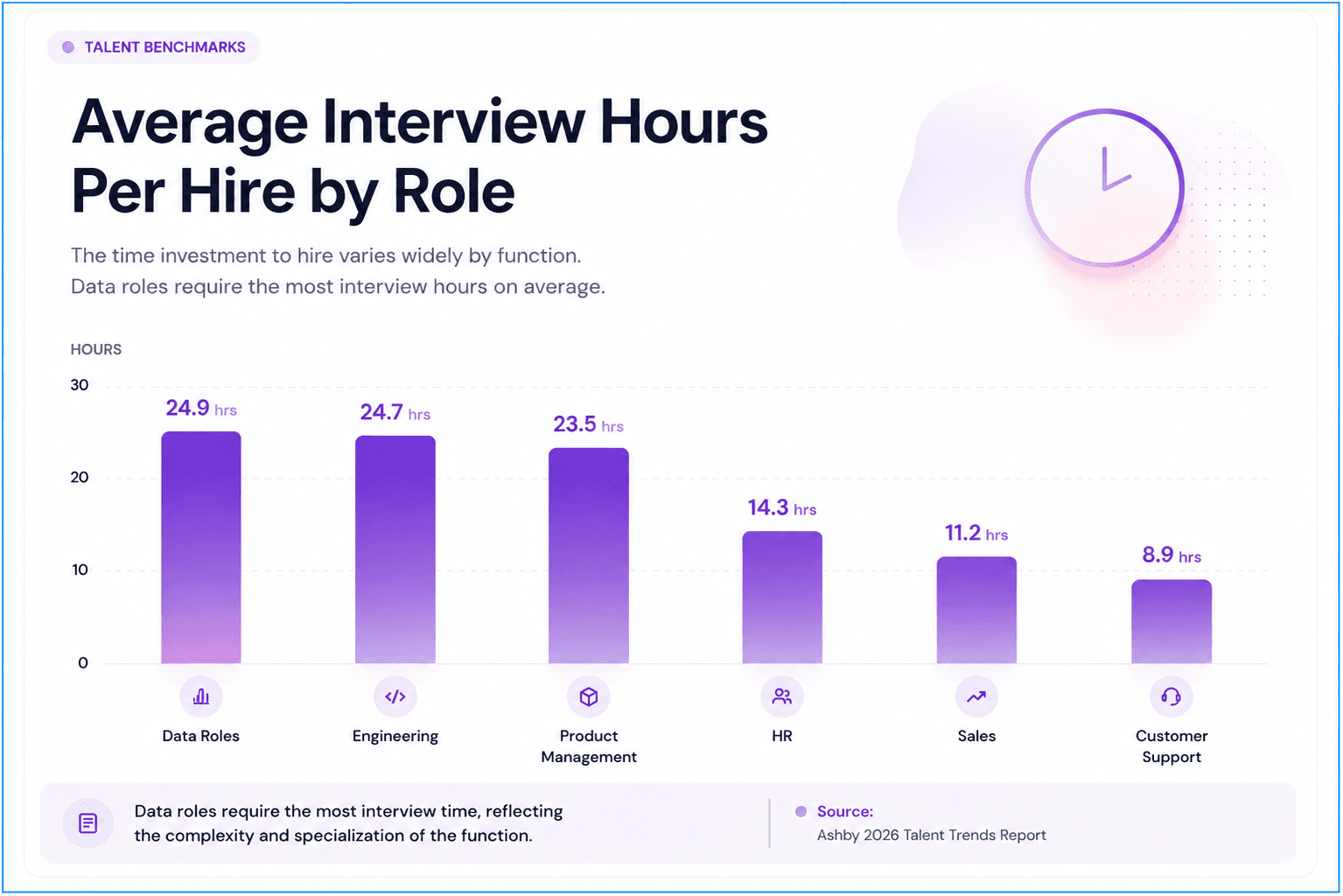
$4,000 in raw interview time. Add the context-switching penalty, every one-hour interview really costs 1.5 hours of productivity (interviewing.io, 2025), and you’re at $6,000. Factor in 3 hours of debrief meetings with 4 participants each at $100/hour, and the total climbs to $7,200 per hire.
Now scale that. If your tech company of 200 engineers hires 50 people per year, a typical growth rate for mid-stage startups, you’re looking at $360,000 annually in hidden
screening costs. That’s three senior engineer salaries spent on evaluating candidates, not
building product.
Here’s what makes this math worse: interview time in tech accounts for 50-70% of the total cost-per-hire, yet most companies don’t even track it (Rent a Recruiter, 2026). The SHRM cost-per-hire benchmark of $4,700 only captures direct recruiting spend. The real cost, once you include engineering time, is 3-4x higher for technical roles.
Most companies underestimate their cost per hire by 40-60% because they ignore internal engineering time (Rent a Recruiter, 2026). When engineer interview hours account for 50-70% of total hiring costs, the SHRM benchmark of $4,700 represents a fraction of the real financial burden of each technical hire.
How Does Context Switching Destroy Developer Productivity During Hiring Surges?
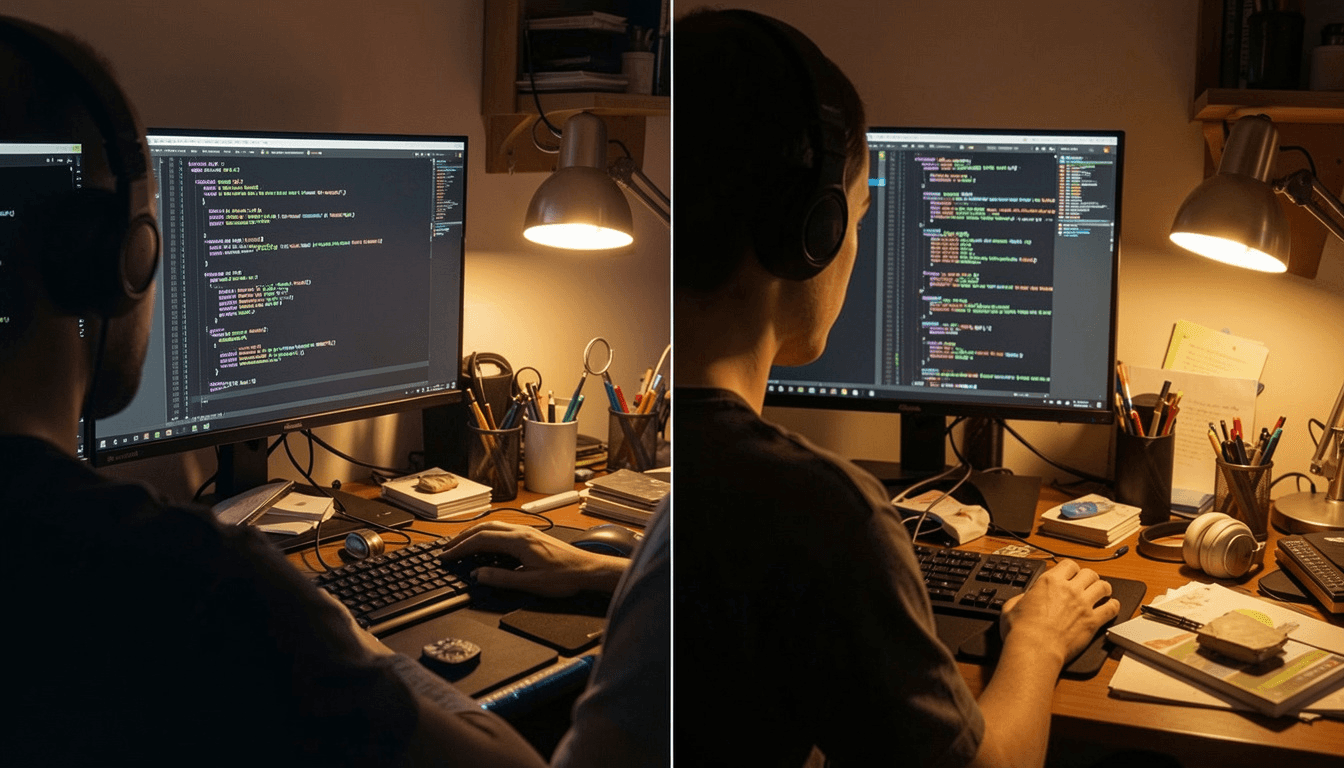
It takes an average of 23 minutes and 15 seconds for a knowledge worker to fully refocus
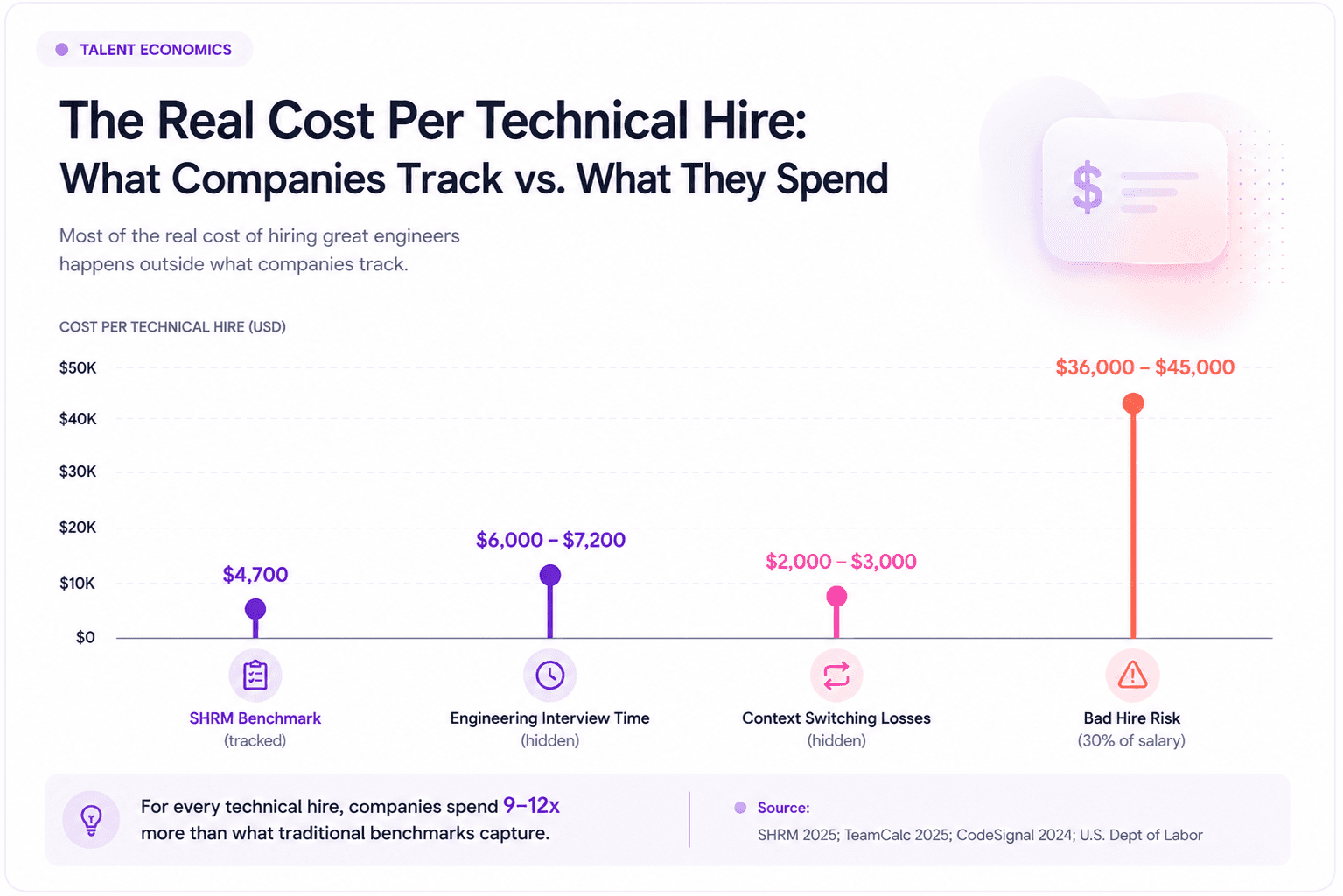
after a single interruption, according to landmark research by Gloria Mark at the University of California, Irvine. For complex coding tasks, recovery time extends to 45 minutes. And interviews aren’t just any interruption they’re scheduled, high-cognitive-load events that break the day into fragments too small for deep work.
An engineer who has two one-hour interviews on a Tuesday doesn’t lose two hours. They
lose the two hours of interviews, plus 15 minutes of prep and 15 minutes of ramp-down for each (interviewing.io, 2025), plus at least 23 minutes of refocus time after each block.
That’s closer to four hours of productive output gone, half the workday, for two
interviews.
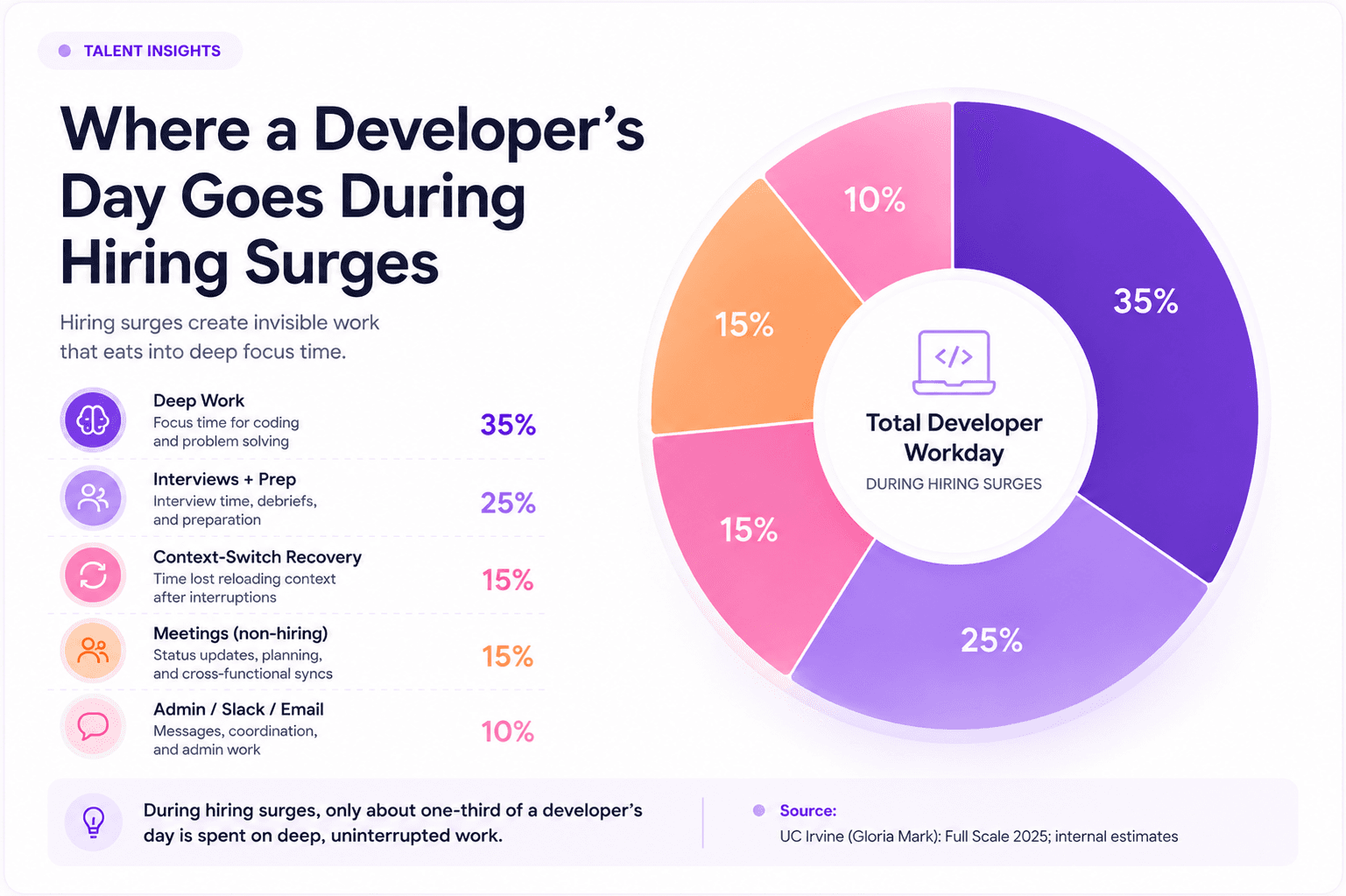
Research shows that context switching can consume up to 40% of productive time across a workday (UC Irvine; Atlassian). Teams with protected focus time deliver 40-60% more features than interrupt-driven teams (Full Scale, 2025). During hiring surges, when your strongest engineers might have 3-5 interviews per week, the math is punishing.
Here’s the part that rarely shows up in hiring dashboards: context switching during hiring
surges doesn’t just slow down the current sprint. It creates a compounding debt. Delayed
features push back releases. Pushed-back releases delay revenue. Delayed revenue
tightens budgets. And tighter budgets make the next round of hiring even more
critical, and more rushed. The interview burden feeds itself.
A developer who conducts two one-hour interviews in a single day loses roughly four hours of productive output once prep, ramp-down, and the 23-minute refocus penalty are factored in (UC Irvine; interviewing.io). During hiring surges, this pattern can consume 40% of an engineering team’s total capacity.
What Happens When Human Screening Lets a Bad Hire Through?
The U.S. Department of Labor estimates that a bad hire costs at least 30% of the employee’s first-year salary. SHRM puts the full cost of replacing any employee between 50% and 200% of annual salary (SHRM via HBK, 2025). For a senior engineer at $120,000/year, that’s somewhere between $36,000 and $240,000 in total damage.
The detailed math is even uglier. A bad senior engineering hire who stays four months before being let go costs roughly $78,000 when you account for the original cost-per-hire, wasted salary, manager time spent on performance management, and the vacancy cost of 60 days to backfill at $500/day in lost output (DistantJob, 2026).
And then there are the costs that don’t fit in a spreadsheet. Managers spend an estimated 17% of their time supervising underperforming employees, time that should go toward strategic planning and developing top performers (Apollo Technical, 2025).
The Gallup 2025 State of the Global Workplace report found that manager engagement dropped from 30% to 27% in 2024, and managers account for 70% of the variance in team engagement. One bad hire doesn’t just cost money. It drags down the people around them.
Why do bad hires happen? Often because unstructured interviews are terrible predictors of job performance. The largest meta-analysis on hiring methods (Sackett et al., 2022) found that structured interviews have a predictive validity coefficient of 0.42, roughly twice the 0.19 of unstructured conversations. Most human-led technical screens, where each interviewer asks their favorite questions with no standardized rubric, fall squarely in the unstructured category.
Structured interviews predict job performance with a validity coefficient of 0.42, roughly double the 0.19 of unstructured interviews (Sackett et al., 2022). When most technical screens lack standardized rubrics, companies are making six-figure hiring decisions on methods barely better than random chance.

How Are Modern Teams Reclaiming Engineering Hours?
Companies that moved coding challenges and technical screens earlier in the hiring funnel, before any engineer’s calendar is touched, saw measurable reductions in wasted time on unqualified candidates (JobTarget Q3 2025 Tech Recruitment Report). The principle is simple: don’t use a $150/hour resource to do what a structured, automated assessment can do with equal or better accuracy.
The most effective approach combines three elements. First, structured assessment at the top of the funnel, using standardized rubrics and multi-format evaluation, not just coding puzzles, but system design thinking, written communication, and real-world problem-solving. Second, automated scoring against role-specific criteria, so that every candidate is measured on the same scale regardless of which day they apply or which
office they’re routed to. Third, reserving human interview time for the final evaluation
stages: culture fit, team dynamics, and the high-signal conversations only experienced
engineers can have.
When we built Parikshak.ai’s assessment engine, we found that teams running structured, AI-scored screens at the top of their funnel were able to reduce the number of live engineering interviews by 60-80% without sacrificing shortlist quality. The key wasn’t removing humans from the process, it was making sure humans only spent time on candidates who’d already demonstrated competence against a clear rubric.
AI-assisted evaluation can shorten the path from job post to a ranked, interview-ready shortlist, but timing depends on the role and workflow configuration.
First-generation AI interview tools focused mainly on video recording and basic keyword
matching. The next wave, platforms built around structured assessment data, explainable
scoring, and multi-format evaluation, treat every screening interaction as a standardized
measurement, not just a conversation to be reviewed later. When your interview tool can
score candidates against role-specific rubrics before an engineer ever opens their
calendar, you’ve fundamentally changed the economics of hiring.
Moving technical assessments earlier in the hiring funnel reduced wasted time on unqualified candidates (JobTarget, 2025). Teams combining structured rubrics with automated scoring report 60-80% fewer live engineering interviews needed to reach the same shortlist quality, recovering hundreds of engineering hours per quarter.
The ROI Formula: Is Automated Screening Worth the Investment?
Here’s where the math gets compelling. The average cost-per-hire for technical roles is
$10,000-$20,000 when you include engineering time (TimeClick, 2026). If a structured
screening platform reduces engineer interview hours by even 50%, the savings are
immediate and measurable.
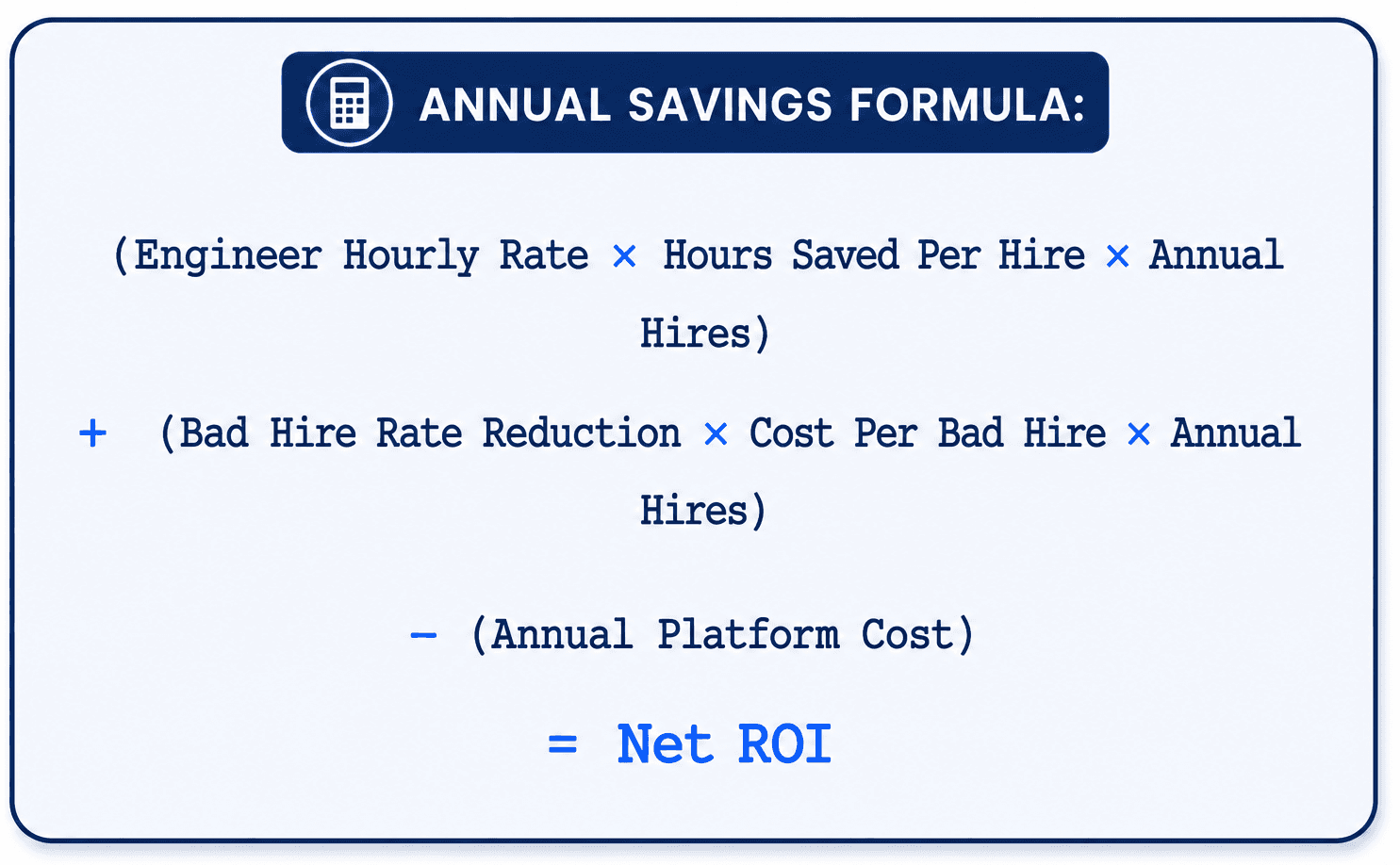
Conservative scenario: 50 hires/year, $100/hr fully loaded engineer rate, saving 20 hours
per hire, with a 10% reduction in bad-hire rate (from industry average of 20-30%). That’s
$100,000 in recovered engineering time, plus roughly $39,000 in avoided bad-hire costs (at $78,000 per bad hire × 5 fewer bad hires). Total savings: $139,000. Most screening
platforms cost $10,000-$50,000 annually. The ROI isn’t close.
But the real ROI isn’t just in dollars saved. It’s in what your engineers do with the time they
get back. Teams with protected focus time deliver 40-60% more features than
interrupt-driven teams (Full Scale, 2025). If reclaiming 1,000 hours of engineering time per year accelerates even one product launch by a quarter, the revenue impact dwarfs the cost savings.
“Your best developers should be coding, not screening. Let Parikshak.ai
handle the first 80%.”
Want to see how structured AI scoring works in practice? Parikshak.ai offers assessment
packs that let you test rubric-based evaluation on your own open roles—no engineering
time required for the first round. [Book a demo]
The hidden costs of human-led technical screening add up to far more than most engineering leaders realize. Between raw interview time ($22,750 per hire), context-switching losses (up to 40% of productive capacity), and the $78,000 cost of a bad senior hire, the status quo is quietly draining budgets and burning out your strongest engineers.
The companies winning the hiring game in 2026 aren't asking their engineers to do less, they're asking them to do less of the wrong thing. Structured, automated screening at the top of the funnel protects deep work while improving the quality of candidates who reach the final round.
Key takeaways:
• Track engineering interview hours as a line item in your cost-per-hire calculation.
• Move structured technical assessments before any engineer's calendar is booked.
• Reserve human interview time for the high-signal, late-stage conversations that actually matter.
• Measure the productivity recovered, not just the dollars saved.
Platforms like Parikshak.ai are designed around exactly this philosophy: structured, rubric-scored assessments that handle the first 80% of screening, so your engineers can focus on what they were hired to do.
Related Blogs
What Are the Hidden Costs of Human-Led Technical Screening?

10 Best AI Interview Platforms for Recruiters in 2026: Honest Reviews for HR Teams

How to Reduce Resume Screening Workload by 50% or More with AI