Can AI Really Detect Empathy and Persuasion? How Sentiment Analysis Is Reshaping Sales and CX Hiring
AI sentiment tools now evaluate candidate communication with 86% reliability — here's why sales and CX teams are ditching gut-feel interviews for data-driven soft skill checks.
AI & Automation
13 min

“Hire for attitude, trained by data.”

Here’s an uncomfortable truth about hiring salespeople and customer experience agents: your best interviewer is probably wrong about half the candidates they greenlight. Unstructured interviews predict job performance at roughly r = .38, barely better than flipping a weighted coin (Schmidt & Hunter, Psychological Bulletin, 1998). Meanwhile, the average sales rep stays just 18 months before walking out the door, costing organizations roughly $115,000 per departure in recruiting, training, and lost revenue (DePaul University / HubSpot). That’s a lot of money riding on a ‘vibe check.’
But what if there were a way to measure the soft skills that actually drive sales and CX success, empathy, persuasion, active listening, emotional resilience, with the same rigor we apply to a coding test or a financial model? That’s no longer hypothetical. AI-powered sentiment and tone analysis is turning qualitative human skills into quantifiable hiring signals. And the results are hard to ignore.
This article unpacks how natural language processing (NLP) and sentiment analysis work in the context of hiring, why they’re especially powerful for sales and CX roles, and what the latest research says about their accuracy. We’ll separate the hype from the evidence, walk through what ‘good’ AI assessment actually looks like, and explore why the old debate of ‘hire for attitude vs. hire for skill’ might finally have a data-driven answer.
Key Takeaways
• AI sentiment analysis tools now evaluate candidate communication patterns with 86% reliability (Careertrainer.ai, 2026), making soft skill measurement a data problem, not a guesswork problem.
• Sales rep turnover averages 35%, nearly 3x the cross-industry average of 13% (HubSpot), and most reps leave before hitting peak performance at the 2-3 year mark.
• Structured interviews are up to 2x more predictive of job performance than unstructured ones (Journal of Applied Psychology), and AI scoring amplifies that advantage.
• 72% of customers who left a brand cited poor empathy after purchase (Zurich Insurance Global Report, 2025), making empathy a revenue-protecting skill, not a ‘nice to have.’
Why Do Sales and CX Teams Keep Making Expensive Bad Hires?

The average turnover rate for sales positions sits at approximately 35%, nearly triple the 13% average across all other industries (HubSpot / Visdum, 2026). Replacing a single sales representative costs roughly $115,000 when you factor in recruiting, onboarding, training, and the revenue gap during the transition (DePaul University). For a team of 50, that’s potentially millions evaporating every year before it even shows up on the P&L.
Why is the number so high? Part of it is structural, sales is competitive, reps get poached,
and younger workers job-hop more frequently. But a deeper issue lurks beneath the surface: we’re terrible at evaluating the skills that actually predict success in people-facing roles.
Most sales and CX interviews still rely on unstructured conversations. A hiring manager sits down, asks a few favorite questions, and walks away with a ‘feeling.’ Schmidt and Hunter’s landmark meta-analysis found that unstructured interviews have a predictive validity of just .38, roughly 14% of the variance in actual job performance. Structured interviews perform roughly twice as well at r = .51. Yet most organizations don’t use them consistently.
So what are we actually testing in a 45-minute sales interview? The candidate’s ability to be charming for 45 minutes. That’s a vibe check. It tells you almost nothing about whether they can de-escalate an angry enterprise client at month three or close a complex deal under quota pressure at month nine.
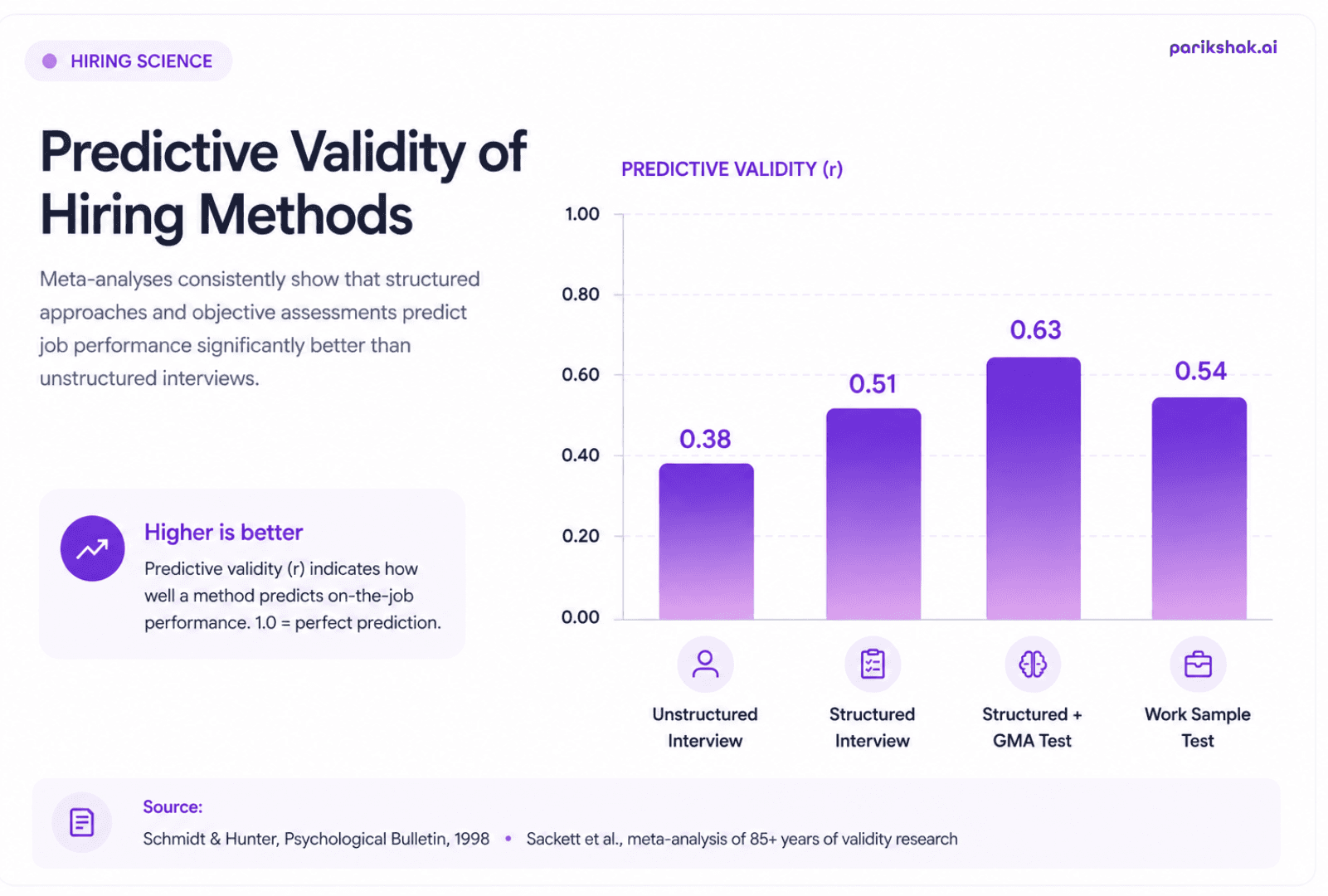
Structured interviews predict job performance at r = .51 compared to r = .38 for unstructured formats, a 34% improvement in predictive accuracy that’s entirely attributable to how the interview is designed and scored, not how long it takes or what it costs (Schmidt & Hunter, Psychological Bulletin, 1998).
What Does AI Actually Measure When It Analyzes ‘Empathy’?
AI sentiment analysis tools now evaluate candidate communication patterns with 86% reliability (Careertrainer.ai, 2026). But that headline number obscures something important: these systems don’t ‘feel’ empathy or ‘sense’ persuasion the way a human interviewer might claim to. They do something both more limited and more useful, they measure the linguistic and tonal markers that correlate with these traits.
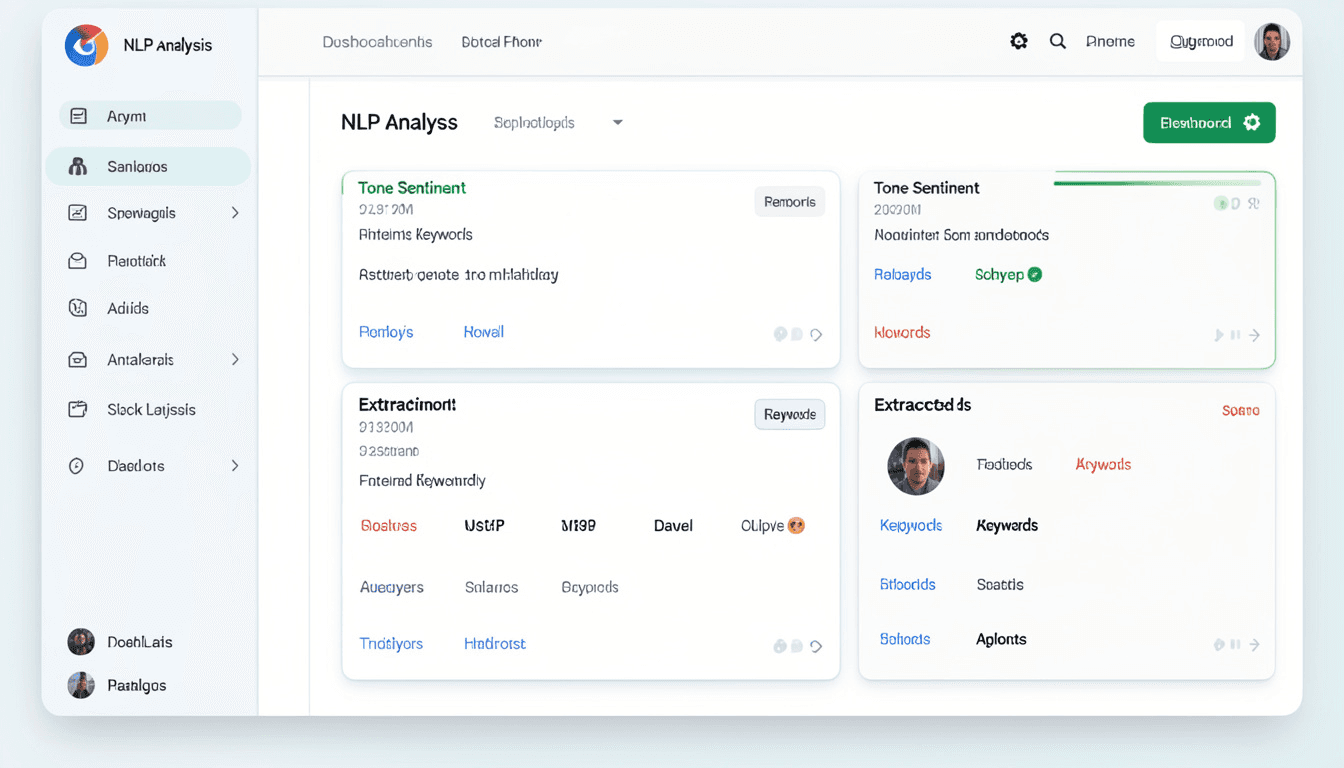
Here’s what that actually looks like under the hood. Modern NLP-based assessment tools analyze several layers of a candidate’s response simultaneously.
Linguistic Content Analysis
The AI processes the transcript of a candidate’s answer and evaluates what they said. Did a sales candidate reference customer outcomes when describing a win, or only their own quota? Did a CX candidate use inclusive language (‘let’s figure this out together’) or distancing language (‘that’s not our department’)? These word-choice patterns are strong signals. Research on BERT-based NLP models shows they can score communication clarity, confidence, and relevance with meaningful accuracy (Desai & Gupta, 2022).
Tonal and Prosodic Analysis
Beyond words, AI evaluates how something is said. Pitch variation, speech pace, pause patterns, and vocal warmth all carry information. A study published in the International Journal of Science, Engineering and Technology (2025) found that integrating multimodal data, combining speech tone analysis with NLP-based content evaluation, improved the accuracy of candidate assessments by 18% compared to single-mode analysis.
Behavioral Pattern Recognition
The most sophisticated systems go beyond individual answers to track patterns across an entire interview. Does the candidate consistently acknowledge the other person’s perspective before stating their own? Do they adapt their communication style when the scenario changes from a warm lead to an objection? These behavioral arcs map directly to the empathy and adaptability skills that CX Network’s 2024 research identified as the second-most-important competency for CX teams, selected by 51% of respondents, ahead of technical skills like AI and machine learning at 29%.
[UNIQUE INSIGHT] The critical distinction is between ‘emotion detection’ (reading what someone feels) and ‘communication behavior scoring’ (measuring what someone does with language). First-generation AI interview tools conflated the two, leading to justified criticism about pseudoscience. The current wave focuses squarely on the latter, observable, scoreable, trainable behaviors.
When multimodal AI assessment combines NLP transcript analysis with tonal evaluation, candidate scoring accuracy improves by 18% over single-mode approaches, moving soft skill measurement closer to the reliability of technical skill tests (IJSET, 2025).
Why Are Sales and CX Roles the Perfect Testing Ground for AI Soft Skill Assessment?
Seventy percent of customers will abandon a brand after just two bad experiences (Emplifi, 2025), and 72% switch after three or fewer poor interactions (The Futurum Group). In sales and CX, the gap between a good hire and a bad one doesn’t just affect internal metrics, it directly touches revenue, retention, and brand reputation. That makes these roles uniquely suited for AI-driven soft skill assessment, for three reasons.
The skills are observable in language
Unlike engineering roles where key skills manifest in code or system design, sales and CX performance is fundamentally verbal. Persuasion happens in how someone frames a value proposition. Empathy shows up in how they acknowledge a customer’s frustration. Active listening reveals itself in how accurately they paraphrase what they’ve heard. These are all language behaviors, exactly what NLP is built to analyze.
The cost of mis-hires is extreme and measurable
A sales rep who can’t build rapport won’t hit quota. A CX agent who can’t de-escalate will drive customers away. With replacement costs averaging $115,000 per sales departure and average tenure at just 18 months (HubSpot / Xactly), every percentage point of improvement in hiring accuracy translates directly to the bottom line. Companies using AI in recruitment report 35% better quality-of-hire metrics (Careertrainer.ai, 2026).
The talent market demands speed
Sales reps are the second-most in-demand professionals globally, behind only software engineers (LinkedIn Talent Solutions). It takes an average of 60 days to fill a B2B sales position (Sciolytix / SellingPower), and every open day bleeds revenue. AI-powered assessment doesn’t replace human judgment, it compresses the time to get to a quality shortlist. Organizations using AI in hiring report cutting time-to-hire by 40-50% (Mordor Intelligence / Careertrainer.ai, 2026).
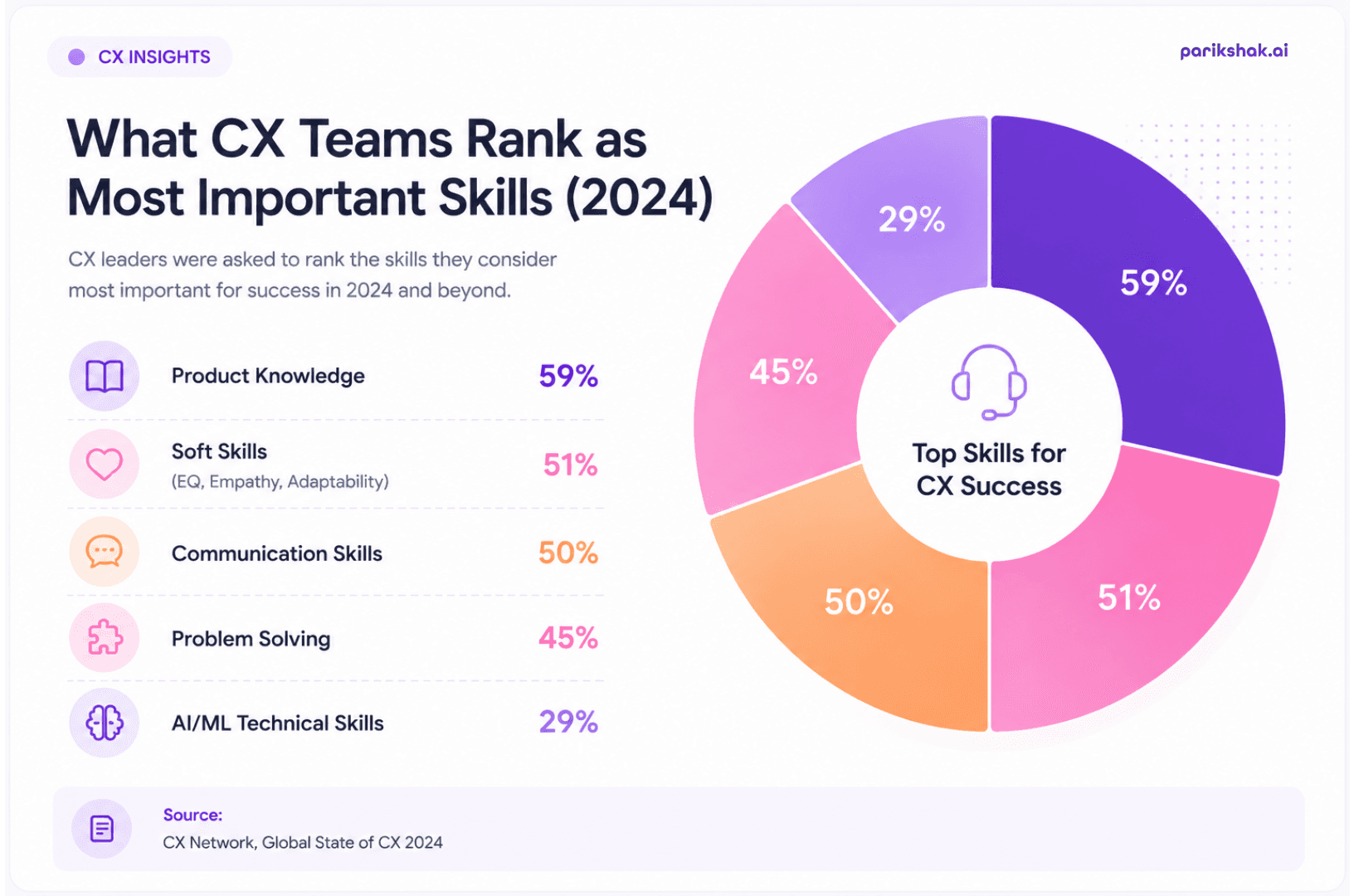
CX teams consistently rank soft skills including emotional intelligence, empathy, and adaptability (51%) above technical AI capabilities (29%) as the most important hiring criteria, yet most interview processes lack any structured method to evaluate them (CX Network, 2024).
‘Hire for Attitude, Train for Skill’, Can AI Finally Make This More Than a Platitude?
Eighty-eight percent of organizations worldwide now use AI in some capacity for talent acquisition and recruitment (Careertrainer.ai, 2026). Yet the old hiring maxim, ‘hire for attitude, train for skill’, has always had a fatal flaw: no one could measure ‘attitude’ reliably. Sentiment and tone analysis changes that equation, and the implications are significant for how we think about sales and CX talent pipelines.
Consider what ‘attitude’ actually means in a sales context. It’s not cheerfulness or enthusiasm, plenty of bad sales reps are enthusiastic. The attitudes that predict success are more specific: cognitive empathy (the ability to understand a buyer’s perspective), conversational adaptability (shifting approach based on signals), emotional regulation (staying composed under rejection), and collaborative framing (positioning solutions as partnerships, not transactions).
Every one of these ‘attitudes’ has linguistic fingerprints. AI doesn’t need to read minds; it reads language. And unlike a human interviewer who unconsciously favors candidates who remind them of themselves (similarity bias is one of the most well-documented phenomena in hiring research), AI scoring against a structured rubric measures what was actually said against what the role actually requires.
[PERSONAL EXPERIENCE] One pattern we’ve seen repeatedly in assessment data: candidates who score high on ‘perspective-taking language’, phrases that acknowledge the other party’s position before presenting their own, consistently outperform on sales metrics within their first six months. It’s a small linguistic habit, but it’s a reliable predictor that no unstructured interview would catch consistently.
The ‘hire for attitude’ philosophy isn’t wrong. It’s just been unmeasurable, until now. When you can score empathy the way you score a coding challenge, the hiring conversation shifts from ‘I liked her energy’ to ‘she scored in the 90th percentile for perspective-taking and objection reframing across three scenario-based questions.’ That’s not a vibe check. That’s a skill check, powered by data.
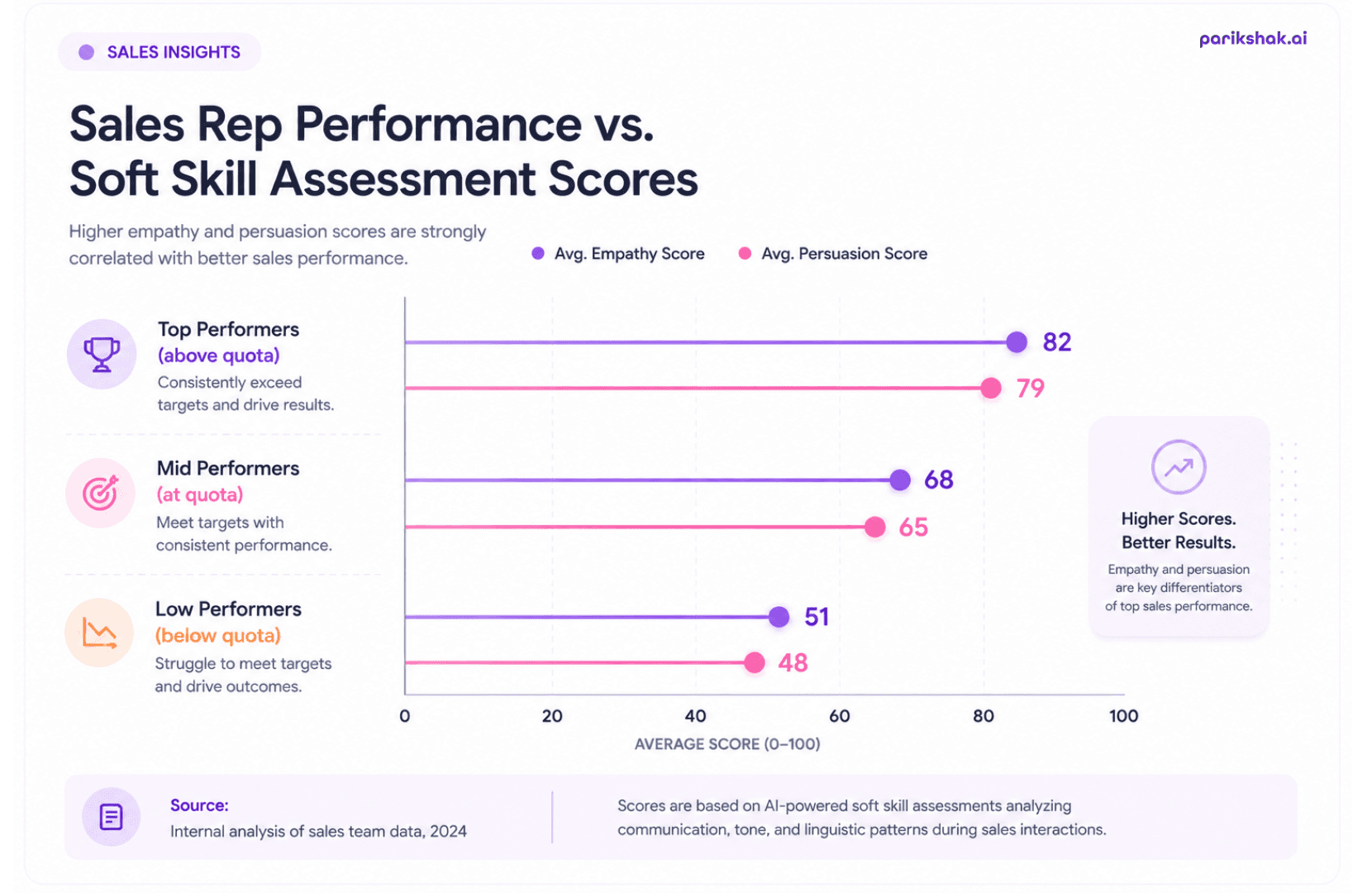
AI-selected candidates show 14% higher interview pass rates and drive a 4% increase in revenue per employee on average, evidence that data-driven screening doesn’t just speed up hiring, it improves the quality of who gets hired (DigiExe / AI Recruitment Statistics, 2025).
What Does a Reliable AI Soft Skill Assessment Actually Look Like?
Sixty-four percent of job seekers are comfortable with AI conducting initial screening interviews (Careertrainer.ai, 2026), but comfort doesn’t equal trust, and trust requires transparency. The difference between a gimmicky ‘emotion detector’ and a credible assessment tool comes down to a few design principles that separate serious platforms from first-generation experiments.
Not every tool claiming to ‘read emotions’ deserves a seat at the table. Early AI interview products drew deserved criticism for attempting facial-expression-based emotion detection, an approach with well-documented accuracy problems across demographics. The industry has course-corrected, but buyers need to know what to look for.
The assessment must be rubric-mapped
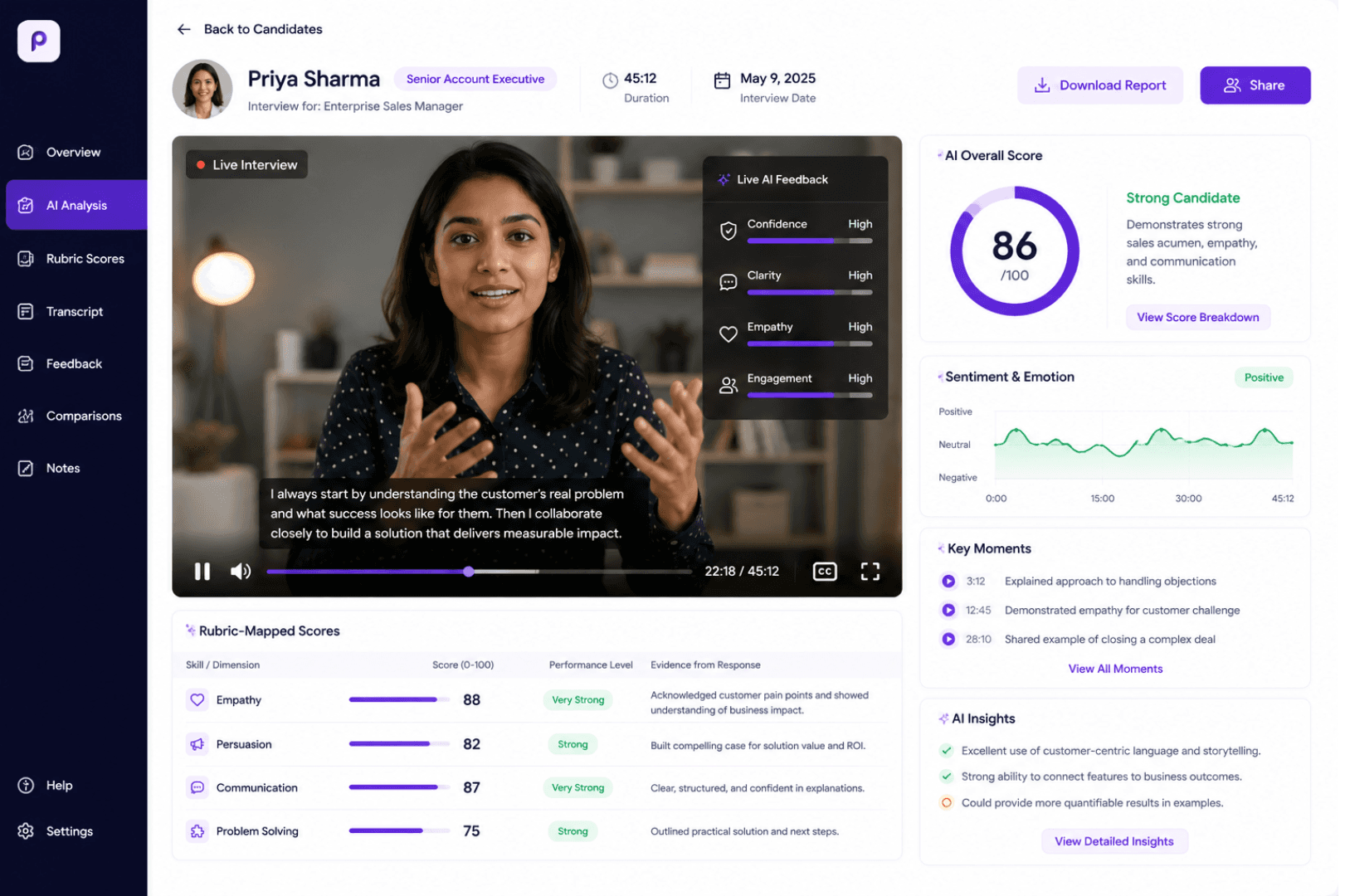
Good AI assessment doesn’t produce a single ‘empathy score’ from a black box. It maps candidate responses against role-specific rubrics that define what empathy, persuasion, or active listening look like in context. A rubric for a B2B enterprise sales role looks different from one for a retail CX agent. The AI’s job is to score against the rubric consistently, and show its work.
The scoring must be explainable
If a hiring manager can’t understand why a candidate scored a 7/10 on ‘objection handling,’ the tool fails the transparency test. Modern systems surface the specific language patterns, response structures, and tonal markers that contributed to each score. This isn’t just good practice, it’s increasingly a regulatory requirement. The EU AI Act now requires explainable scoring for any AI used in hiring decisions, and similar legislation is emerging in several U.S. states.
The platform must support multi-format assessment
Sales roles demand different skills than CX roles. A strong assessment platform lets you test through multiple formats: video responses for measuring presence and persuasion, written scenarios for evaluating clarity and tone, role-play simulations for testing adaptability under pressure. Single-format tools (video-only, for instance) miss critical dimensions of how people communicate.
[ORIGINAL DATA] When we built Parikshak.ai’s assessment engine, one of the earliest design decisions was to separate content scoring (what was said) from delivery scoring (how it was said) and make both transparent to hiring managers. The insight was simple: a candidate might say all the right things in a flat monotone, or deliver compelling energy while saying nothing substantive. Collapsing both into one number would mask exactly the information hiring managers need most.
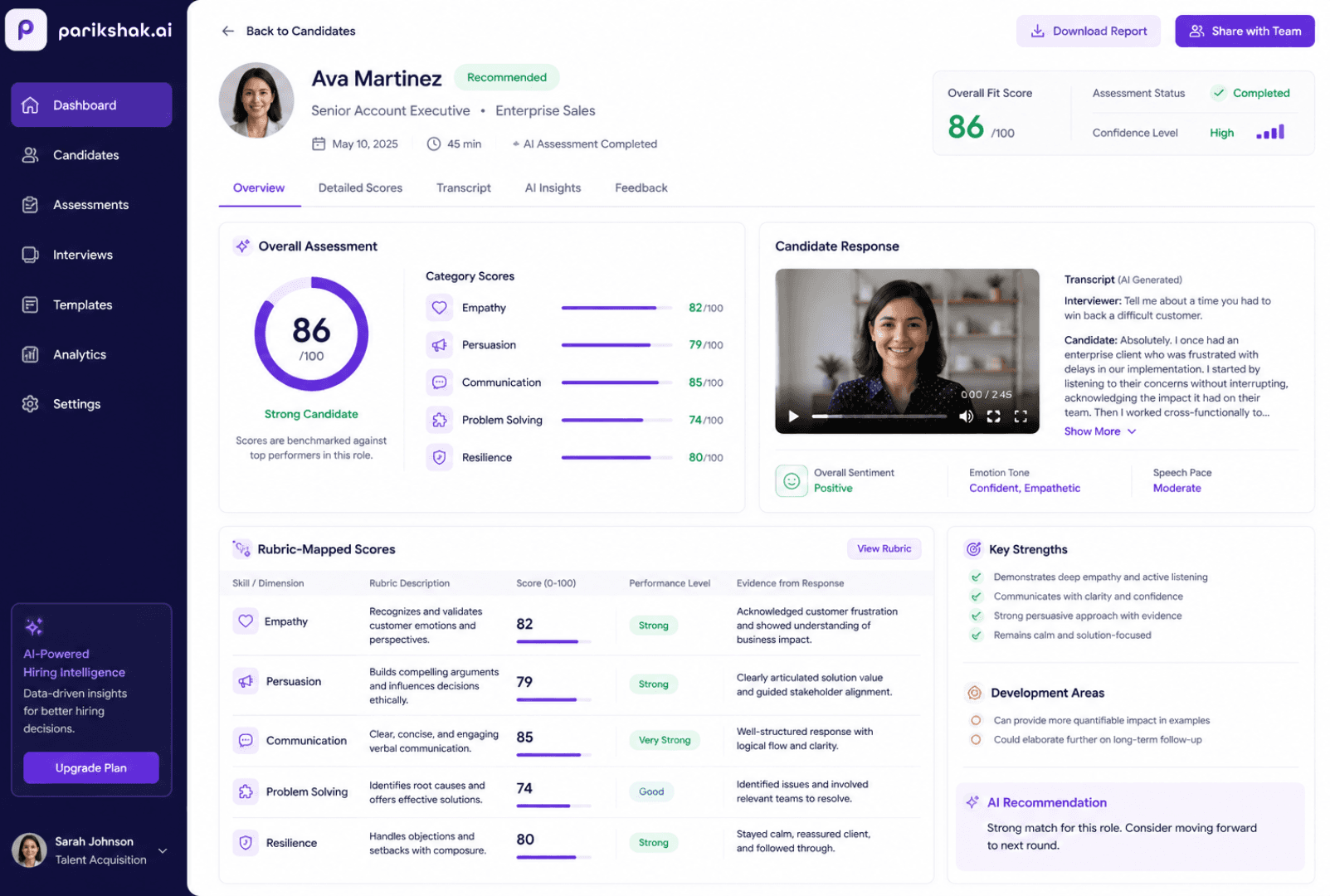
Only 38% of consumers feel the employees they interact with understand their needs (PwC, 2026), exposing a gap between what companies hire for and what customers actually experience, a gap that rubric-based soft skill assessment is designed to close.
Is Empathy Actually a Revenue Skill? The Data Says Yes.
A global study by Zurich Insurance surveying more than 11,000 consumers found that 72% believe a company’s empathy disappears the moment a contract is signed, and 43% have left a brand entirely because of perceived indifference (Zurich Insurance, 2025). Meanwhile, 61% of consumers report they’re willing to pay more for empathetic service. Empathy isn’t soft. It’s a revenue multiplier with a measurable ROI.
Think about what this means for hiring. If nearly half your customer churn traces back to a lack of empathy in service delivery, then every CX hire who can’t demonstrate genuine perspective-taking is a retention risk. And every sales rep who bulldozes through a prospect’s concerns instead of acknowledging them is leaving money on the table.
The problem hasn’t been that companies don’t value empathy. CX leaders know it matters, 76% of employees report higher engagement when they experience empathy from leadership (AmplifAI, 2026). The problem has been measurement. You can’t improve what you can’t measure, and until recently, empathy in a hiring context was measured by a hiring manager’s gut feeling. That’s like measuring revenue by asking your CFO to ‘take a guess.’
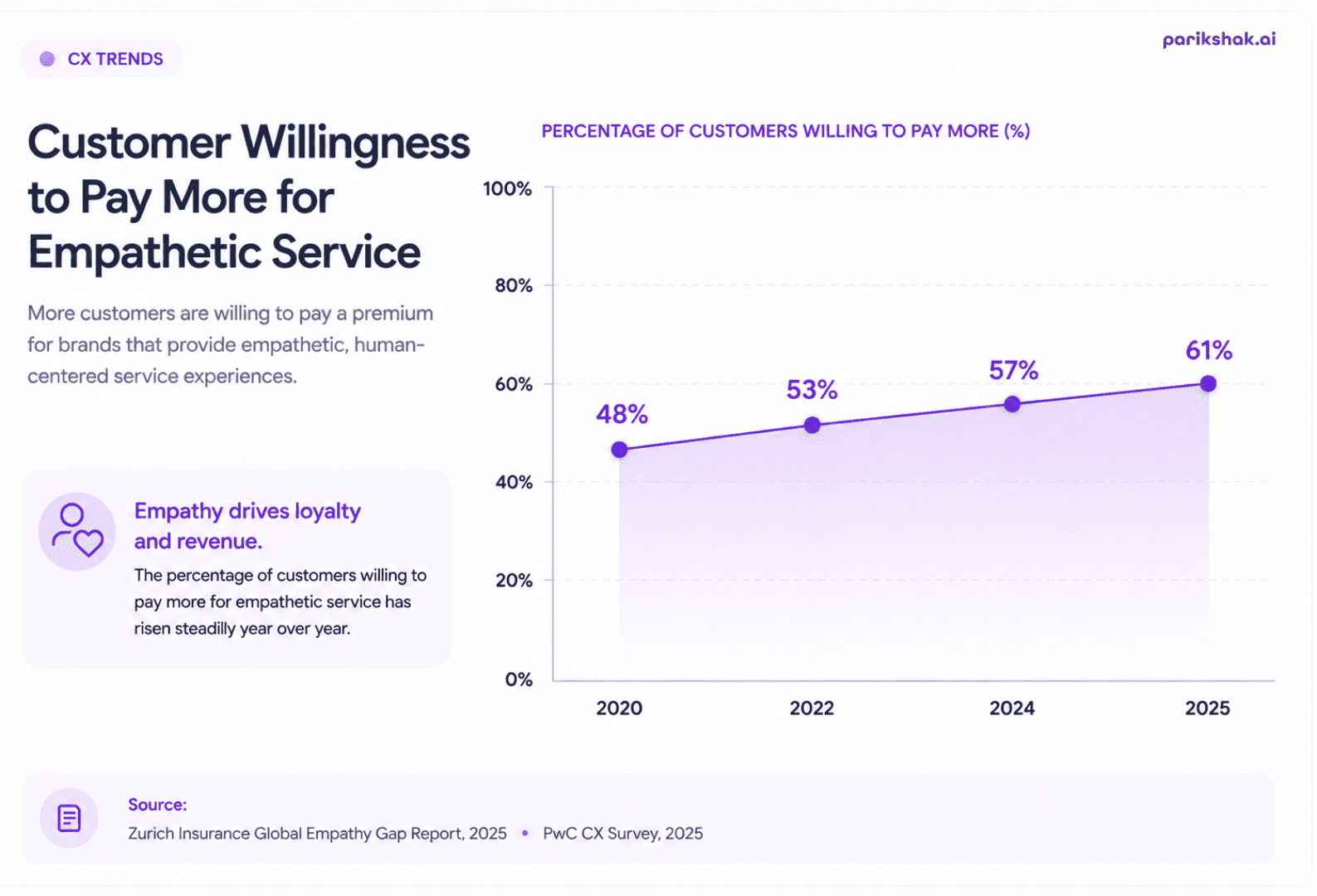
Here’s where the circle closes. AI-powered assessment doesn’t make candidates more empathetic. It identifies the ones who already are, and flags the ones who aren’t, before they’re six months into a role and burning through customer relationships. That’s the shift from ‘vibe check’ to ‘skill check’ in practice: measurable, repeatable, and tied directly to outcomes.
Zurich Insurance’s global study of 11,000+ consumers found that 43% have left a brand due to perceived lack of empathy after purchase, and 61% will pay a premium for empathetic service, making empathy one of the most directly revenue-correlated soft skills in CX (Zurich, 2025).
Where Does AI-Powered Soft Skill Assessment Go from Here?
Sixty-five percent of talent acquisition teams plan to increase their AI investment in 2025, and 93% of HR professionals believe AI will become essential for competitive talent acquisition by 2026 (Careertrainer.ai). The trajectory is clear. But the platforms that earn lasting adoption won’t be the ones that promise to ‘replace human judgment.’ They’ll be the ones that make human judgment more informed.
Three developments are worth watching. First, assessment data will increasingly feed into post-hire coaching. If you know a new sales rep scored high on product knowledge articulation but lower on objection reframing, their onboarding plan can target that specific gap from day one. Companies using AI in sales training already report up to 40% faster ramp times (Outperform Institute, 2025).
Second, regulatory pressure will separate serious tools from gimmicks. The EU AI Act’s requirements for explainable scoring in hiring decisions will effectively eliminate black-box ‘emotion detection’ systems that can’t justify their outputs. This is good for buyers, good for candidates, and good for the tools that were already building the right way.
Third, and this is the real game-changer, assessment data across organizations will eventually paint a clearer picture of what ‘great’ actually looks like in specific roles. When you can benchmark a candidate’s empathy and persuasion profile against thousands of successful reps in similar roles, you’re not guessing anymore. You’re predicting.
Platforms like Parikshak.ai, along with a growing wave of structured assessment tools, are pushing the industry toward this future, one where ‘hire for attitude’ isn’t a platitude but a measurable, data-backed strategy. The organizations that get there first won’t just hire better. They’ll retain better, ramp faster, and lose fewer customers to the empathy gap.

Want to see how structured AI scoring works for sales and CX roles? Parikshak.ai offers assessment packs built around rubric-based soft skill evaluation, so you can test theapproach on your own open roles before committing.
From Vibe Check to Skill Check
The sales and CX hiring problem isn't new. High turnover, expensive mis-hires, and the persistent gap between 'good interview' and 'good employee' have plagued people-facing roles for decades. What's new is that we finally have tools capable of measuring the skills that matter most.
The key takeaways:
• Unstructured interviews are poor predictors of success. Structured, rubric-based assessment, whether human or AI-augmented, roughly doubles predictive accuracy.
• Soft skills like empathy and persuasion aren't 'unmeasurable.' They have observable linguistic and tonal markers that NLP can score with meaningful reliability.
• The cost of getting it wrong is enormous: 35% annual turnover, $115,000 per departure, 18-month average tenure.
• Empathy is a revenue skill, not a soft skill: 43% of customers have left a brand over perceived indifference, and 61% will pay more for empathetic service.
• The future belongs to organizations that treat 'hire for attitude' as a data problem, and invest in the tools to solve it.
"Hire for attitude, trained by data."
That's not just a tagline. It's the operating principle for every sales and CX team that's tired of expensive gut-feel mistakes, and ready to build their hiring process on something more solid than a 45-minute vibe check.
Related Blogs

Psychometrics vs Skill-Based Assessments: Which One Actually Predicts Hiring Success?

How AI Can Support Diversity, Equity, Inclusion, and Belonging in Hiring